Department of Bio-Organic Chemistry, Institute of Complex Molecular Systems (ICMS), Eindhoven University of Technology, 5600 MB, Eindhoven, The Netherlands.
Department of Mathematics and Computer Science, Institute of Complex Molecular Systems (ICMS), Eindhoven University of Technology, 5600 MB, Eindhoven, The Netherlands.
Nat Commun. 2021 Nov 25;12(1):6897. doi: 10.1038/s41467-021-27229-0.
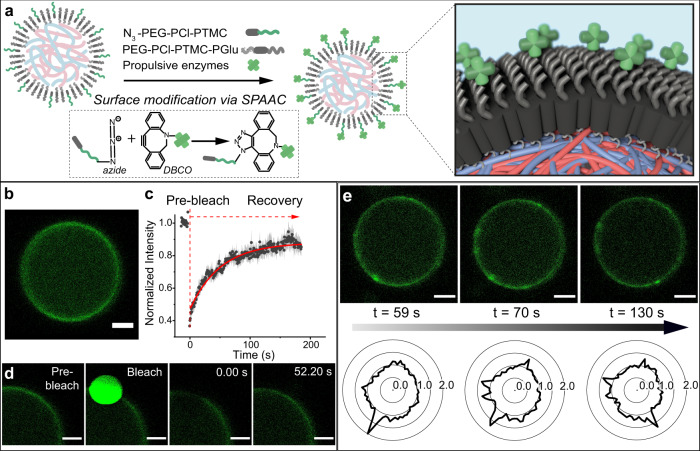
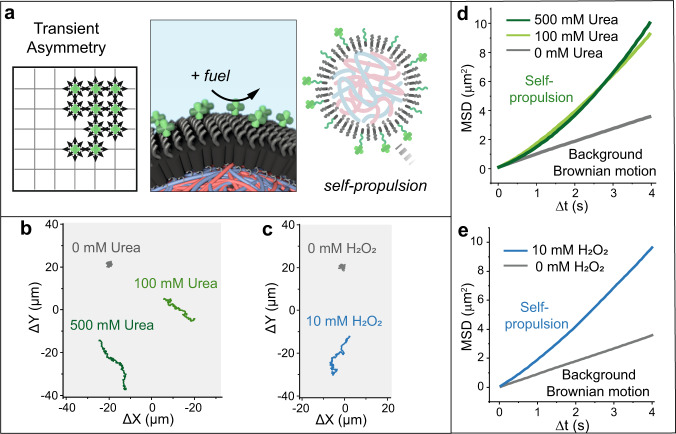
Random fluctuations are inherent to all complex molecular systems. Although nature has evolved mechanisms to control stochastic events to achieve the desired biological output, reproducing this in synthetic systems represents a significant challenge. Here we present an artificial platform that enables us to exploit stochasticity to direct motile behavior. We found that enzymes, when confined to the fluidic polymer membrane of a core-shell coacervate, were distributed stochastically in time and space. This resulted in a transient, asymmetric configuration of propulsive units, which imparted motility to such coacervates in presence of substrate. This mechanism was confirmed by stochastic modelling and simulations in silico. Furthermore, we showed that a deeper understanding of the mechanism of stochasticity could be utilized to modulate the motion output. Conceptually, this work represents a leap in design philosophy in the construction of synthetic systems with life-like behaviors.
随机波动是所有复杂分子系统固有的。尽管大自然已经进化出控制随机事件的机制,以达到预期的生物输出,但在合成系统中重现这一过程仍然是一个巨大的挑战。在这里,我们提出了一个人工平台,使我们能够利用随机性来指导运动行为。我们发现,当酶被限制在同心凝聚体的流体制聚合物膜中时,它们会在时间和空间上随机分布。这导致了推进单元的瞬时、不对称构型,从而在存在底物的情况下赋予了凝聚体运动能力。这种机制通过随机建模和计算机模拟得到了证实。此外,我们还表明,更深入地了解随机性的机制可以用来调节运动输出。从概念上讲,这项工作代表了在构建具有类生命行为的合成系统的设计理念上的飞跃。