Thepthien Bang-On, Tinn Chit Su, Ofuchi Takuma, Kim Bee
ASEAN Institute for Health Development, Mahidol University, Nakhon Pathom, Thailand.
Nuffield Department of Medicine, Trinity College, University of Oxford, Oxford, United Kingdom.
Tob Induc Dis. 2021 Nov 11;19:88. doi: 10.18332/tid/142894. eCollection 2021.
The prevalence of adolescent e-cigarette use has increased markedly in recent years. Specifically, the prevalence of e-cigarette use over the past 30 days was higher than the prevalence of use of other tobacco products. However, there is no definitive data on e-cigarette use among adolescents, including a description of how e-cigarette use is part of a more widespread pattern of substance abuse. The objective of this study was to assess the prevalence of e-cigarette use in combination with tobacco, alcohol, or marijuana, and the risk of polysubstance use among a sample of Thai adolescents, analyzed by sociodemographic characteristics.
Data were extracted from the Bangkok Behavioral Surveillance Survey (BBSS) cross-sectional survey conducted in 2019. The survey used self-reports from a sample of adolescents aged 14-17 years in Bangkok (n=6167). Multinomial logistic regression was used to determine the status of poly drug use in combination with e-cigarettes.
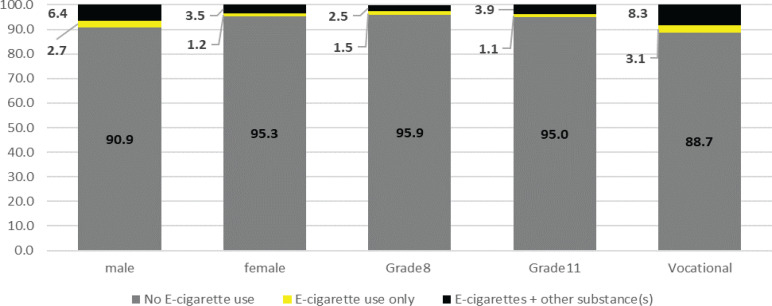
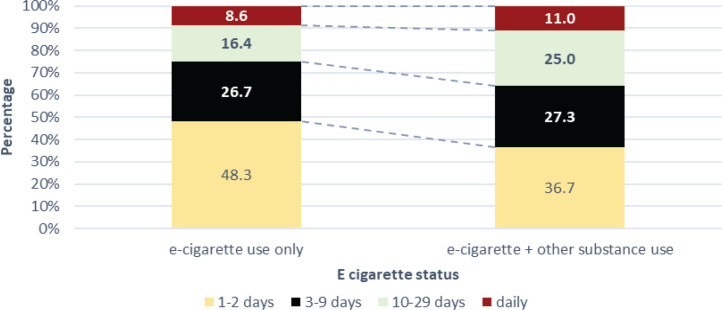
In all, 6.8% of adolescents in this sample reported having used e-cigarettes in the last 30 days. Among the students who used e-cigarettes, the majority (72.0%) reported using other substances along with e-cigarettes, and alcohol was the most common addictive substance used in combination with e-cigarette use. The use of e-cigarettes only and e-cigarettes in combination with other addictive substances (compared to the non-e-cigarette group) tended to be higher among male students, having low academic achievement, having a friend who smokes, being persuaded by a close friend, having ever had sex (OR: 1.48-3.70), and having close friends who drink alcohol (vs none) (OR=3.26).
Polysubstance use is highly prevalent among adolescents who use e-cigarettes. There should be extensive screening for e-cigarette consumption, including use of other addictive substances, especially alcohol. Early and comprehensive prevention efforts to reduce the use of e-cigarettes and other addictive substances can have a huge impact on the health of the adolescent population.
近年来,青少年使用电子烟的比例显著上升。具体而言,过去30天内使用电子烟的比例高于使用其他烟草制品的比例。然而,关于青少年使用电子烟的数据并不确切,包括电子烟使用如何成为更广泛的药物滥用模式的一部分的描述。本研究的目的是评估泰国青少年样本中电子烟与烟草、酒精或大麻同时使用的比例,以及按社会人口学特征分析的多物质使用风险。
数据取自2019年进行的曼谷行为监测调查(BBSS)横断面调查。该调查采用了曼谷14至17岁青少年样本(n = 6167)的自我报告。采用多项逻辑回归来确定与电子烟同时使用的多药使用状况。
总体而言,该样本中6.8%的青少年报告在过去30天内使用过电子烟。在使用电子烟的学生中,大多数(72.0%)报告同时使用了其他物质,酒精是与电子烟同时使用的最常见成瘾物质。仅使用电子烟以及将电子烟与其他成瘾物质同时使用(与不使用电子烟的组相比)在男生、学业成绩低、有吸烟朋友、受到密友劝说、有过性行为(比值比:1.48 - 3.70)以及有饮酒密友(与没有相比)(比值比 = 3.26)的人群中更为常见。
在使用电子烟的青少年中,多物质使用非常普遍。应广泛筛查电子烟消费情况,包括使用其他成瘾物质,尤其是酒精。早期和全面的预防措施以减少电子烟和其他成瘾物质的使用,对青少年人群的健康会产生巨大影响。