Xagoraris Marinos, Revelou Panagiota-Kyriaki, Arvanitis Nikos, Basalekou Marianthi, Pappas Christos S, Tarantilis Petros A
Laboratory of Chemistry, Department of Food Science and Human Nutrition. Agricultural University of Athens, 75 Iera Odos, 11855, Athens, Greece.
Department of Food Science and Technology, University of West Attica, Ag. Spyridonos Str, 12243, Egaleo, Athens, Greece.
Curr Res Food Sci. 2021 Nov 16;4:815-820. doi: 10.1016/j.crfs.2021.11.003. eCollection 2021.
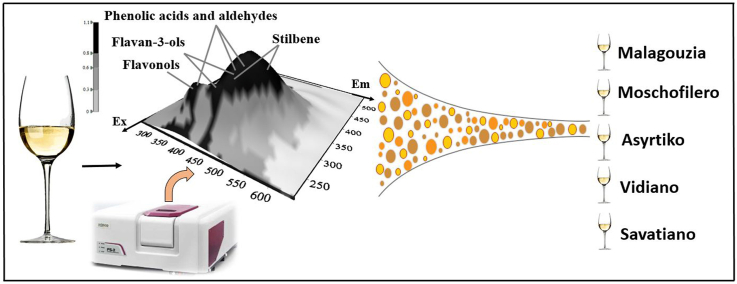
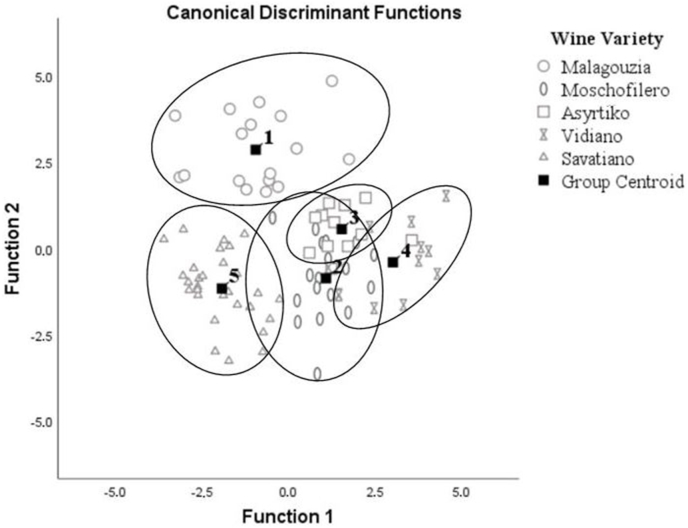
White wine is among the most widely consumed alcoholic beverages. Varietal discrimination of wines has received increasing attention. Today's consumers require a sense of authenticity and are deterred by falsehood or misrepresentation in product marketing. However, wine can involve various types of frauds, which directly affects the distribution of wine in national and international markets. Right-angle fluorescence spectroscopy is a simple and rapid analytical technique that in combination with chemometric algorithms, constitutes a novel method for wine authentication. In this study, the stepwise-Linear Discriminant Analysis algorithm was applied in three representative spectral regions related to phenolic compounds for the purpose of distinguishing white wines according to the grape variety. The wavelength at 310 nm attributed to the hydroxycinnamic acids and stilbene provided a higher classification rate (95.5%) than the λex 280 and 295 nm regions (79.8%), suggesting that these compounds are highly related to the botanical origin of samples. The chemometric models were validated utilizing cross-validation and an external validation set to enhance the robustness of the proposed methodology. The above-mentioned methodology constitutes a powerful tool for the varietal discrimination of white wines and can be used in industrial setting. The ultimate goal of this study is to contribute to the efforts towards the authentication of Greek white wine which will eventually support producers and suppliers to remain competitive and simultaneously protect the consumers from fraudulent practices.
白葡萄酒是消费最为广泛的酒精饮料之一。葡萄酒的品种鉴别受到了越来越多的关注。如今的消费者需要一种真实感,并且会被产品营销中的虚假或不实信息所阻碍。然而,葡萄酒可能涉及各种欺诈行为,这直接影响了葡萄酒在国内和国际市场的销售。直角荧光光谱法是一种简单快速的分析技术,与化学计量算法相结合,构成了一种用于葡萄酒鉴别的新方法。在本研究中,逐步线性判别分析算法被应用于与酚类化合物相关的三个代表性光谱区域,目的是根据葡萄品种对白葡萄酒进行区分。归因于羟基肉桂酸和芪类化合物的310 nm波长处的分类率(95.5%)高于λex 280和295 nm区域(79.8%),这表明这些化合物与样品的植物来源高度相关。利用交叉验证和外部验证集对化学计量模型进行了验证,以增强所提出方法的稳健性。上述方法构成了一种用于白葡萄酒品种鉴别的强大工具,可用于工业环境。本研究的最终目标是为希腊白葡萄酒的鉴别工作做出贡献,这最终将支持生产商和供应商保持竞争力,同时保护消费者免受欺诈行为的侵害。