Departamento de Ciencias Farmacéuticas, Facultad de Ciencias Químicas, Universidad Nacional de Córdoba, X5000HUA, Córdoba, Argentina.
Consejo Nacional de Investigaciones Científicas y Técnicas (CONICET) Unidad de Investigación y Desarrollo en Tecnología Farmacéutica (UNITEFA), X5000HUA, Córdoba, Argentina.
J Comput Aided Mol Des. 2022 Jan;36(1):25-37. doi: 10.1007/s10822-021-00432-3. Epub 2021 Nov 26.
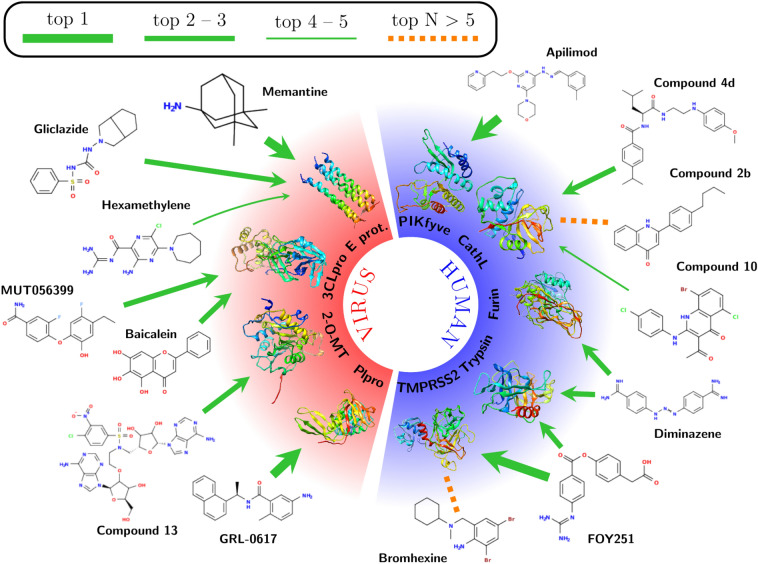
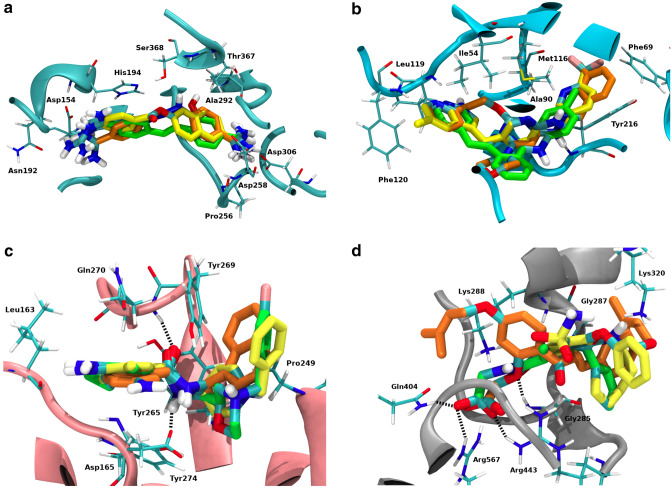
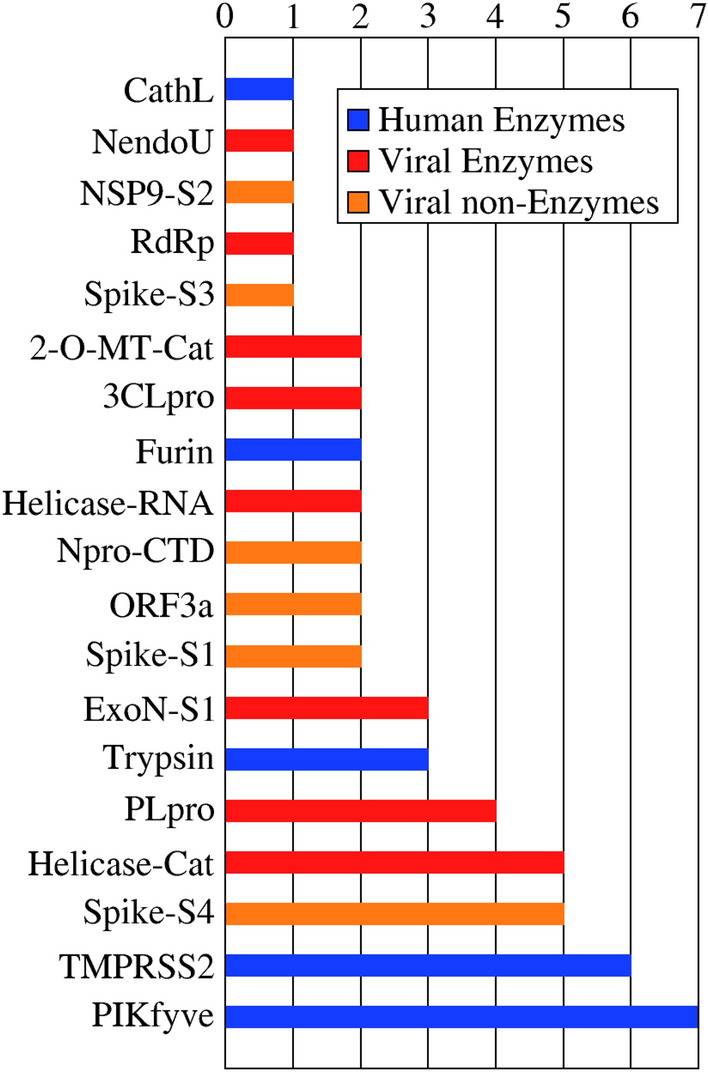
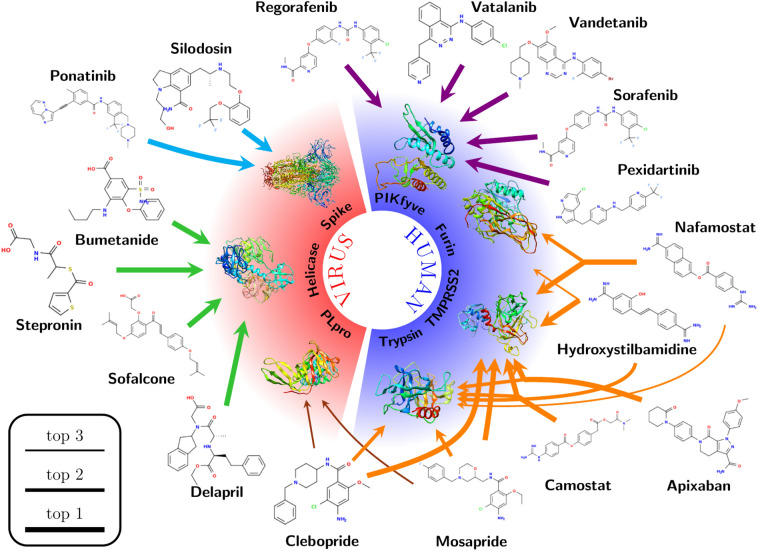
Screening already approved drugs for activity against a novel pathogen can be an important part of global rapid-response strategies in pandemics. Such high-throughput repurposing screens have already identified several existing drugs with potential to combat SARS-CoV-2. However, moving these hits forward for possible development into drugs specifically against this pathogen requires unambiguous identification of their corresponding targets, something the high-throughput screens are not typically designed to reveal. We present here a new computational inverse-docking protocol that uses all-atom protein structures and a combination of docking methods to rank-order targets for each of several existing drugs for which a plurality of recent high-throughput screens detected anti-SARS-CoV-2 activity. We demonstrate validation of this method with known drug-target pairs, including both non-antiviral and antiviral compounds. We subjected 152 distinct drugs potentially suitable for repurposing to the inverse docking procedure. The most common preferential targets were the human enzymes TMPRSS2 and PIKfyve, followed by the viral enzymes Helicase and PLpro. All compounds that selected TMPRSS2 are known serine protease inhibitors, and those that selected PIKfyve are known tyrosine kinase inhibitors. Detailed structural analysis of the docking poses revealed important insights into why these selections arose, and could potentially lead to more rational design of new drugs against these targets.
筛选已获批准的药物以对抗新型病原体,这可能是大流行期间全球快速反应策略的重要组成部分。此类高通量药物重定位筛选已经确定了几种具有对抗 SARS-CoV-2 潜力的现有药物。然而,要将这些命中药物进一步开发为专门针对该病原体的药物,就需要明确识别其相应的靶标,而高通量筛选通常无法揭示这些靶标。我们在此提出了一种新的计算反对接方案,该方案使用全原子蛋白结构和多种对接方法,对多个近期高通量筛选检测到抗 SARS-CoV-2 活性的现有药物的每个靶标进行排序。我们通过已知的药物-靶标对验证了该方法的有效性,包括非抗病毒和抗病毒化合物。我们将 152 种不同的潜在可重新利用的药物进行了反对接处理。最常见的首选靶标是人类酶 TMPRSS2 和 PIKfyve,其次是病毒酶 Helicase 和 PLpro。选择 TMPRSS2 的所有化合物都是已知的丝氨酸蛋白酶抑制剂,而选择 PIKfyve 的化合物则是已知的酪氨酸激酶抑制剂。对接构象的详细结构分析揭示了为什么会出现这些选择的重要见解,并且可能会导致针对这些靶标设计更合理的新药。