Khan Mohd Kamran, Pandey Anamika, Hamurcu Mehmet, Gezgin Sait, Athar Tabinda, Rajput Vishnu D, Gupta Om Prakash, Minkina Tatiana
Department of Soil Science and Plant Nutrition, Faculty of Agriculture, Selcuk University, Konya 42079, Turkey.
Faculty of Agriculture, Institute of Soil and Environmental Sciences, University of Agriculture Faisalabad, Faisalabad 38040, Pakistan.
Biology (Basel). 2021 Nov 2;10(11):1123. doi: 10.3390/biology10111123.
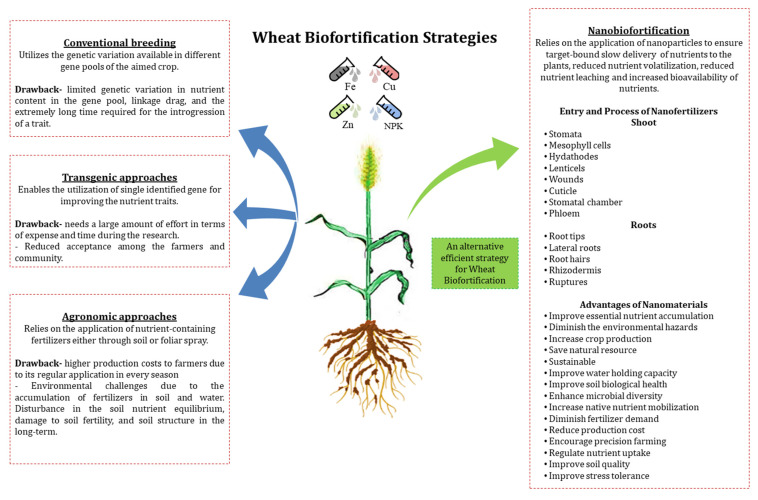
The deficiency of nutrients in food crops is a major issue affecting the health of human beings, mainly in underdeveloped areas. Despite the development in the methods of food fortification, several barriers such as lack of proper regulations and smaller public-private partnerships hinder its successful implementation in society. Consequently, genetic and agronomic biofortification has been suggested as the potential techniques for fortifying the nutrients in diets. However, the time-consuming nature and restricted available diversity in the targeted crop gene pool limit the benefits of genetic biofortification. In agronomic biofortification, organic fertilizers face the problem of prolonged duration of nutrients release and lesser content of minerals; while in inorganic fertilizers, the large-sized fertilizers (greater than 100 nm) suffer from volatilization and leaching losses. The application of nanotechnology in agriculture holds enormous potential to cope with these challenges. The utility of nanomaterials for wheat biofortification gains its importance by supplying the appropriate dose of fertilizer at the appropriate time diminishing the environmental concerns and smoothening the process of nutrient uptake and absorption. Wheat is a major crop whose nano-biofortification can largely handle the issue of malnutrition and nutrients deficiency in human beings. Though several research experiments have been conducted at small levels to see the effects of nano-biofortification on wheat plants, a review article providing an overview of such studies and summarizing the benefits and outcomes of wheat nano-biofortification is still lacking. Although a number of review articles are available on the role of nanotechnology in wheat crop, these are mostly focused on the role of nanoparticles in alleviating biotic and abiotic stress conditions in wheat. None of them focused on the prospects of nanotechnology for wheat biofortification. Hence, in this review for the first time, the current advancement in the employment of different nanotechnology-based approaches for wheat biofortification has been outlined. Different strategies including the supply of nano-based macro- and micronutrients that have shown promising results for wheat improvement have been discussed in detail. Understanding several aspects related to the safe usage of nanomaterials and their future perspectives may enhance their successful utilization in terms of economy and fulfillment of nutritional requirements following wheat nano-biofortification.
粮食作物中的营养物质缺乏是一个影响人类健康的主要问题,主要存在于欠发达地区。尽管食品强化方法有所发展,但缺乏适当法规和公私伙伴关系规模较小等若干障碍阻碍了其在社会中的成功实施。因此,遗传和农艺生物强化被认为是在饮食中强化营养物质的潜在技术。然而,目标作物基因库中耗时的性质和有限的可用多样性限制了遗传生物强化的益处。在农艺生物强化中,有机肥料面临养分释放持续时间长和矿物质含量较低的问题;而在无机肥料中,大尺寸肥料(大于100纳米)存在挥发和淋失损失。纳米技术在农业中的应用具有应对这些挑战的巨大潜力。纳米材料对小麦生物强化的效用通过在适当时间提供适当剂量的肥料而变得重要,减少了环境问题,并使养分吸收过程更加顺畅。小麦是一种主要作物,其纳米生物强化在很大程度上可以解决人类营养不良和营养缺乏问题。尽管已经进行了一些小规模的研究实验来观察纳米生物强化对小麦植株的影响,但仍缺乏一篇综述文章来概述此类研究并总结小麦纳米生物强化的益处和成果。虽然有一些关于纳米技术在小麦作物中作用的综述文章,但这些大多集中在纳米颗粒在缓解小麦生物和非生物胁迫条件方面的作用。它们都没有关注纳米技术在小麦生物强化方面的前景。因此,在这篇综述中首次概述了采用不同基于纳米技术的方法进行小麦生物强化的当前进展。详细讨论了不同的策略,包括提供对小麦改良显示出有前景结果的纳米基大量和微量营养素。了解与纳米材料安全使用相关的几个方面及其未来前景,可能会提高它们在小麦纳米生物强化后的经济利用和营养需求满足方面的成功应用。