Faculty of Chemistry and Pharmacy, Sofia University "St. Kl. Ohridski", 1164 Sofia, Bulgaria.
Institute for Biological Instrumentation of the Russian Academy of Sciences, Federal Research Center 'Pushchino Scientific Center for Biological Research of the Russian Academy of Sciences', 142290 Pushchino, Russia.
Biomolecules. 2021 Oct 24;11(11):1576. doi: 10.3390/biom11111576.
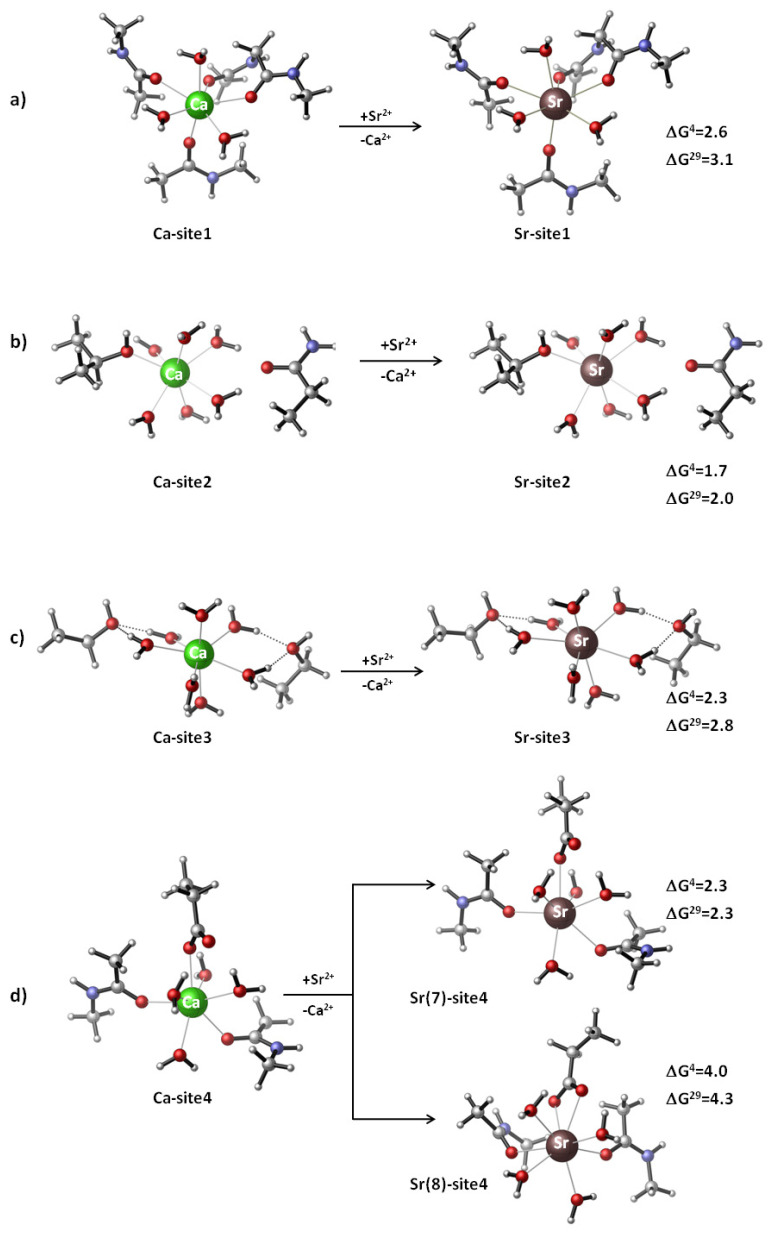
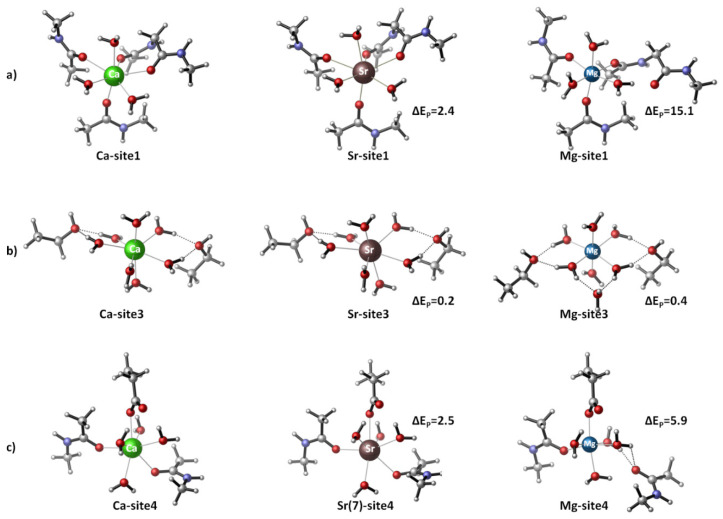
The extracellular calcium-sensing receptor (CaSR) controls vital bone cell functions such as cell growth, differentiation and apoptosis. The binding of the native agonist (Ca) to CaSR activates the receptor, which undergoes structural changes that trigger a cascade of events along the cellular signaling pathways. Strontium (in the form of soluble salts) has been found to also be a CaSR agonist. The activation of the receptor by Sr is considered to be the major mechanism through which strontium exerts its anti-osteoporosis effect, mostly in postmenopausal women. Strontium-activated CaSR initiates a series of signal transduction events resulting in both osteoclast apoptosis and osteoblast differentiation, thus strengthening the bone tissue. The intimate mechanism of Sr activation of CaSR is still enigmatic. Herewith, by employing a combination of density functional theory (DFT) calculations and polarizable continuum model (PCM) computations, we have found that the Ca binding sites 1, 3, and 4 in the activated CaSR, although possessing a different number and type of protein ligands, overall structure and charge state, are all selective for Ca over Sr. The three binding sites, regardless of their structural differences, exhibit almost equal metal selectivity if they are flexible and have no geometrical constraints on the incoming Sr. In contrast to Ca and Sr, Mg constructs, when allowed to fully relax during the optimization process, adopt their stringent six-coordinated octahedral structure at the expense of detaching a one-backbone carbonyl ligand and shifting it to the second coordination layer of the metal. The binding of Mg and Sr to a rigid/inflexible calcium-designed binding pocket requires an additional energy penalty for the binding ion; however, the price for doing so (to be paid by Sr) is much less than that of Mg. The results obtained delineate the key factors controlling the competition between metal cations for the receptor and shed light on some aspects of strontium's therapeutic effects.
细胞外钙敏感受体 (CaSR) 控制着重要的骨细胞功能,如细胞生长、分化和凋亡。天然激动剂 (Ca) 与 CaSR 的结合激活受体,受体发生结构变化,触发细胞信号通路中的级联反应。已经发现锶(以可溶性盐的形式)也是 CaSR 的激动剂。受体被 Sr 激活被认为是锶发挥其抗骨质疏松作用的主要机制,主要在绝经后妇女中。Sr 激活的 CaSR 启动一系列信号转导事件,导致破骨细胞凋亡和成骨细胞分化,从而增强骨组织。Sr 激活 CaSR 的内在机制仍然神秘。在此,我们采用密度泛函理论 (DFT) 计算和极化连续体模型 (PCM) 计算相结合的方法,发现激活的 CaSR 中的 Ca 结合位点 1、3 和 4,尽管具有不同数量和类型的蛋白质配体,整体结构和电荷状态,均对 Ca 具有选择性,而对 Sr 没有选择性。三个结合位点,无论其结构差异如何,如果它们是灵活的,并且对进入的 Sr 没有几何限制,那么它们对金属的选择性几乎相同。与 Ca 和 Sr 不同,Mg 构建体在优化过程中被允许完全松弛时,会以牺牲一个骨架羰基配体并将其转移到金属的第二个配位层为代价,采用其严格的六配位八面体结构。Mg 和 Sr 与刚性/非刚性钙设计的结合口袋结合需要结合离子的额外能量代价;然而,这样做的代价(Sr 需要支付)比 Mg 要低得多。所得到的结果描绘了控制金属阳离子与受体竞争的关键因素,并阐明了锶治疗效果的某些方面。