Department of Anatomy, Histology, Forensic Medicine and Orthopedics, Sapienza University of Rome, Via A. Borelli 50, 00161 Rome, Italy.
Department of Science, Roma Tre University, Viale Guglielmo Marconi 446, 00146 Rome, Italy.
Biomolecules. 2021 Nov 10;11(11):1668. doi: 10.3390/biom11111668.
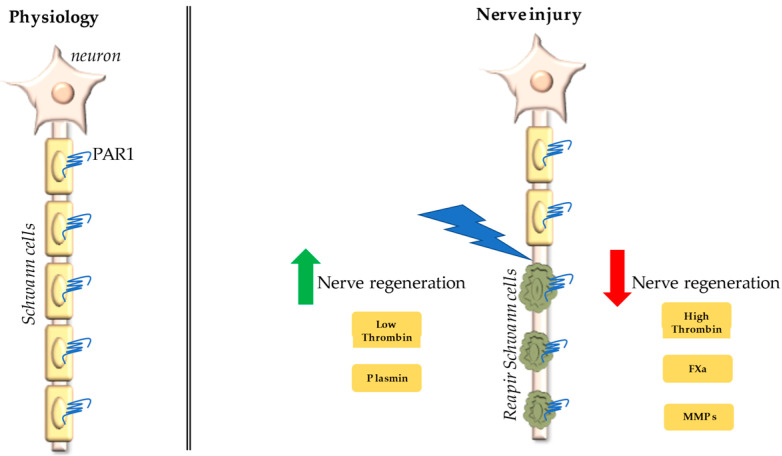
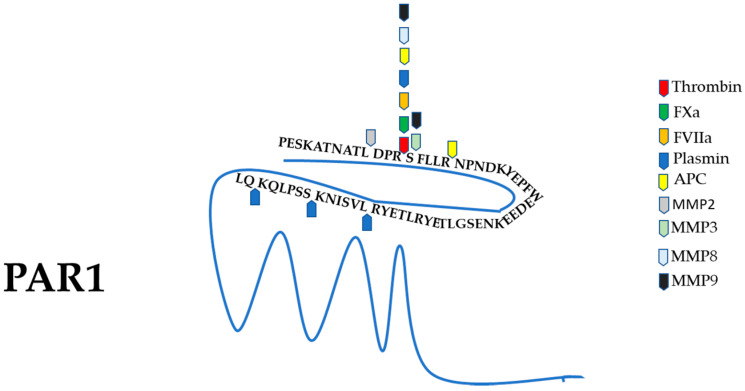
In contrast with the brain and spinal cord, peripheral nerves possess a striking ability to regenerate after damage. This characteristic of the peripheral nervous system is mainly due to a specific population of glial cells, the Schwann cells. Schwann cells promptly activate after nerve injury, dedifferentiate assuming a repair phenotype, and assist axon regrowth. In general, tissue injury determines the release of a variety of proteases which, in parallel with the degradation of their specific targets, also activate plasma membrane receptors known as protease-activated receptors (PARs). PAR1, the prototypical member of the PAR family, is also known as thrombin receptor and is present at the Schwann cell plasma membrane. This receptor is emerging as a possible regulator of the pro-regenerative capacity of Schwann cells. Here, we summarize the most recent literature data describing the possible contribution of PAR1 and PAR1-activating proteases in regulating the regeneration of peripheral nerves.
与大脑和脊髓不同,外周神经在损伤后具有显著的再生能力。外周神经系统的这一特征主要归因于一类特定的神经胶质细胞——雪旺细胞。雪旺细胞在神经损伤后迅速激活,去分化并呈现出修复表型,协助轴突再生。一般来说,组织损伤会导致各种蛋白酶的释放,这些蛋白酶在降解其特定靶标时,也会激活被称为蛋白酶激活受体 (PARs) 的质膜受体。PAR1 是 PAR 家族的典型成员,也被称为凝血酶受体,存在于雪旺细胞的质膜上。该受体作为雪旺细胞促再生能力的可能调节剂正在被研究。在这里,我们总结了最近描述 PAR1 和 PAR1 激活蛋白酶在调节周围神经再生中的可能作用的文献数据。