Morales Mérida Alejandra, Helier Aude, Cortés-Gómez Adriana A, Girondot Marc
Laboratoire Écologie, Systématique, Évolution, Université Paris Saclay, AgroParisTech, Centre National de la Recherche Scientifique, 91405 Orsay, France.
Doctorado en Ciencias Naturales para el Desarrollo (DOCINADE), Instituto Tecnológico de Costa Rica (TEC), Universidad Nacional de Costa Rica (UNA), Universidad Estatal a Distancia (UNED), Heredia 40101, Costa Rica.
Animals (Basel). 2021 Nov 5;11(11):3168. doi: 10.3390/ani11113168.
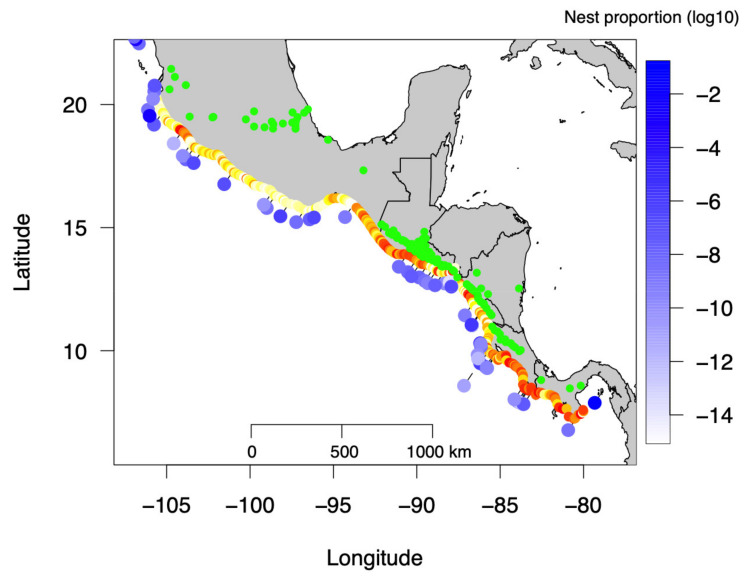
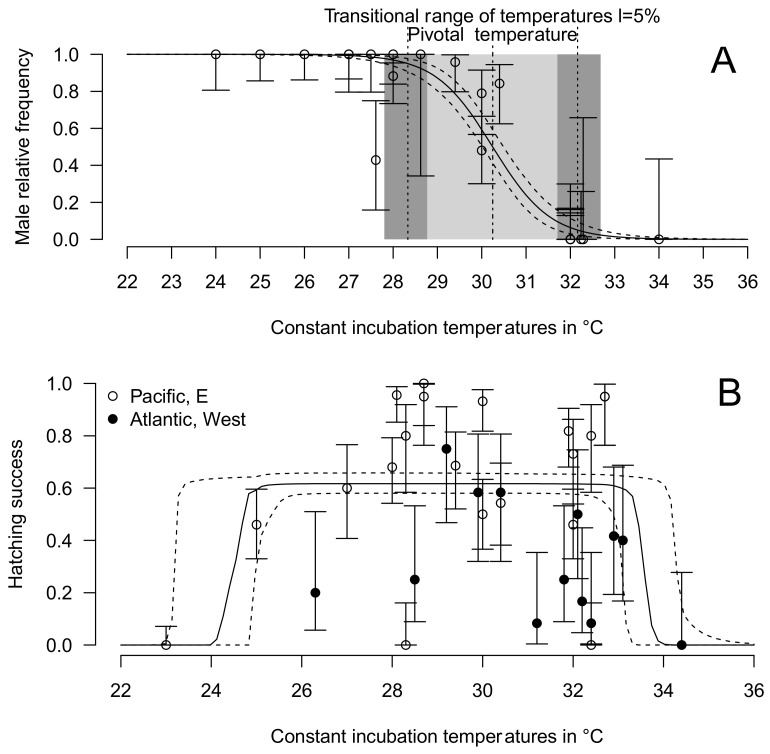
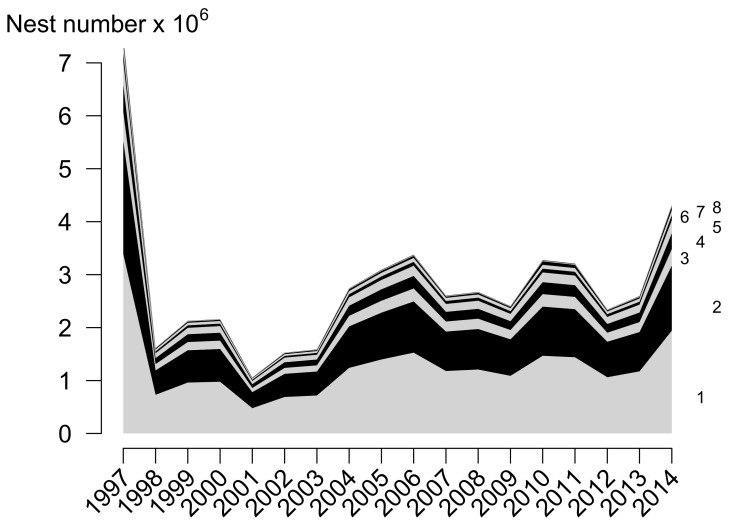
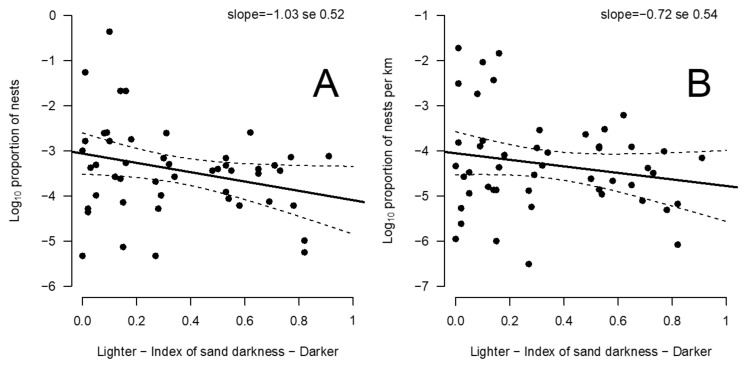
In marine turtles, sex is determined during a precise period during incubation: males are produced at lower temperatures and females at higher temperatures, a phenomenon called temperature-dependent sex determination. Nest temperature depends on many factors, including solar radiation. Albedo is the measure of the proportion of reflected solar radiation, and in terms of sand color, black sand absorbs the most energy, while white sand reflects more solar radiation. Based on this observation, darker sand beaches with higher temperatures should produce more females. As marine turtles show a high degree of philopatry, including natal homing, dark beaches should also produce more female hatchlings that return to nest when mature. When sand color is heterogeneous in a region, we hypothesize that darker beaches would have the most nests. Nevertheless, the high incubation temperature on beaches with a low albedo may result in low hatching success. Using Google Earth images and the SWOT database of nesting olive ridleys () in the Pacific coast of Mexico and Central America, we modeled sand color and nesting activity to test the hypothesis that darker beaches host larger concentrations of females because of feminization on darker beaches and female philopatry. We found the opposite result: the lower hatching success at beaches with a lower albedo could be the main driver of nesting activity heterogeneity for olive ridleys in Central America.
在海龟中,性别在孵化过程中的一个精确时期被决定:较低温度下产生雄性,较高温度下产生雌性,这种现象称为温度依赖型性别决定。巢穴温度取决于许多因素,包括太阳辐射。反照率是反射太阳辐射比例的度量,就沙子颜色而言,黑色沙子吸收的能量最多,而白色沙子反射更多的太阳辐射。基于这一观察结果,温度较高的深色沙滩应该会产生更多雌性海龟。由于海龟表现出高度的恋巢性,包括出生地归巢,深色沙滩也应该会产生更多成熟后返回巢穴的雌性幼龟。当一个地区的沙子颜色不均匀时,我们推测深色沙滩的巢穴最多。然而,反照率低的沙滩上较高的孵化温度可能导致孵化成功率低。利用谷歌地球图像和墨西哥太平洋沿岸及中美洲橄榄蠵龟筑巢的SWOT数据库,我们对沙子颜色和筑巢活动进行了建模,以检验深色沙滩因雌性化和雌性恋巢性而拥有更大雌性集中群体这一假设。我们发现了相反的结果:反照率较低的沙滩上较低的孵化成功率可能是中美洲橄榄蠵龟筑巢活动异质性的主要驱动因素。