Department of Hygiene and Epidemiology, Collegium Medicum, University of Zielona Góra, 28 Zyty St., 65-046 Zielona Góra, Poland.
Second Department of Psychiatry and Psychiatric Rehabilitation, Medical University of Lublin, 1 Głuska St., 20-059 Lublin, Poland.
Genes (Basel). 2021 Nov 20;12(11):1834. doi: 10.3390/genes12111834.
There has been a noticeable and systematic growth of the use of psychoactive substances over the past few decades. Dual diagnosis is a clinical term referring to the occurrence of psychoactive substance use disorder comorbid with another psychiatric disorder in the same person. The most common type of dual diagnosis is the co-occurrence of alcohol use disorder and mood disorders in the form of a depressive episode. Co-occurrent substance use disorders are frequently influenced by genetic factors. In selecting our area of research, we focused on dopamine and the (Dopamine Receptor D4) gene polymorphism as well as associations with personality features.
The aim of the study was to compare exon 3 (DRD4 Ex3) gene polymorphisms in patients diagnosed with polysubstance use disorder and co-occurrence of a depressive episode to exon 3 gene polymorphisms in patients diagnosed with polysubstance use disorder and without co-occurrence of a depressive episode and a group of healthy volunteers. The study also aimed at establishing associations between personality features and exon 3 gene polymorphisms of male patients diagnosed with polysubstance use disorder with co-occurrence of a depressive episode which may present a specific endophenotype of this group of patients.
The study group comprised 602 male volunteers: patients diagnosed with polysubstance use disorder comorbid with a depressive episode (PUD MDD) ( = 95; mean age = 28.29, standard deviation (SD) = 7.40), patients diagnosed with polysubstance use disorder (PUD) ( = 206; mean age = 28.13, SD = 5.97), and controls ( = 301; mean age = 22.13, SD = 4.57). The patients and control subjects were diagnosed by a psychiatrist using the Mini International Neuropsychiatric Interview (MINI), the NEO Five-Factor Personality Inventory (NEO-FFI), and the State-Trait Anxiety Inventory (STAI) questionnaires. An analysis of the exon 3 polymorphism was performed.
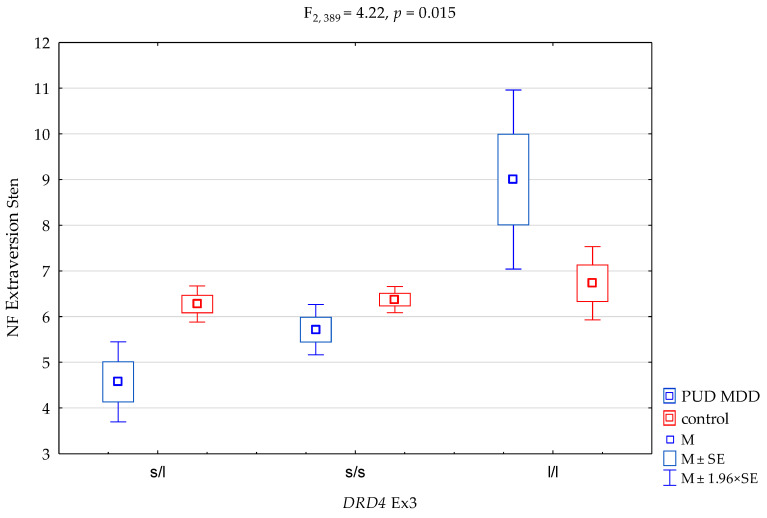
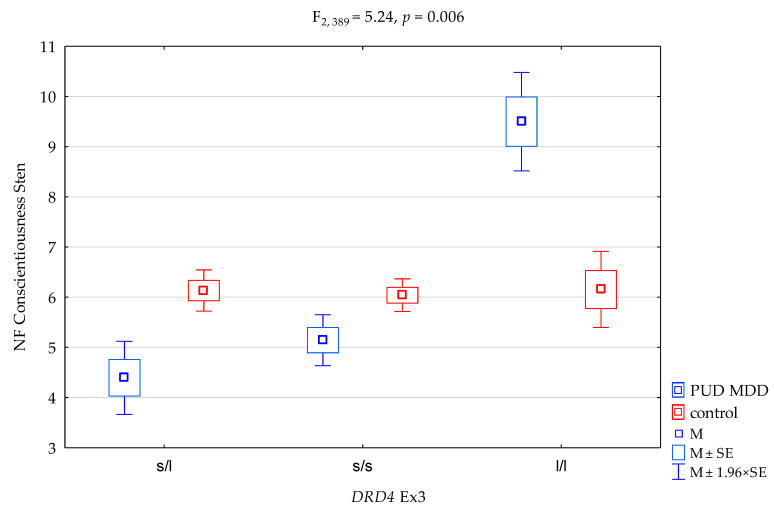
The patients diagnosed with PUD MDD compared to the control group of healthy volunteers showed significantly higher scores on both the STAI status and features scale and the NEO-FFI Neuroticism and Openness Scale, as well as lower scores on the Extraversion, Agreeableness, and Conscientiousness NEO-FFI scales. In the exon 3 gene polymorphism, the s allele was more frequent in the PUD MDD compared to the l allele, which was less frequent. The results of the 2 × 3 factor analysis of variance (ANOVA) in patients and controls and the variant exon 3 interaction were found on the Extraversion Scale and the Conscientiousness Scale of the NEO-FFI.
The associations show that psychological factors combined with genetic data create a new area of research on addiction, including the problem of dual diagnosis. However, we want to be careful and draw no definite conclusions at this stage of our research.
在过去几十年中,人们对精神活性物质的使用明显且呈系统增长。双重诊断是一个临床术语,指的是同一人同时出现精神活性物质使用障碍和另一种精神障碍。最常见的双重诊断类型是酒精使用障碍和以抑郁发作为形式的心境障碍同时发生。并发物质使用障碍经常受到遗传因素的影响。在选择我们的研究领域时,我们专注于多巴胺和(多巴胺受体 D4)基因多态性以及与人格特征的关联。
本研究的目的是比较诊断为多种物质使用障碍且同时发生抑郁发作的患者与仅诊断为多种物质使用障碍且无抑郁发作的患者以及一组健康志愿者的第 3 外显子(DRD4 Ex3)基因多态性。该研究还旨在确定与同时患有抑郁发作的多种物质使用障碍男性患者的人格特征与第 3 外显子基因多态性之间的关联,这可能是这群患者的一个特定表型特征。
研究组包括 602 名男性志愿者:诊断为多种物质使用障碍合并抑郁发作的患者(PUD MDD)(=95;平均年龄=28.29,标准差(SD)=7.40)、诊断为多种物质使用障碍的患者(PUD)(=206;平均年龄=28.13,SD=5.97)和对照组(=301;平均年龄=22.13,SD=4.57)。这些患者和对照组由精神病医生使用 Mini International Neuropsychiatric Interview(MINI)、NEO Five-Factor Personality Inventory(NEO-FFI)和 State-Trait Anxiety Inventory(STAI)问卷进行诊断。进行了第 3 外显子多态性分析。
与对照组健康志愿者相比,诊断为 PUD MDD 的患者在 STAI 状态和特征量表以及 NEO-FFI 神经质和开放性量表上的得分明显更高,而在 NEO-FFI 外向性、宜人性和尽责性量表上的得分则较低。在第 3 外显子基因多态性中,与 l 等位基因相比,s 等位基因在 PUD MDD 中更为常见。2×3 方差分析(ANOVA)的结果在患者和对照组以及变体第 3 外显子的交互作用中发现了 NEO-FFI 的外向性和尽责性量表上。
这些关联表明,心理因素与遗传数据相结合,为包括双重诊断在内的成瘾问题研究开辟了一个新领域。然而,在我们研究的现阶段,我们要谨慎行事,不做出明确的结论。