Maseri Marlyn, Mamat Mazlina, Yew Hoe Tung, Chekima Ali
Electronic Engineering (Computer) Program, Faculty of Engineering, Universiti Malaysia Sabah, Kota Kinabalu 88400, Sabah, Malaysia.
Children (Basel). 2021 Nov 3;8(11):1001. doi: 10.3390/children8111001.
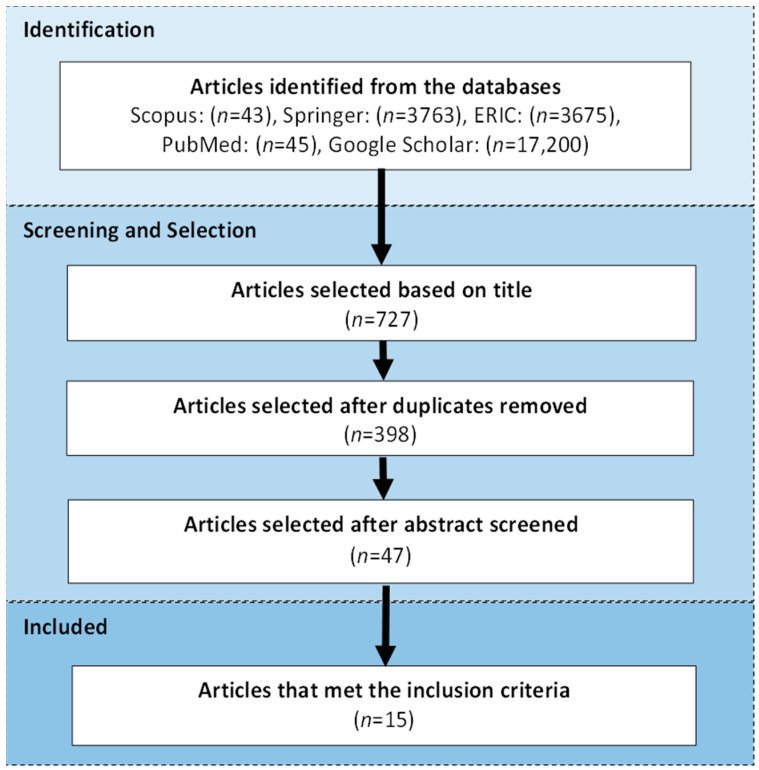
Autism-assistive apps offer therapists and caregivers new approaches for educating and assisting individuals with autism spectrum disorder (ASD), mainly in social interaction. Even though these apps are deemed effective, they are not. These autism-assistive apps are not highly customizable, which limits their usefulness. This article examined the application software that was applied to encourage verbal communication in the intervention for children with ASD. The aim was to determine the minimum requirements for a verbal communication intervention app that adequately satisfies children with ASD, caregivers, and therapists. Databases were searched, including Scopus, Springer, PubMed, Education Resources Information Centre, and Google Scholar, with the following free-text terms combining Boolean operators: autism, children, intervention, verbal communication, software, app, and technology. A total of fifteen studies were found relevant, and the following information was collected: participant characteristics, information on the devices and apps, target behaviors, intervention procedures, and intervention outcomes. The findings suggest that the autism-assistive apps effectively improve verbal communication of children with ASD. For that, the apps should be attractive and engaging to the children with ASD, able to identify the child's capability and suggest appropriate lesson activities, as well as encompass specific learning outcomes with multilevel lesson strategy. The apps should also use systematic evidence-based intervention procedures in the activities, be able to evaluate the child's learning progress, and allow caregivers or therapists to keep track of application usage and performance. The use of apps in intervention does provide many benefits. However, they should never replace qualified therapists. App-based interventions make home-based treatment more focused, systematic, and economical.
自闭症辅助应用程序为治疗师和护理人员提供了教育和帮助自闭症谱系障碍(ASD)患者的新方法,主要用于社交互动。尽管这些应用程序被认为是有效的,但实际上并非如此。这些自闭症辅助应用程序的可定制性不高,这限制了它们的实用性。本文研究了用于鼓励ASD儿童在干预中进行言语交流的应用软件。目的是确定一个能充分满足ASD儿童、护理人员和治疗师需求的言语交流干预应用程序的最低要求。我们搜索了多个数据库,包括Scopus、Springer、PubMed、教育资源信息中心和谷歌学术,使用以下自由文本术语并结合布尔运算符:自闭症、儿童、干预、言语交流、软件、应用程序和技术。共找到15项相关研究,并收集了以下信息:参与者特征、设备和应用程序信息、目标行为、干预程序和干预结果。研究结果表明,自闭症辅助应用程序能有效改善ASD儿童的言语交流。为此,应用程序应吸引ASD儿童并使其参与其中,能够识别儿童的能力并建议适当的课程活动,以及通过多层次课程策略涵盖特定的学习成果。应用程序还应在活动中使用基于系统证据的干预程序,能够评估儿童的学习进展,并允许护理人员或治疗师跟踪应用程序的使用情况和性能。在干预中使用应用程序确实带来了很多好处。然而,它们绝不能取代合格的治疗师。基于应用程序的干预使家庭治疗更加集中、系统和经济。