Reche-Olmedo Laura, Torres-Collado Laura, Compañ-Gabucio Laura María, Garcia-de-la-Hera Manuela
Unidad de Epidemiología de la Nutrición, Departamento de Salud Pública, Historia de la Ciencia y Ginecología, Universidad Miguel Hernández (UMH), 03550 Alicante, Spain.
Instituto de Investigación Sanitaria y Biomédica de Alicante, ISABIAL, 03010 Alicante, Spain.
Children (Basel). 2021 Nov 7;8(11):1024. doi: 10.3390/children8111024.
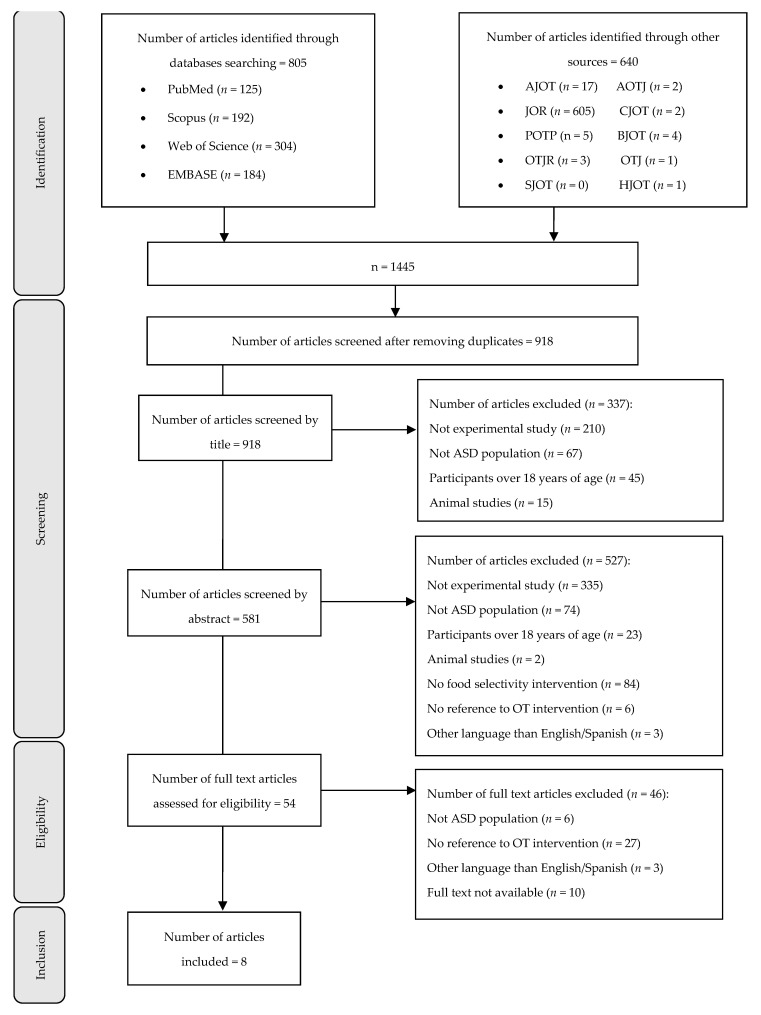
Food selectivity is common in children with autism spectrum disorder (ASD). It can be defined as the unwillingness to eat common or new foods, resulting in a lack of variety in the diet or limited food consumption for multiple reasons, such as inflexibility or sensory alterations. We conducted a peer scoping review to describe the interventions that are carried out from occupational therapy (OT) in children with ASD with food selectivity. Two authors independently searched the databases PubMed, Scopus, Web of Science, and EMBASE, as well as the OT journals indexed in Journal Citation Reports. Articles exploring OT interventions in children (≤12 years) with ASD and food selectivity, published in Spanish or English, with experimental design, and with full text available were included. Of the 1445 articles identified, 8 articles met the inclusion criteria. Three main intervention categories were identified: sensory-behavioral, family focused, and other interventions. Most of the interventions from OT were aimed at treating sensory-behavioral aspects. Only three articles described interventions led exclusively by occupational therapists, and the rest were led by a multidisciplinary team. Finally, although these interventions are not exclusive to OT, occupational therapists can participate together with other professionals as an essential component in the treatment of food selectivity in children with ASD.
食物选择性在自闭症谱系障碍(ASD)儿童中很常见。它可被定义为不愿意吃常见或新的食物,导致饮食缺乏多样性或因多种原因(如灵活性不足或感觉改变)而食物摄入量有限。我们进行了一项同行范围审查,以描述针对有食物选择性的ASD儿童所开展的职业治疗(OT)干预措施。两位作者独立检索了数据库PubMed、Scopus、科学网和EMBASE,以及《期刊引证报告》中索引的职业治疗期刊。纳入了以西班牙语或英语发表的、采用实验设计且有全文的、探讨针对≤12岁有食物选择性的ASD儿童的职业治疗干预措施的文章。在识别出的1445篇文章中,有8篇符合纳入标准。确定了三个主要干预类别:感觉行为、以家庭为重点和其他干预措施。职业治疗的大多数干预措施旨在治疗感觉行为方面。只有三篇文章描述了仅由职业治疗师主导的干预措施,其余的由多学科团队主导。最后,虽然这些干预措施并非职业治疗所独有,但职业治疗师可以与其他专业人员一起作为治疗有食物选择性的ASD儿童的重要组成部分参与其中。