Seebacher Nicole A, Krchniakova Maria, Stacy Alexandra E, Skoda Jan, Jansson Patric J
Department of Oncology, University of Oxford, Oxford OX3 9DU, UK.
Department of Experimental Biology, Faculty of Science, Masaryk University, 62500 Brno, Czech Republic.
Antioxidants (Basel). 2021 Nov 11;10(11):1801. doi: 10.3390/antiox10111801.
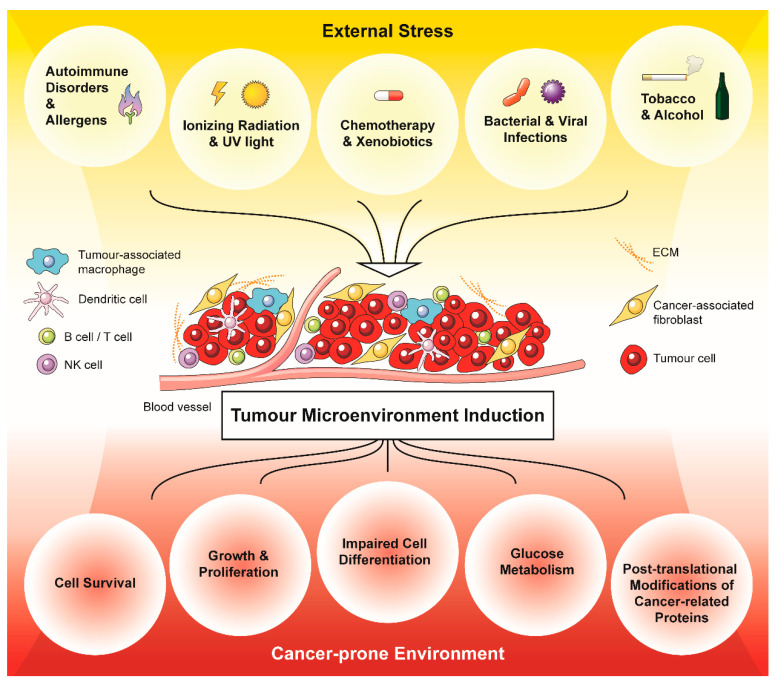
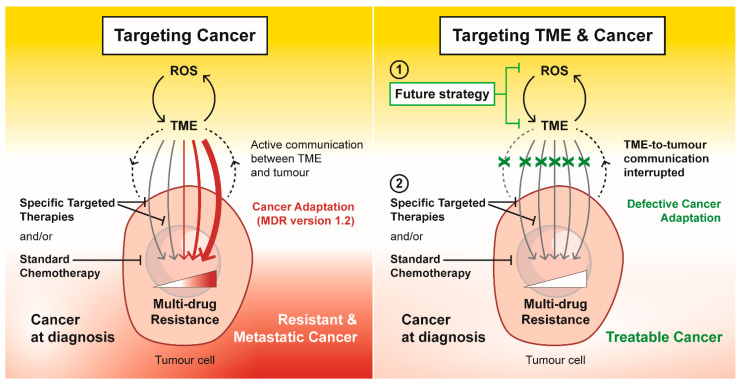
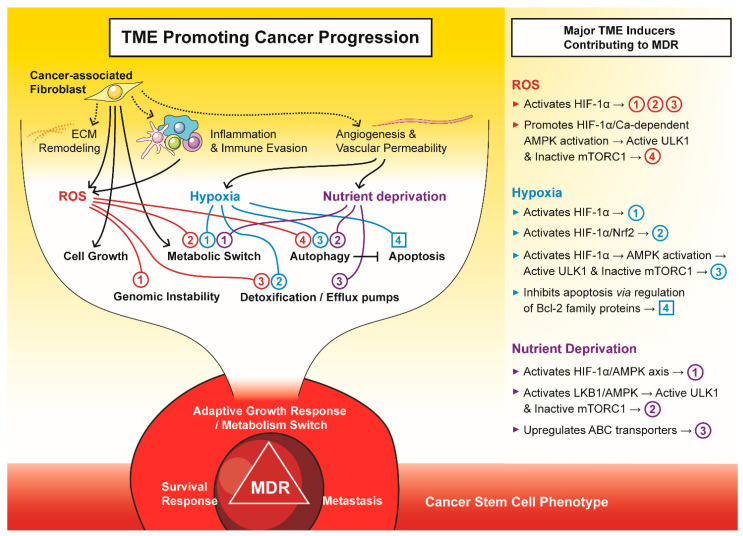
Multi-drug resistance (MDR) is a leading cause of cancer-related death, and it continues to be a major barrier to cancer treatment. The tumour microenvironment (TME) has proven to play an essential role in not only cancer progression and metastasis, but also the development of resistance to chemotherapy. Despite the significant advances in the efficacy of anti-cancer therapies, the development of drug resistance remains a major impediment to therapeutic success. This review highlights the interplay between various factors within the TME that collectively initiate or propagate MDR. The key TME-mediated mechanisms of MDR regulation that will be discussed herein include (1) altered metabolic processing and the reactive oxygen species (ROS)-hypoxia inducible factor (HIF) axis; (2) changes in stromal cells; (3) increased cancer cell survival via autophagy and failure of apoptosis; (4) altered drug delivery, uptake, or efflux and (5) the induction of a cancer stem cell (CSC) phenotype. The review also discusses thought-provoking ideas that may assist in overcoming the TME-induced MDR. We conclude that stressors from the TME and exposure to chemotherapeutic agents are strongly linked to the development of MDR in cancer cells. Therefore, there remains a vast area for potential research to further elicit the interplay between factors existing both within and outside the TME. Elucidating the mechanisms within this network is essential for developing new therapeutic strategies that are less prone to failure due to the development of resistance in cancer cells.
多药耐药(MDR)是癌症相关死亡的主要原因,并且仍然是癌症治疗的主要障碍。肿瘤微环境(TME)已被证明不仅在癌症进展和转移中起重要作用,而且在化疗耐药的发展中也起重要作用。尽管抗癌治疗的疗效取得了显著进展,但耐药性的发展仍然是治疗成功的主要障碍。本综述强调了TME中各种因素之间的相互作用,这些因素共同引发或传播MDR。本文将讨论的关键TME介导的MDR调节机制包括:(1)代谢过程改变和活性氧(ROS)-缺氧诱导因子(HIF)轴;(2)基质细胞变化;(3)通过自噬增加癌细胞存活和凋亡失败;(4)药物递送、摄取或外排改变;以及(5)癌症干细胞(CSC)表型的诱导。该综述还讨论了可能有助于克服TME诱导的MDR的发人深省的观点。我们得出结论,TME的应激源和化疗药物的暴露与癌细胞中MDR的发展密切相关。因此,仍有广阔的潜在研究领域,以进一步揭示TME内外因素之间的相互作用。阐明该网络中的机制对于开发新的治疗策略至关重要,这些策略不太容易因癌细胞产生耐药性而失败。