Gać Paweł, Czerwińska Karolina, Poręba Małgorzata, Prokopowicz Adam, Martynowicz Helena, Mazur Grzegorz, Poręba Rafał
Department of Population Health, Division of Environmental Health and Occupational Medicine, Wroclaw Medical University, 50-368 Wroclaw, Poland.
Department of Paralympic Sports, Wroclaw University of Health and Sport Sciences, 51-617 Wroclaw, Poland.
Antioxidants (Basel). 2021 Nov 12;10(11):1803. doi: 10.3390/antiox10111803.
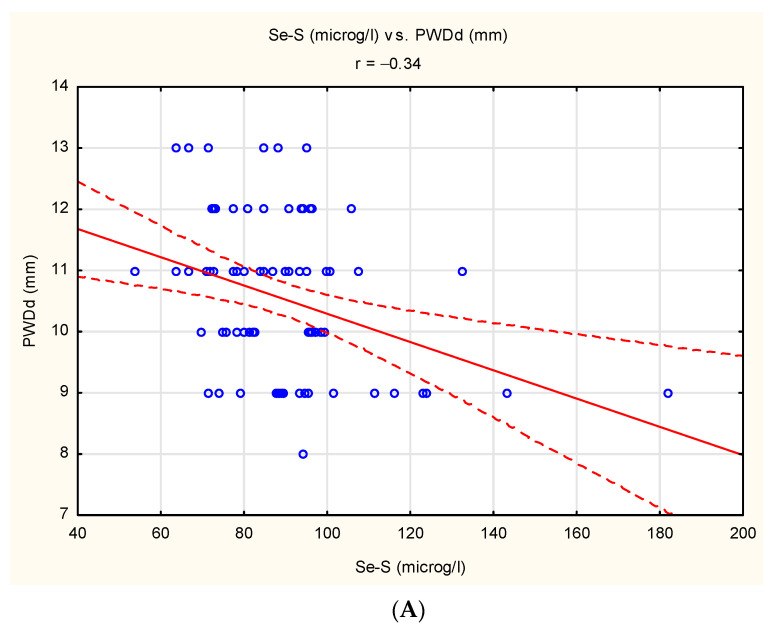
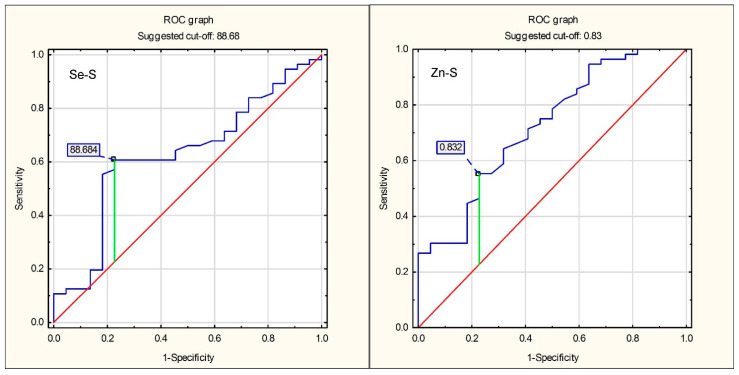
The aim of the study was to assess the relationship between serum selenium and zinc concentrations (Se-S and Zn-S) and the left ventricle geometry in patients suffering from arterial hypertension. A total of 78 people with arterial hypertension (mean age: 53.72 ± 12.74 years) participated in the study. Se-S and Zn-S were determined in all patients. The type of left ventricular remodelling and hypertrophy was determined by the left ventricular mass index (LVMI) and relative wall thickness (RWT) measured by echocardiography. Se-S and Zn-S in the whole group were 89.84 ± 18.75 µg/L and 0.86 ± 0.13 mg/L. Normal left ventricular geometry was found in 28.2% of patients; left ventricular hypertrophy (LVH) in 71.8%, including concentric remodelling in 28.2%, concentric hypertrophy in 29.5%, and eccentric hypertrophy in 14.1%. LVH was statistically significantly more frequent in patients with Se-S < median compared to patients with Se-S ≥ median (87.2% vs. 56.4%, < 0.05), as well as in patients with Zn-S < median compared to patients with Zn-S ≥ median (83.8% vs. 60.9%, < 0.05). In hypertensive patients, older age, higher LDL cholesterol, higher fasting glucose, lower Se-S, and lower Zn-S were independently associated with LVH. In conclusion, in hypertensive patients, left ventricular hypertrophy may be associated with low levels of selenium and zinc in the serum.
本研究的目的是评估动脉高血压患者血清硒和锌浓度(Se-S和Zn-S)与左心室几何结构之间的关系。共有78例动脉高血压患者(平均年龄:53.72±12.74岁)参与了本研究。测定了所有患者的Se-S和Zn-S。通过超声心动图测量的左心室质量指数(LVMI)和相对壁厚度(RWT)来确定左心室重构和肥大的类型。全组患者的Se-S和Zn-S分别为89.84±18.75μg/L和0.86±0.13mg/L。28.2%的患者左心室几何结构正常;71.8%的患者有左心室肥大(LVH),其中包括28.2%的向心性重构、29.5%的向心性肥大和14.1%的离心性肥大。与Se-S≥中位数的患者相比,Se-S<中位数的患者LVH在统计学上更为常见(87.2%对56.4%,P<0.05);与Zn-S≥中位数的患者相比,Zn-S<中位数的患者LVH也更为常见(83.8%对60.9%,P<0.05)。在高血压患者中,年龄较大、低密度脂蛋白胆固醇较高、空腹血糖较高、Se-S较低和Zn-S较低与LVH独立相关。总之,在高血压患者中,左心室肥大可能与血清中硒和锌水平较低有关。