Department of Biochemistry, School of Medicine with the Division of Dentistry, Medical University of Silesia, Jordana 19 Street, 41-808, Zabrze, Poland.
Second Department of Cardiology, School of Medicine with the Division of Dentistry, Medical University of Silesia, M. C. Skłodowskiej 10 Street, 41-808, Zabrze, Poland.
Cell Stress Chaperones. 2019 May;24(3):661-673. doi: 10.1007/s12192-019-00991-3. Epub 2019 May 1.
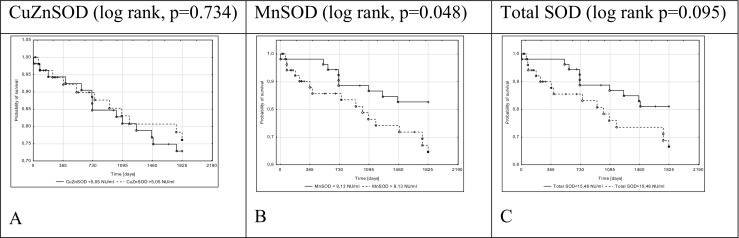
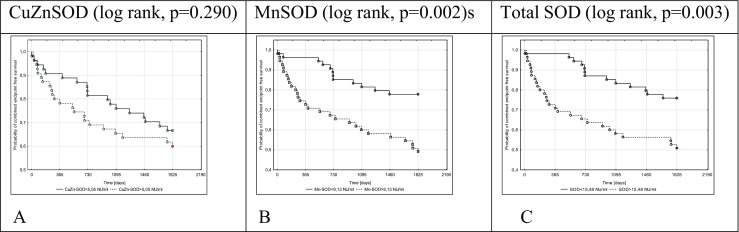
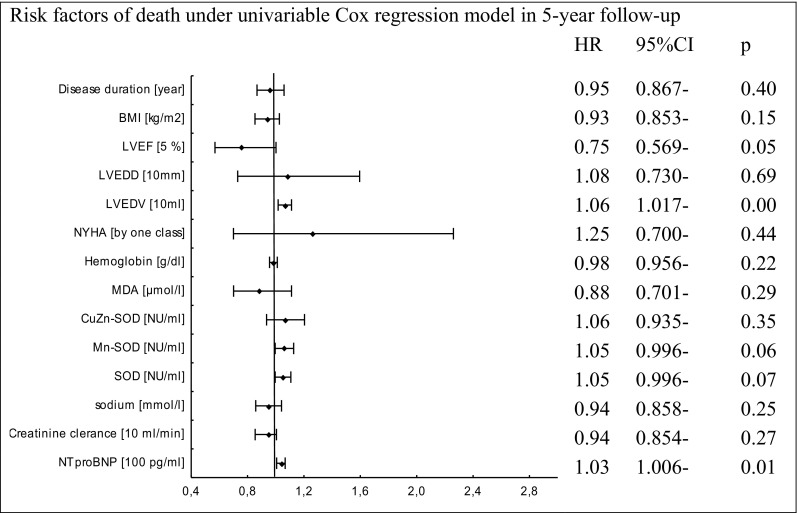
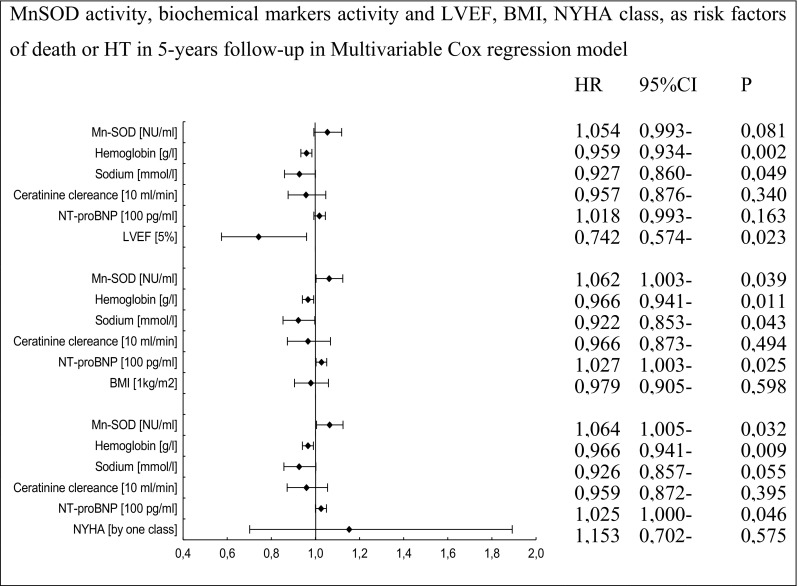
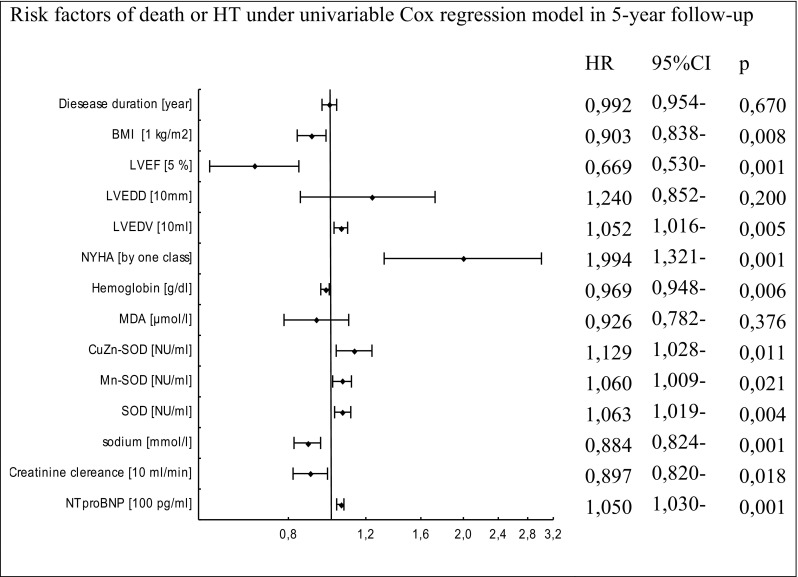
Oxidative stress contributes to progression of heart failure (HF). The present study analyzed the efficacy of the activities of superoxide dismutase (SOD) and its isoenzymes (CuZnSOD and MnSOD) as prognostic factors in dilated cardiomyopathy. The usefulness of activities of total SOD, MnSOD, and CuZnSOD was assessed, taking into account clinical, echocardiographic, and laboratory parameters as risk predictors of long-term clinical outcomes (death, heart transplant, combined end point) in 109 patients with nonischemic dilated cardiomyopathy (NIDCM) in this study with a 5-year follow-up. Regression analysis showed that total serum SOD activity was a predictor of worse long-term clinical outcome even after adjustment for NT-proBNP, hemoglobin, sodium, creatinine clearance, left ventricular ejection fraction (LVEF), BMI, and NYHA class (LVEF: HR 1.059, 95% CI 1.007-1.114, P = 0.026; BMI: HR 1.073, 95% CI 1.021-1.126, P = 0.005; NYHA: HR 1.073, 95% CI 1.022-1.126, P = 0.005). MnSOD and CuZnSOD activities were also predictors of worse long-term clinical outcome even after adjustment for laboratory parameters and BMI or NYHA class; however, after adjustment for LVEF, a borderline statistical significance was achieved (LVEF: HR 1.054, 95% CI 0.993-1.119, P = 0.081 [MnSOD]; HR 1.092, 95% CI 0.989-1.297, P = 0.082 [CuZnSOD]). Increased activities of total serum SOD and its isoenzymes in NIDCM patients correspond with a poor prognosis and may have prognostic value in the prediction of long-term clinical outcomes. In conclusion, the present study shows that serum SOD activity may be a useful predictor of adverse outcome in HF.
氧化应激是心力衰竭(HF)进展的原因之一。本研究分析了超氧化物歧化酶(SOD)及其同工酶(CuZnSOD 和 MnSOD)活性作为扩张型心肌病预后因素的功效。本研究评估了总 SOD、MnSOD 和 CuZnSOD 活性的有效性,考虑了临床、超声心动图和实验室参数,这些参数是 109 例非缺血性扩张型心肌病(NIDCM)患者 5 年临床结局(死亡、心脏移植、联合终点)的风险预测因子。回归分析显示,即使在校正 NT-proBNP、血红蛋白、钠、肌酐清除率、左心室射血分数(LVEF)、BMI 和 NYHA 分级后,总血清 SOD 活性仍然是不良长期临床结局的预测因子(LVEF:HR 1.059,95%CI 1.007-1.114,P=0.026;BMI:HR 1.073,95%CI 1.021-1.126,P=0.005;NYHA:HR 1.073,95%CI 1.022-1.126,P=0.005)。MnSOD 和 CuZnSOD 活性也是不良长期临床结局的预测因子,即使在校正实验室参数和 BMI 或 NYHA 分级后也是如此;然而,在校正 LVEF 后,达到了边缘统计学意义(LVEF:HR 1.054,95%CI 0.993-1.119,P=0.081[MnSOD];HR 1.092,95%CI 0.989-1.297,P=0.082[CuZnSOD])。NIDCM 患者总血清 SOD 和同工酶活性增加与预后不良相关,可能对预测长期临床结局具有预后价值。总之,本研究表明,血清 SOD 活性可能是 HF 不良预后的有用预测因子。