Karakus Ozlem Ozen, Darwish Noureldien H E, Sudha Thangirala, Salaheldin Taher A, Fujioka Kazutoshi, Dickinson Peter C Taylor, Weil Brian, Mousa Shaker A
The Pharmaceutical Research Institute, Albany College of Pharmacy and Health Sciences, Rensselaer, NY 12144, USA.
Clinical Pathology (Hematology Section), Faculty of Medicine, Mansoura University, Mansoura 35516, Egypt.
Biomedicines. 2021 Nov 18;9(11):1713. doi: 10.3390/biomedicines9111713.
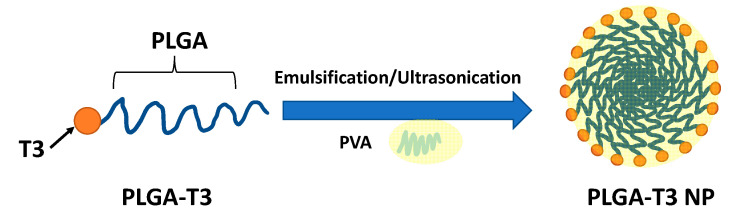
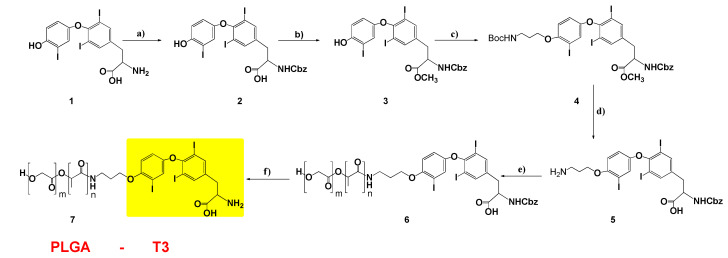
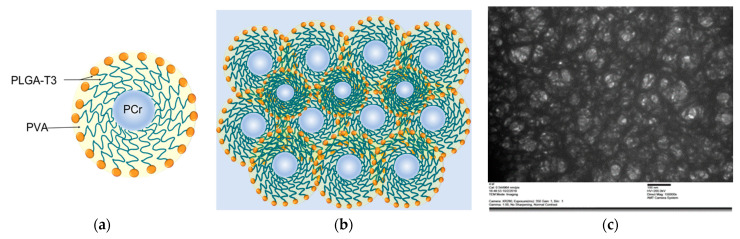
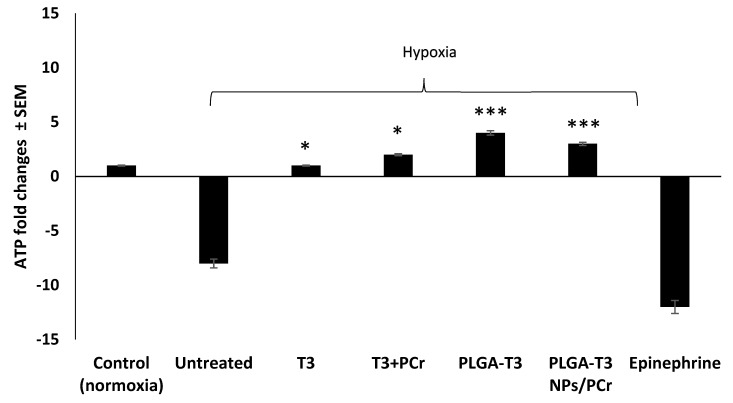
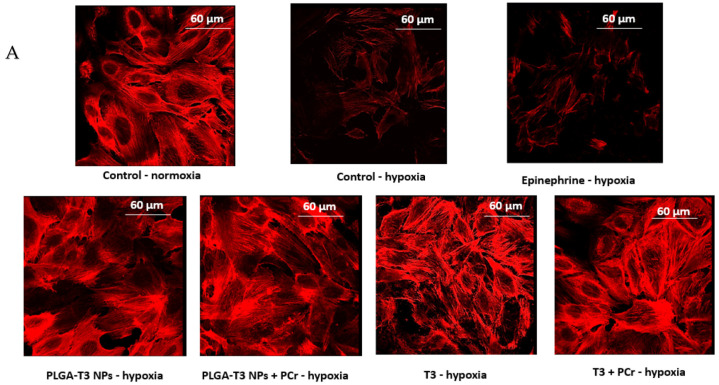
Ischemic heart disease is the main cause of death globally. Cardioprotection is the process whereby mechanisms that reduce myocardial damage, and activate protective factors, contribute to the preservation of the heart. Targeting these processes could be a new strategy in the treatment of post-ischemic heart failure (HF). Triiodothyronine (T3) and thyroxine (T4), which have multiple effects on the heart, prevent myocardial damage. This study describes the formulation, and characterization, of chemically modified polymeric nanoparticles incorporating T3, to target the thyroid hormone receptors. Modified T3 was conjugated to polylactide-co-glycolide (PLGA) to facilitate T3 delivery and restrict its nuclear translocation. Modified T3 and PLGA-T3 was characterized with H-NMR. The protective role of synthesized phosphocreatine (PCr) encapsulated PLGA-T3 nanoparticles (PLGA-T3/PCr NPs) and PLGA-T3 nanoparticles (PLGA-T3 NPs) in hypoxia-mediated cardiac cell insults was investigated. The results showed that PLGA-T3/PCr NPs represent a potentially new therapeutic agent for the control of tissue damage in cardiac ischemia and resuscitation.
缺血性心脏病是全球主要的死亡原因。心脏保护是指减少心肌损伤并激活保护因子的机制有助于心脏保护的过程。针对这些过程可能是治疗缺血性心力衰竭(HF)的一种新策略。对心脏有多种作用的三碘甲状腺原氨酸(T3)和甲状腺素(T4)可预防心肌损伤。本研究描述了结合T3以靶向甲状腺激素受体的化学修饰聚合物纳米颗粒的制备和表征。将修饰的T3与聚乳酸-羟基乙酸共聚物(PLGA)偶联,以促进T3递送并限制其核转位。用H-NMR对修饰的T3和PLGA-T3进行表征。研究了合成的磷酸肌酸(PCr)包封的PLGA-T3纳米颗粒(PLGA-T3/PCr NPs)和PLGA-T3纳米颗粒(PLGA-T3 NPs)在缺氧介导的心脏细胞损伤中的保护作用。结果表明,PLGA-T3/PCr NPs是控制心脏缺血和复苏中组织损伤的一种潜在新型治疗剂。