Chaloupka Michael, Stoermer Lina, Apfelbeck Maria, Buchner Alexander, Wenter Vera, Stief Christian G, Westhofen Thilo, Kretschmer Alexander
Department of Urology, LMU Klinikum, Ludwig-Maximilians University Munich, 81377 Munich, Germany.
Department of Nuclear Medicine, LMU Klinikum, Ludwig-Maximilians University Munich, 81377 Munich, Germany.
Cancers (Basel). 2021 Nov 11;13(22):5636. doi: 10.3390/cancers13225636.
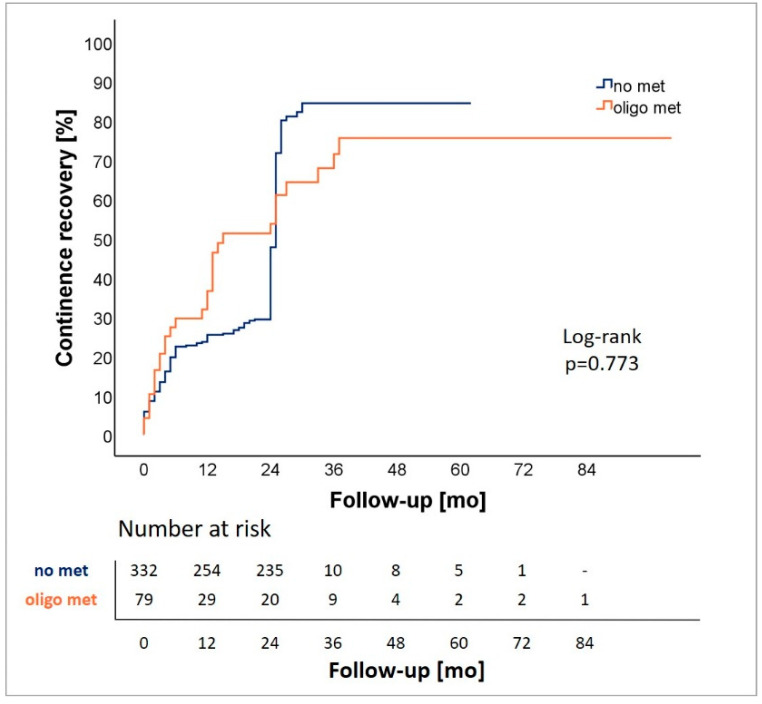
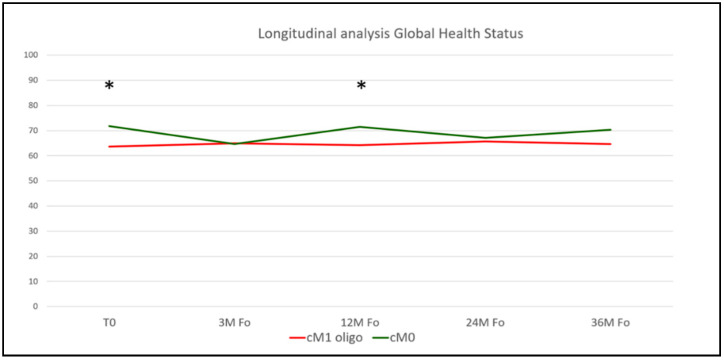
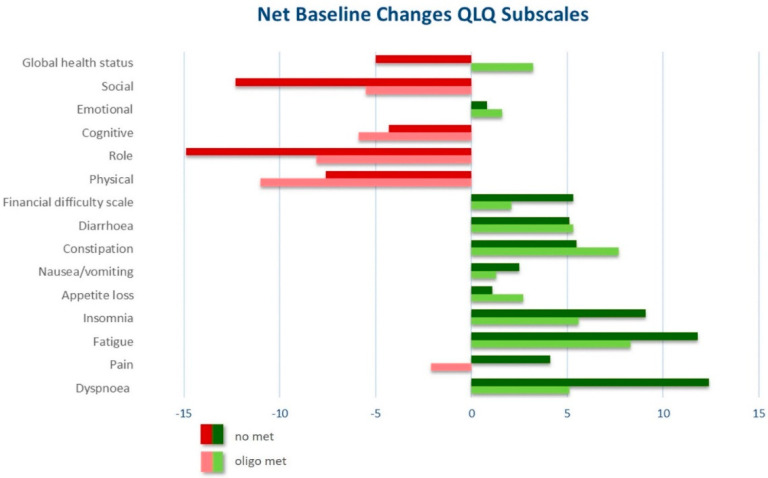
(1) Background: local treatment of the primary tumor has become a valid therapeutic option in de-novo oligo-metastatic prostate cancer (PC). However, evidence regarding radical prostatectomy (RP) in this setting is still subpar, and the effect of cytoreductive RP on postoperative health-related quality of life (HRQOL) is still unclear. (2) Methods: for the current study, patients with de-novo oligo-metastatic PC (cM1-oligo), defined as ≤5 bone lesions in the preoperative staging, were included, and matched cohorts using the variables age, body-mass index (BMI), and pT-stage were generated. Patient-reported outcome measures (PROMS) were assessed pre- and postoperatively using the validated EORTC-QLQ-C30, IIEF-5, and ICIQ-SF questionnaires. The primary endpoint for univariate and multivariable analysis was good general HRQOL defined by previously validated cut-off values. (3) Results: in total, 1268 patients ( = 84 (7%) cM1-oligo) underwent RP between 2012 and 2020 at one tertiary care center. A matched cohort of 411 patients ( = 79 with oligo-metastatic bone disease (cM1-oligo) and = 332 patients without clinical indication of metastatic disease (cM0)) was created. The median follow-up was 25mo. There was no significant difference in good general HRQOL rates between cM1-oligo-patients and cM0-patients before RP (45.6% vs. 55.2%, = 0.186), and at time of follow-up (44% vs. 56%, = 0.811). Global health status (GHS) worsened significantly in cM0-patients compared to baseline (-5, = 0.001), whereas GHS did not change significantly in cM1-oligo-patients (+3.2, = 0.381). In multivariate analysis stratified for good erectile function (IIEF5 > 18; OR 5.722, 95% CI 1.89-17.36, = 0.002) and continence recovery (OR 1.671, 95% CI 1.03-2.70, = 0.036), cM1-oligo was not an independent predictive feature for general HRQOL (OR 0.821, 95% CI 0.44-1.53, = 0.536). (4) Conclusions: in this large contemporary retrospective analysis, we observed no significant difference in HRQOL in patients with the oligometastatic bone disease after cytoreductive radical prostatectomy, when compared to patients with localized disease at time of surgery.
(1)背景:原发性肿瘤的局部治疗已成为新发寡转移前列腺癌(PC)的一种有效治疗选择。然而,在这种情况下,关于根治性前列腺切除术(RP)的证据仍然不足,而减瘤性RP对术后健康相关生活质量(HRQOL)的影响仍不明确。(2)方法:在本研究中,纳入了术前分期为≤5处骨转移灶的新发寡转移PC(cM1-寡转移)患者,并根据年龄、体重指数(BMI)和pT分期生成匹配队列。术前和术后使用经过验证的欧洲癌症研究与治疗组织生活质量核心问卷(EORTC-QLQ-C30)、国际勃起功能指数-5(IIEF-5)和国际尿失禁咨询问卷-简表(ICIQ-SF)对患者报告的结局指标(PROMS)进行评估。单因素和多因素分析的主要终点是根据先前验证的临界值定义的良好总体HRQOL。(3)结果:2012年至2020年期间,在一家三级医疗中心共有1268例患者接受了RP(n = 84(7%)为cM1-寡转移)。创建了一个由411例患者组成的匹配队列(n = 79例有寡转移骨病(cM1-寡转移),n = 332例无转移疾病临床指征(cM0))。中位随访时间为25个月。RP术前,cM1-寡转移患者与cM0患者的良好总体HRQOL率无显著差异(45.6%对55.2%,P = 0.186),随访时也无显著差异(44%对56%,P = 0.811)。与基线相比,cM0患者的总体健康状况(GHS)显著恶化(-5,P = 0.001),而cM1-寡转移患者的GHS无显著变化(+3.2,P = 0.381)。在针对良好勃起功能(IIEF5>18;OR 5.722, 95%CI 1.89 - 17.36,P = 0.002)和控尿恢复(OR 1.671, 95%CI 1.03 - 2.70,P = 0.036)进行分层的多因素分析中,cM1-寡转移不是总体HRQOL的独立预测特征(OR 0.821, 95%CI 0.44 - 1.53,P = 0.536)。(4)结论:在这项大型当代回顾性分析中,我们观察到,与手术时患有局限性疾病的患者相比,减瘤性根治性前列腺切除术后患有寡转移骨病的患者在HRQOL方面无显著差异。