
基于乙醇电解液制备的彩色纳米管状阳极氧化钛的形态学与光学特性
Morphological and Optical Characterization of Colored Nanotubular Anodic Titanium Oxide Made in an Ethanol-Based Electrolyte.
作者信息
Michalska-Domańska Marta, Czerwiński Mateusz, Łazińska Magdalena, Dubey Vikas, Jakubaszek Marcin, Zawadzki Zbigniew, Kostecki Jerzy
机构信息
Institute of Optoelectronics, Military University of Technology, 2 Kaliskiego Str., 00-908 Warsaw, Poland.
Institute of Materials Science, Military University of Technology, 2 Kaliskiego Str., 00-908 Warsaw, Poland.
出版信息
Materials (Basel). 2021 Nov 18;14(22):6992. doi: 10.3390/ma14226992.
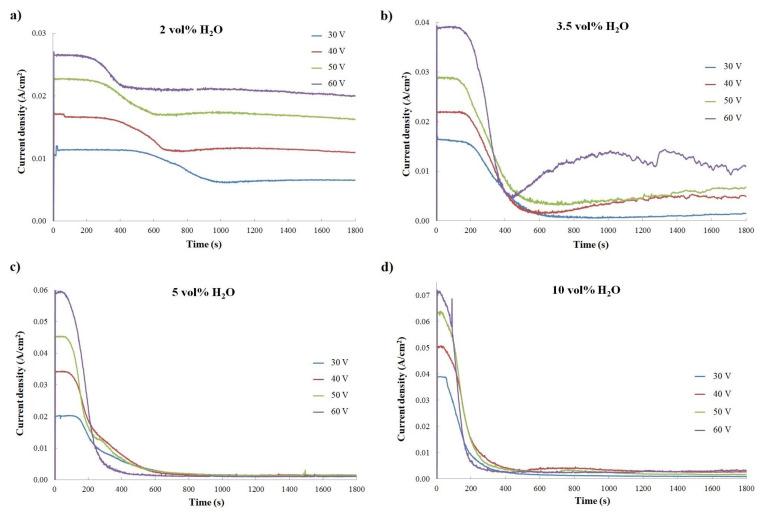
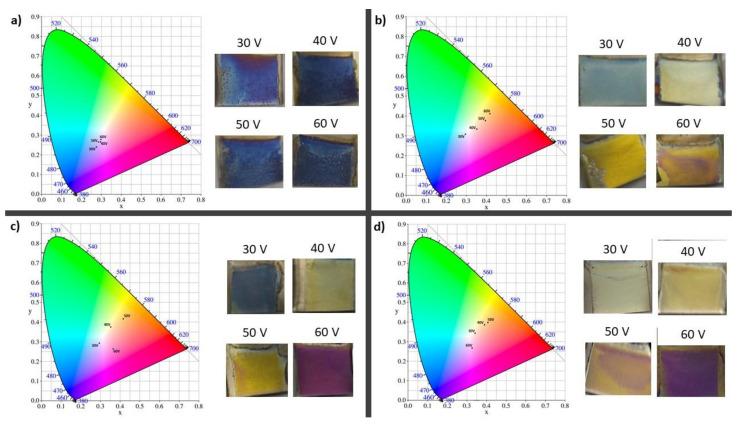
In this paper, the possibility of color controlling anodic titanium oxide by changing anodizing conditions of titanium in an ethanol-based electrolyte is demonstrated. Colored anodic titanium oxide was fabricated in an ethanol-based electrolyte containing 0.3 M ammonium fluoride and various amounts of deionized water (2, 3.5, 5, or 10 vol%), at voltages that varied from 30 to 60 V and at a constant anodization temperature of 20 °C. Morphological characterization of oxide layers was established with the use of a scanning electron microscope. Optical characterization was determined by measuring diffusion reflectance and calculating theoretical colors. The resulting anodic oxides in all tested conditions had nanotubular morphology and a thickness of up to hundreds of nanometers. For electrolytes with 3.5, 5, and 10 vol% water content, the anodic oxide layer thickness increased with the applied potential increase. The anodic titanium oxide nanotube diameters and the oxide thickness of samples produced in an electrolyte with 2 vol% water content were independent of applied voltage and remained constant within the error range of all tested potentials. Moreover, the color of anodic titanium oxide produced in an electrolyte with 2 vol% of water was blue and was independent from applied voltage, while the color of samples from other electrolyte compositions changed with applied voltage. For samples produced in selected conditions, iridescence was observed. It was proposed that the observed structural color of anodic titanium oxide results from the synergy effect of nanotube diameter and oxide thickness.
本文证明了通过改变钛在乙醇基电解液中的阳极氧化条件来对阳极氧化钛进行颜色控制的可能性。在含有0.3M氟化铵和不同量去离子水(2、3.5、5或10体积%)的乙醇基电解液中,于30至60V的电压下、在20℃的恒定阳极氧化温度下制备了彩色阳极氧化钛。利用扫描电子显微镜对氧化层进行了形态表征。通过测量漫反射率并计算理论颜色来进行光学表征。在所有测试条件下得到的阳极氧化物均具有纳米管形态,厚度可达数百纳米。对于水含量为3.5、5和10体积%的电解液,阳极氧化层厚度随施加电位的增加而增加。在水含量为2体积%的电解液中制备的样品的阳极氧化钛纳米管直径和氧化物厚度与施加电压无关,在所有测试电位的误差范围内保持恒定。此外,在水含量为2体积%的电解液中制备的阳极氧化钛的颜色为蓝色,且与施加电压无关,而其他电解液组成的样品颜色随施加电压而变化。对于在选定条件下制备的样品,观察到了虹彩现象。有人提出,观察到的阳极氧化钛的结构颜色是由纳米管直径和氧化物厚度的协同效应导致的。



 Zotero 插件