Graduate School of Systems Life Sciences, Kyushu University, 744 Motooka, Nishi-ku, Fukuoka 819-0395, Japan.
Department of Applied Chemistry, Faculty of Engineering, Kyushu University, 744 Motooka, Nishi-ku, Fukuoka 819-0395, Japan.
Molecules. 2021 Nov 10;26(22):6795. doi: 10.3390/molecules26226795.
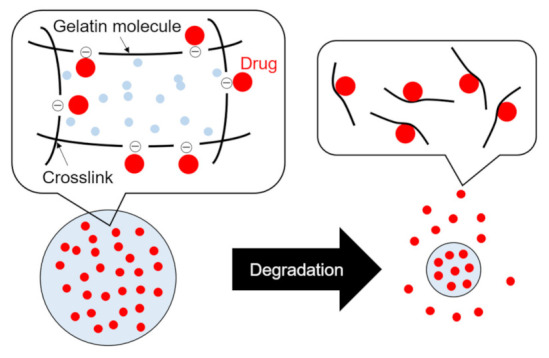
Gelatin, a denatured form of collagen, is an attractive biomaterial for biotechnology. In particular, gelatin particles have been noted due to their attractive properties as drug carriers. The drug release from gelatin particles can be easily controlled by the crosslinking degree of gelatin molecule, responding to the purpose of the research. The gelatin particles capable of drug release are effective in wound healing, drug screening models. For example, a sustained release of growth factors for tissue regeneration at the injured sites can heal a wound. In the case of the drug screening model, a tissue-like model composed of cells with high activity by the sustained release of drug or growth factor provides reliable results of drug effects. Gelatin particles are effective in drug delivery and the culture of spheroids or cell sheets because the particles prevent hypoxia-derived cell death. This review introduces recent research on gelatin microparticles-based strategies for regenerative therapy and drug screening models.
明胶是胶原蛋白的变性形式,是生物技术中一种有吸引力的生物材料。特别是,由于明胶粒子作为药物载体的吸引力,已经引起了人们的关注。通过控制明胶分子的交联度,可以轻松控制明胶粒子的药物释放,以满足研究目的。能够释放药物的明胶粒子在伤口愈合、药物筛选模型中非常有效。例如,在受伤部位持续释放生长因子以促进组织再生,可以治愈伤口。在药物筛选模型中,通过药物或生长因子的持续释放,由高活性细胞组成的类似组织的模型提供了可靠的药物效果结果。由于粒子可以防止缺氧引起的细胞死亡,因此明胶粒子在药物输送和球体或细胞片的培养中非常有效。本文介绍了基于明胶微球的再生治疗和药物筛选模型的最新研究进展。