Park Heejun, Kim Jeong-Soo, Kim Sebin, Ha Eun-Sol, Kim Min-Soo, Hwang Sung-Joo
College of Pharmacy, Duksung Women's University, 33, Samyangro 144-gil, Dobong-gu, Seoul 01369, Korea.
Dong-A ST Co. Ltd., 21, Geumhwa-ro 105beon-gil, Giheung-gu, Yongin-si 17073, Korea.
Pharmaceutics. 2021 Nov 14;13(11):1928. doi: 10.3390/pharmaceutics13111928.
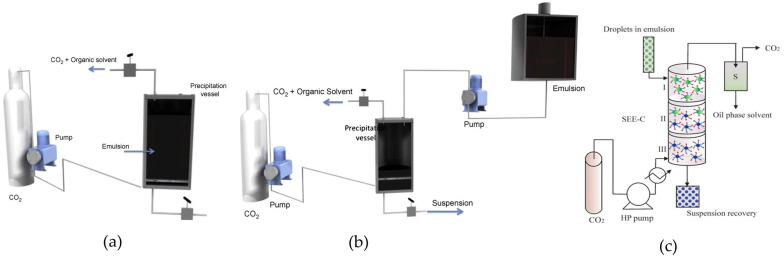
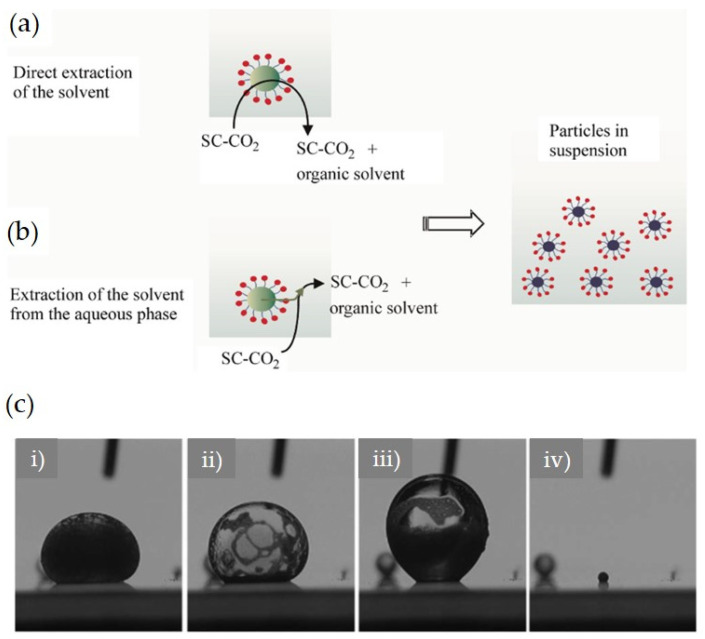
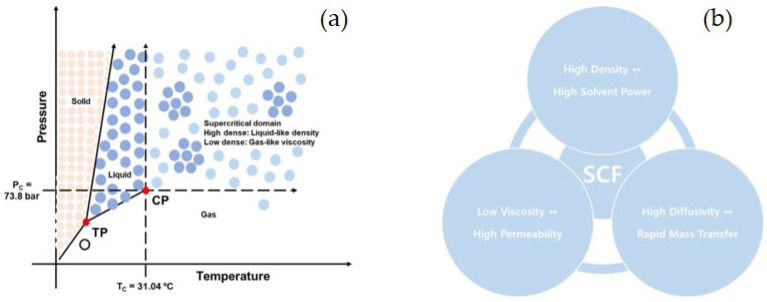
Micro-/nanoparticle formulations containing drugs with or without various biocompatible excipients are widely used in the pharmaceutical field to improve the physicochemical and clinical properties of the final drug product. Among the various micro-/nanoparticle production technologies, emulsion-based particle formation is the most widely used because of its unique advantages such as uniform generation of spherical small particles and higher encapsulation efficiency (EE). For this emulsion-based micro-/nanoparticle technology, one of the most important factors is the extraction efficiency associated with the fast removal of the organic solvent. In consideration of this, a technology called supercritical fluid extraction of emulsions (SFEE) that uses the unique mass transfer mechanism and solvent power of a supercritical fluid (SCF) has been proposed to overcome the shortcomings of several conventional technologies such as solvent evaporation, extraction, and spray drying. This review article presents the main aspects of SFEE technology for the preparation of micro-/nanoparticles by focusing on its pharmaceutical applications, which have been organized and classified according to several types of drug delivery systems and active pharmaceutical ingredients. It was definitely confirmed that SFEE can be applied in a variety of drugs from water-soluble to poorly water-soluble. In addition, it has advantages such as low organic solvent residual, high EE, desirable release control, better particle size control, and agglomeration prevention through efficient and fast solvent removal compared to conventional micro-/nanoparticle technologies. Therefore, this review will be a good resource for determining the applicability of SFEE to obtain better pharmaceutical quality when researchers in related fields want to select a suitable manufacturing process for preparing desired micro-/nanoparticle drug delivery systems containing their active material.
含有药物以及各种生物相容性辅料或不含这些辅料的微/纳米颗粒制剂在制药领域被广泛应用,以改善最终药品的物理化学性质和临床特性。在各种微/纳米颗粒生产技术中,基于乳液的颗粒形成技术应用最为广泛,因为它具有独特的优势,如能均匀生成球形小颗粒且包封率(EE)较高。对于这种基于乳液的微/纳米颗粒技术,最重要的因素之一是与快速去除有机溶剂相关的萃取效率。考虑到这一点,人们提出了一种名为乳液超临界流体萃取(SFEE)的技术,该技术利用超临界流体(SCF)独特的传质机制和溶剂能力,以克服溶剂蒸发、萃取和喷雾干燥等几种传统技术的缺点。这篇综述文章重点介绍了SFEE技术在制备微/纳米颗粒方面的主要内容,主要围绕其在制药领域的应用,这些应用已根据几种类型的药物递送系统和活性药物成分进行了整理和分类。已明确证实,SFEE可应用于从水溶性到难溶性的各种药物。此外,与传统的微/纳米颗粒技术相比,它具有有机溶剂残留低、包封率高、释放控制理想、粒度控制更好以及通过高效快速去除溶剂防止团聚等优点。因此,当相关领域的研究人员想要选择合适的制造工艺来制备含有其活性物质的理想微/纳米颗粒药物递送系统时,这篇综述将是确定SFEE适用性以获得更好药品质量的良好参考资源。