Barros-Rodríguez Adoración, Rangseekaew Pharada, Lasudee Krisana, Pathom-Aree Wasu, Manzanera Maximino
Department of Microbiology, Institute for Water Research, University of Granada, 18071 Granada, Spain.
Doctor of Philosophy Program in Applied Microbiology (International Program), Faculty of Science, Chiang Mai University, Chiang Mai 50200, Thailand.
Plants (Basel). 2021 Oct 28;10(11):2325. doi: 10.3390/plants10112325.
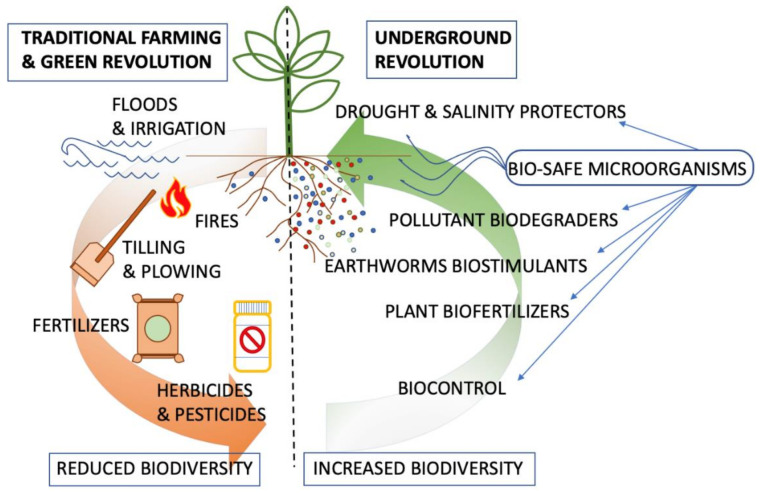
Agriculture represents an important mechanism in terms of reducing plant, animal, and microbial biodiversity and altering the environment. The pressure to cope with the increasing food demands of the human population has intensified the environmental impact, and alternative ways to produce food are required in order to minimize the decrease in biodiversity. Conventional agricultural practices, such as floods and irrigation systems; the removal of undesired vegetation by fires, tilling, and plowing; the use of herbicides, fertilizers, and pesticides; and the intensification of these practices over the last 50 years, have led to one of the most important environmental threats-a major loss of biodiversity. In this study, we review the impact that agriculture and its intensification have had on the environment and biodiversity since its invention. Moreover, we demonstrate how these impacts could be reduced through the use of microorganisms as biostimulants.
农业是减少植物、动物和微生物生物多样性以及改变环境的一个重要因素。应对人口不断增长的粮食需求的压力加剧了环境影响,因此需要采用替代的粮食生产方式,以尽量减少生物多样性的减少。传统农业做法,如洪水和灌溉系统;通过焚烧、翻耕和犁地清除不需要的植被;使用除草剂、化肥和杀虫剂;以及在过去50年里这些做法的强化,已导致了最重要的环境威胁之一——生物多样性的重大丧失。在本研究中,我们回顾了农业及其集约化自发明以来对环境和生物多样性所产生的影响。此外,我们还展示了如何通过使用微生物作为生物刺激剂来减少这些影响。