Vega-Hernández Rubí, Ochoa Sara A, Valle-Rios Ricardo, Jaimes-Ortega Gustavo A, Arellano-Galindo José, Aparicio-Ozores Gerardo, Ibarra José Antonio, Hernández-Castro Rigoberto, Cruz-Córdova Ariadnna, Xicohtencatl-Cortes Juan
Laboratorio de Investigación en Bacteriología Intestinal, Unidad de Investigación en Enfermedades Infecciosas, Hospital Infantil de México Federico Gómez, 06720 Ciudad de México, Mexico.
Posgrado en Biomedicina y Biotecnología Molecular, Escuela Nacional de Ciencias Biológicas, Instituto Politécnico Nacional, 09340 Ciudad de México, Mexico.
Microorganisms. 2021 Oct 27;9(11):2233. doi: 10.3390/microorganisms9112233.
Urinary tract infections (UTIs) are a public health problem in Mexico, and uropathogenic (UPEC) is one of the main etiological agents. Flagella, type I fimbriae, and curli promote the ability of these bacteria to successfully colonize its host.
This study aimed to determine whether flagella-, type I fimbriae-, and curli-expressing UPEC induces the release of proinflammatory cytokines in an established coculture system.
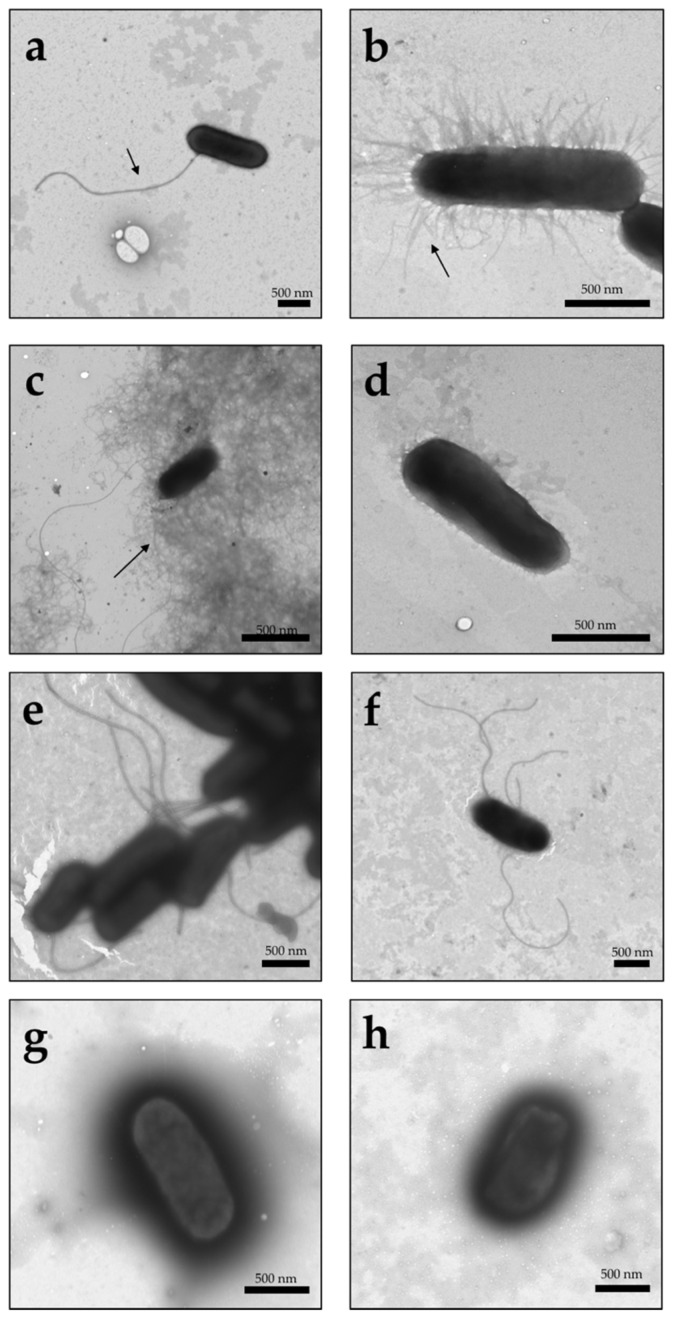
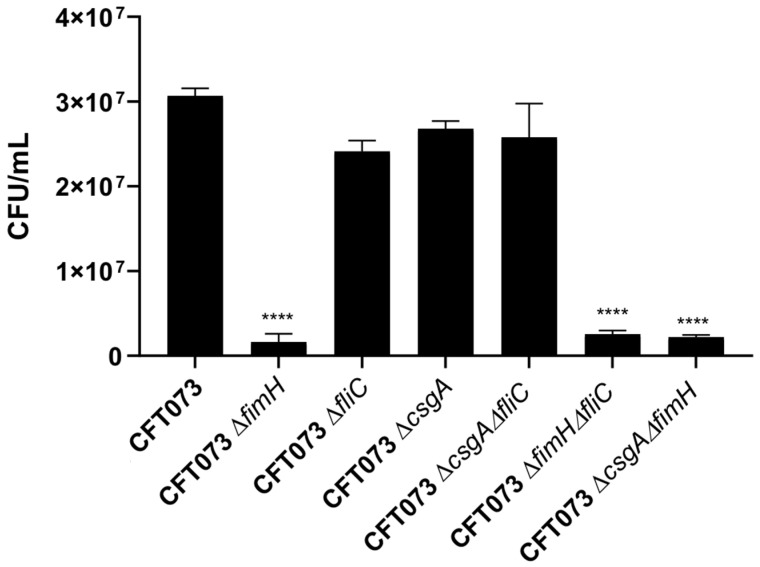
The , , and genes by UPEC strain were disrupted by allelic replacement. Flagella, type I fimbriae, and curli were visualized by transmission electron microscopy (TEM). HTB-5 (upper chamber) and HMC-1 (lower chamber) cells cocultured in Transwell plates were infected with these UPEC strains and purified proteins. There was adherence to HTB-5 cells treated with different UPEC strains and they were quantified as colony-forming units (CFU)/mL.
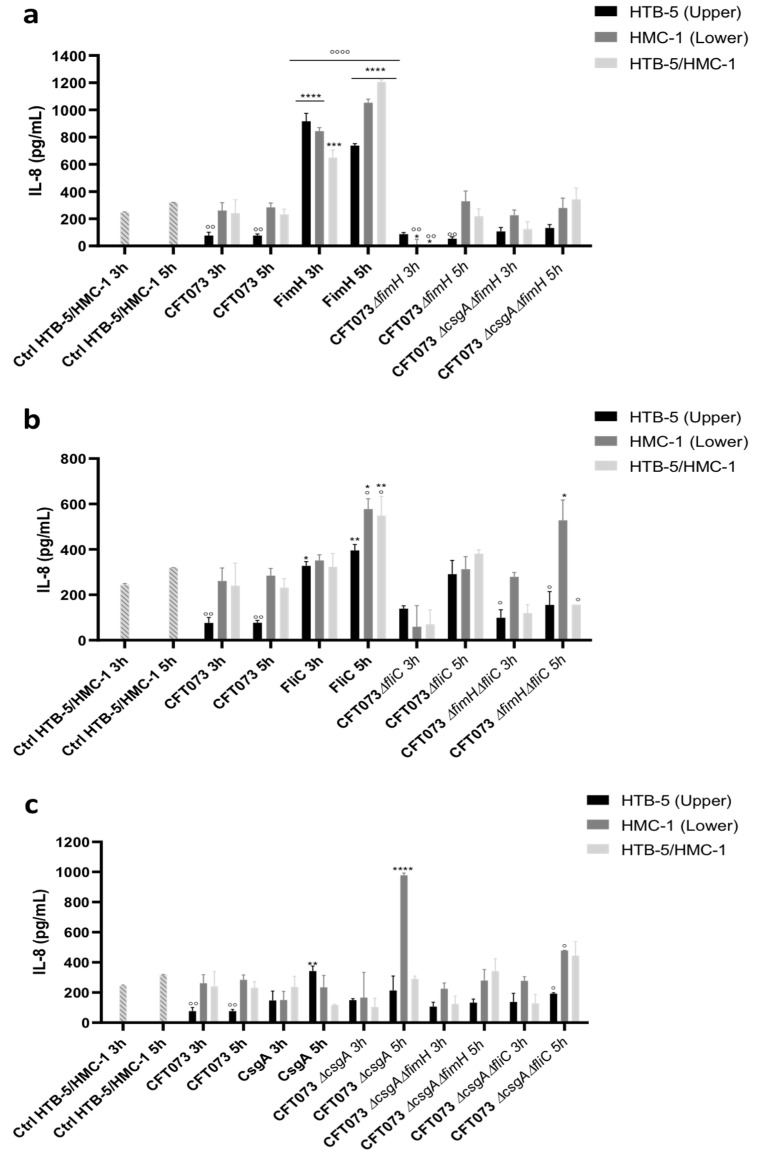
High concentrations of IL-6 and IL-8 were induced by the FimH and FliC proteins; however, these cytokines were detected in low concentrations in presence of CsgA. Compared with UPEC CFT073, CFT073Δ, CFT073ΔΔ, and CFT073ΔΔ strains significantly reduced the adherence to HTB-5 cells.
The FimH and FliC proteins are involved in IL-6 and IL-8 release in a coculture model of HTB-5 and HMC-1 cells.
尿路感染(UTIs)是墨西哥的一个公共卫生问题,尿路致病性大肠杆菌(UPEC)是主要病原体之一。鞭毛、I型菌毛和卷曲菌毛促进了这些细菌成功定殖于宿主的能力。
本研究旨在确定表达鞭毛、I型菌毛和卷曲菌毛的UPEC在既定的共培养系统中是否会诱导促炎细胞因子的释放。
通过等位基因置换破坏UPEC菌株的 、 和 基因。通过透射电子显微镜(TEM)观察鞭毛、I型菌毛和卷曲菌毛。将在Transwell板中共培养的HTB-5(上室)和HMC-1(下室)细胞用这些UPEC菌株和纯化蛋白进行感染。用不同UPEC菌株处理的HTB-5细胞存在黏附情况,并将其定量为菌落形成单位(CFU)/mL。
FimH和FliC蛋白诱导了高浓度的IL-6和IL-8;然而,在存在CsgA的情况下,这些细胞因子的浓度较低。与UPEC CFT073相比,CFT073Δ、CFT073ΔΔ和CFT073ΔΔ菌株显著降低了对HTB-5细胞的黏附。
在HTB-5和HMC-1细胞的共培养模型中,FimH和FliC蛋白参与了IL-6和IL-8的释放。