
卷曲菌毛:一种与人类膀胱炎相关的大肠杆菌粘附素。
Curli fimbria: an Escherichia coli adhesin associated with human cystitis.
作者信息
Cordeiro Melina Aparecida, Werle Catierine Hirsch, Milanez Guilherme Paier, Yano Tomomasa
机构信息
Departamento de Genética, Evolução e Bioagentes, IB, Universidade Estadual de Campinas, SP, Brazil.
Departamento de Genética, Evolução e Bioagentes, IB, Universidade Estadual de Campinas, SP, Brazil.
出版信息
Braz J Microbiol. 2016 Apr-Jun;47(2):414-6. doi: 10.1016/j.bjm.2016.01.024. Epub 2016 Mar 2.
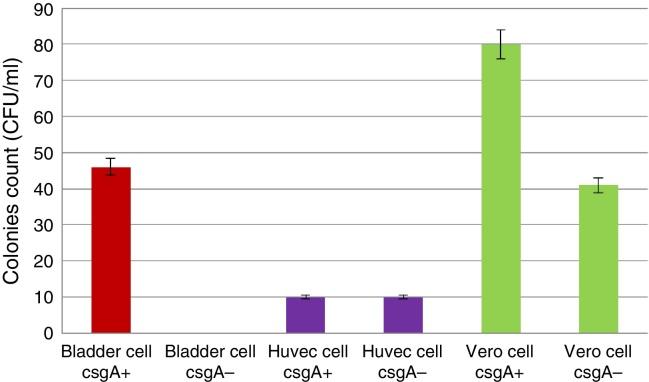
Escherichia coli is the major causative agent of human cystitis. In this study, a preliminary molecular analysis carried out by PCR (polymerase chain reaction) demonstrated that 100% of 31 E. coli strains isolated from patients with recurrent UTIs (urinary tract infections) showed the presence of the curli fimbria gene (csgA). Curli fimbria is known to be associated with bacterial biofilm formation but not with the adhesion of human cystitis-associated E. coli. Therefore, this work aimed to study how curli fimbria is associated with uropathogenic E. coli (UPEC) as an adhesion factor. For this purpose, the csgA gene was deleted from strain UPEC-4, which carries three adhesion factor genes (csgA, fimH and ompA). The wild-type UPEC-4 strain and its mutant (ΔcsgA) were analyzed for their adhesion ability over HTB-9 (human bladder carcinoma), Vero (kidney cells of African green monkey) and HUVEC (human umbilical vein) cells in the presence of α-d-mannose. All the wild-type UPEC strains tested (100%) were able to adhere to all three cell types, while the UPEC-4 ΔcsgA mutant lost its adherence to HTB-9 but continued to adhere to the HUVEC and Vero cells. The results suggest that curli fimbria has an important role in the adhesion processes associated with human UPEC-induced cystitis.
大肠杆菌是人类膀胱炎的主要病原体。在本研究中,通过聚合酶链反应(PCR)进行的初步分子分析表明,从复发性尿路感染(UTIs)患者中分离出的31株大肠杆菌中,100%都显示出卷曲菌毛基因(csgA)的存在。已知卷曲菌毛与细菌生物膜形成有关,但与人类膀胱炎相关大肠杆菌的黏附无关。因此,这项工作旨在研究卷曲菌毛作为一种黏附因子如何与尿路致病性大肠杆菌(UPEC)相关联。为此,从携带三种黏附因子基因(csgA、fimH和ompA)的UPEC - 4菌株中删除了csgA基因。在α - d - 甘露糖存在的情况下,分析了野生型UPEC - 4菌株及其突变体(ΔcsgA)对HTB - 9(人膀胱癌细胞)、Vero(非洲绿猴肾细胞)和HUVEC(人脐静脉细胞)的黏附能力。所有测试的野生型UPEC菌株(100%)都能够黏附于所有三种细胞类型,而UPEC - 4 ΔcsgA突变体失去了对HTB - 9的黏附能力,但仍能黏附于HUVEC和Vero细胞。结果表明,卷曲菌毛在与人类UPEC引起的膀胱炎相关的黏附过程中起重要作用。
 Zotero 插件