Schock Marina, Schmidt Steffen, Ersfeld Klaus
Molecular Parasitology, Department of Biology, University of Bayreuth, Universitätsstr. 30, 95447 Bayreuth, Germany.
Computational Biochemistry, University of Bayreuth, Universitätsstr. 30, 95447 Bayreuth, Germany.
Microorganisms. 2021 Oct 27;9(11):2234. doi: 10.3390/microorganisms9112234.
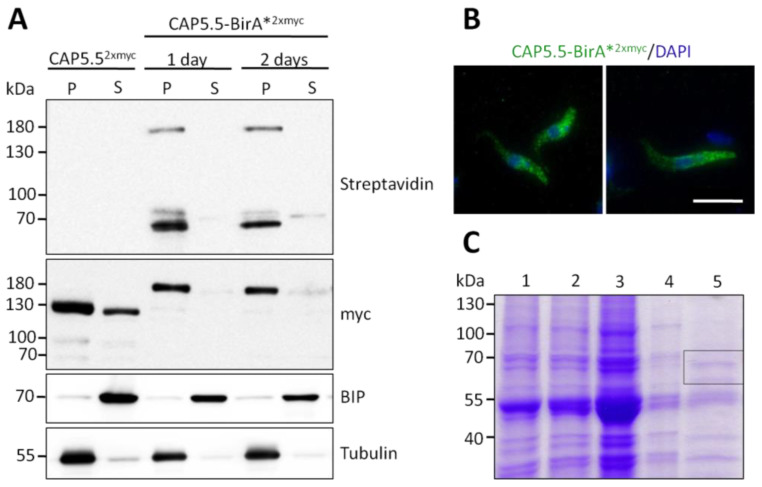
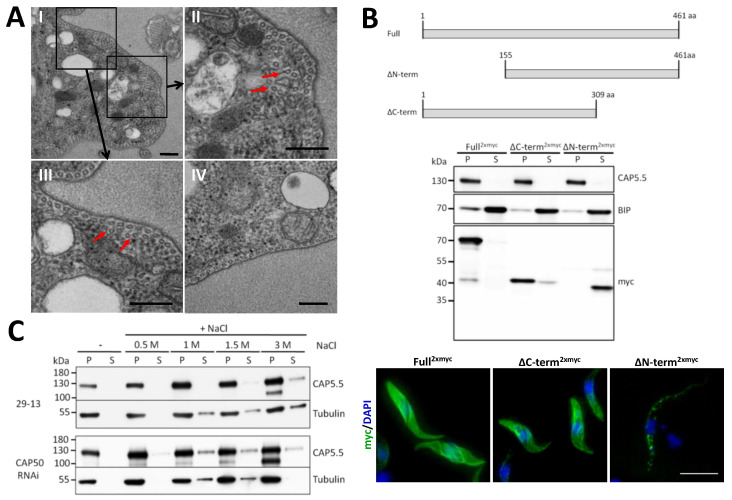
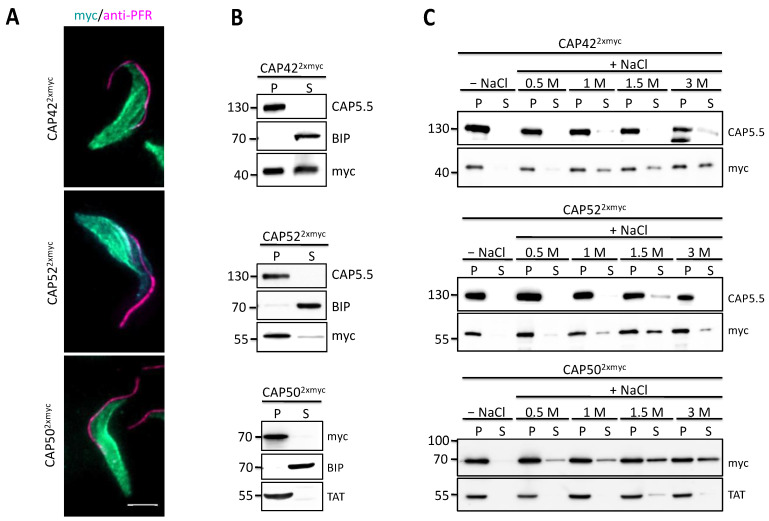
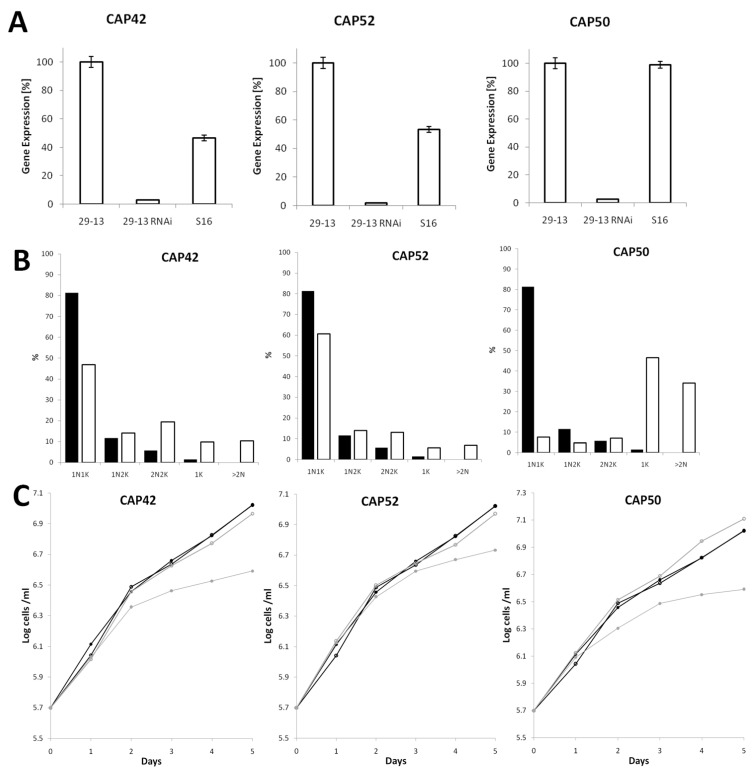
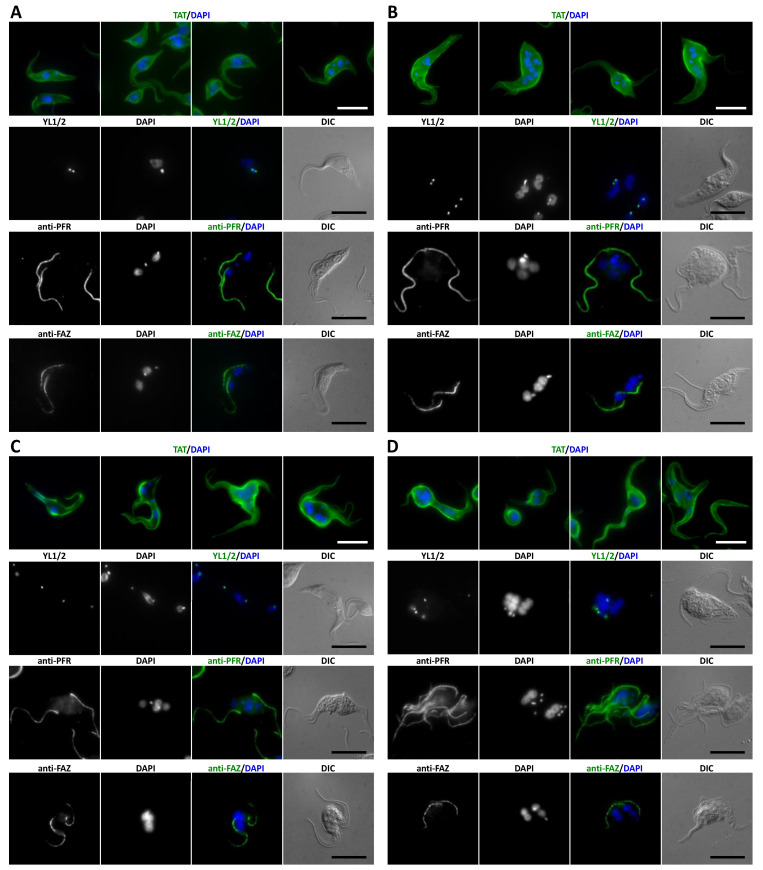
, the causative agent of African sleeping sickness, harbours a highly ordered, subpellicular microtubule cytoskeleton that defines many aspects of morphology, motility and virulence. This array of microtubules is associated with a large number of proteins involved in its regulation. Employing proximity-dependent biotinylation assay (BioID) using the well characterised cytoskeleton-associated protein CAP5.5 as a probe, we identified CAP50 (Tb927.11.2610). This protein colocalises with the subpellicular cytoskeleton microtubules but not with the flagellum. Depletion by RNAi results in defects in cytokinesis, morphology and partial disorganisation of microtubule arrays. Published proteomics data indicate a possible association of CAP50 with two other, yet uncharacterised, cytoskeletal proteins, CAP52 (Tb927.6.5070) and CAP42 (Tb927.4.1300), which were therefore included in our analysis. We show that their depletion causes phenotypes similar to those described for CAP50 and that they are essential for cellular integrity.
非洲昏睡病的病原体拥有高度有序的皮下微管细胞骨架,该骨架决定了形态、运动性和毒力的许多方面。这一微管阵列与大量参与其调节的蛋白质相关联。利用以特征明确的细胞骨架相关蛋白CAP5.5作为探针的邻近依赖性生物素化分析(BioID),我们鉴定出了CAP50(Tb927.11.2610)。该蛋白与皮下细胞骨架微管共定位,但不与鞭毛共定位。RNA干扰导致的基因敲除会引起胞质分裂缺陷、形态异常以及微管阵列的部分紊乱。已发表的蛋白质组学数据表明,CAP50可能与另外两种尚未明确的细胞骨架蛋白CAP52(Tb927.6.5070)和CAP42(Tb927.4.1300)相关联,因此我们将它们纳入了分析。我们发现,它们的缺失会导致与CAP50所描述的类似表型,并且它们对于细胞完整性至关重要。