Department of Nutrition and Health, College of Medicine and Health Sciences, United Arab Emirates University, Al Ain P.O. Box 15551, United Arab Emirates.
Department of Medical Microbiology and Immunology, College of Medicine and Health Sciences, United Arab Emirates University, Al Ain P.O. Box 15551, United Arab Emirates.
Nutrients. 2021 Oct 27;13(11):3818. doi: 10.3390/nu13113818.
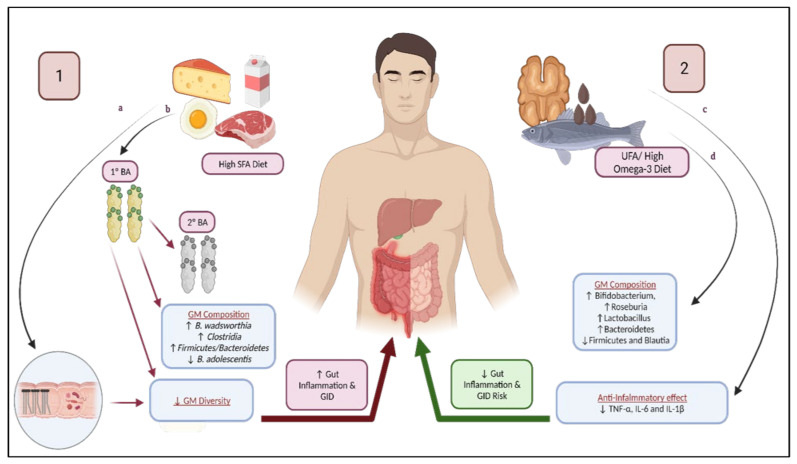
Children with autism spectrum disorder (ASD) report a higher frequency and severity of gastrointestinal disorders (GID) than typically developing (TD) children. GID-associated discomfort increases feelings of anxiety and frustration, contributing to the severity of ASD. Emerging evidence supports the biological intersection of neurodevelopment and microbiome, indicating the integral contribution of GM in the development and function of the nervous system, and mental health, and disease balance. Dysbiotic GM could be a contributing factor in the pathogenesis of GID in children with ASD. High-fat diets may modulate GM through accelerated growth of bile-tolerant bacteria, altered bacterial ratios, and reduced bacterial diversity, which may increase the risk of GID. Notably, saturated fatty acids are considered to have a pronounced effect on the increase of bile-tolerant bacteria and reduction in microbial diversity. Additionally, omega-3 exerts a favorable impact on GM and gut health due to its anti-inflammatory properties. Despite inconsistencies in the data elaborated in the review, the dietary fat composition, as part of an overall dietary intervention, plays a role in modulating GID, specifically in ASD, due to the altered microbiome profile. This review emphasizes the need to conduct future experimental studies investigating the effect of diets with varying fatty acid compositions on GID-specific microbiome profiles in children with ASD.
自闭症谱系障碍(ASD)儿童比典型发育(TD)儿童报告更高频率和更严重的胃肠道疾病(GID)。与 GID 相关的不适会增加焦虑和沮丧感,从而加重 ASD 的严重程度。新出现的证据支持神经发育和微生物组之间的生物学交叉,表明 GM 对神经系统的发育和功能以及心理健康和疾病平衡有重要贡献。肠道菌群失调可能是 ASD 儿童 GID 发病机制的一个促成因素。高脂肪饮食可能通过加速耐受胆汁的细菌生长、改变细菌比例和降低细菌多样性来调节 GM,从而增加 GID 的风险。值得注意的是,饱和脂肪酸被认为对耐受胆汁的细菌增加和微生物多样性减少有显著影响。此外,由于其抗炎特性,ω-3 对 GM 和肠道健康有有利影响。尽管综述中阐述的数据存在不一致,但饮食中的脂肪组成作为整体饮食干预的一部分,由于微生物组谱的改变,在调节 GID 方面发挥作用,特别是在 ASD 中。这篇综述强调需要进行未来的实验研究,调查不同脂肪酸组成的饮食对 ASD 儿童特定 GID 微生物组谱的影响。