Institute of Diabetes and Clinical Metabolic Research, University Hospital of Schleswig-Holstein, 24105 Kiel, Germany.
Division of Endocrinology, Diabetes and Clinical Nutrition, Department of Medicine 1, University Hospital of Schleswig-Holstein, 24105 Kiel, Germany.
Nutrients. 2021 Oct 29;13(11):3866. doi: 10.3390/nu13113866.
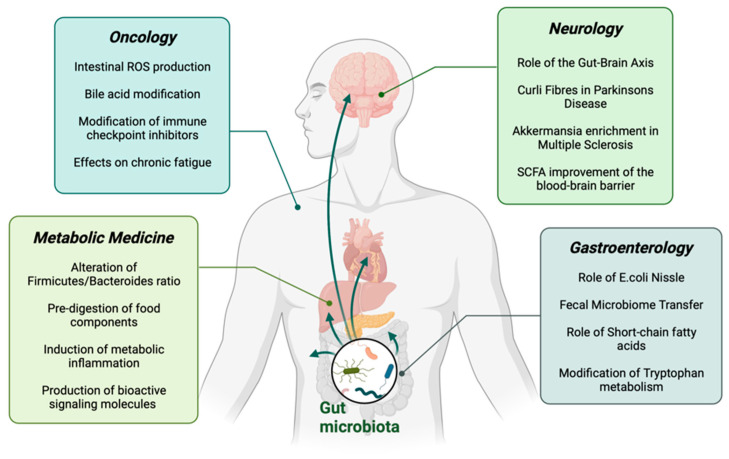
Within the last two decades tremendous efforts in biomedicine have been undertaken to understand the interplay of commensal bacteria living in and on our human body with our own human physiology. It became clear that (1) a high diversity especially of the microbial communities in the gut are important to preserve health and that (2) certain bacteria via nutrition-microbe-host metabolic axes are beneficially affecting various functions of the host, including metabolic control, energy balance and immune function. While a large set of evidence indicate a special role for small chain fatty acids (SCFA) in that context, recently also metabolites of amino acids (e.g., tryptophan and arginine) moved into scientific attention. Of interest, microbiome alterations are not only important in nutrition associated diseases like obesity and diabetes, but also in many chronic inflammatory, oncological and neurological abnormalities. From a clinician's point of view, it should be mentioned, that the microbiome is not only interesting to develop novel therapies, but also as a modifiable factor to improve efficiency of modern pharmaceutics, e.g., immune-therapeutics in oncology. However, so far, most data rely on animal experiments or human association studies, whereas controlled clinical intervention studies are spare. Hence, the translation of the knowledge of the last decades into clinical routine will be the challenge of microbiome based biomedical research for the next years. This review aims to provide examples for future clinical applications in various entities and to suggest bacterial species and/or microbial effector molecules as potential targets for intervention studies.
在过去的二十年中,人们在生物医学领域做出了巨大的努力,以了解生活在人体内部和表面的共生细菌与人体自身生理学之间的相互作用。研究表明:(1) 多样性高的微生物群落,尤其是肠道中的微生物群落,对维持健康非常重要;(2) 某些细菌通过营养-微生物-宿主代谢轴对宿主的各种功能产生有益影响,包括代谢控制、能量平衡和免疫功能。虽然大量证据表明小分子脂肪酸 (SCFA) 在这方面具有特殊作用,但最近氨基酸代谢物(如色氨酸和精氨酸)也引起了科学界的关注。值得注意的是,微生物组的改变不仅与肥胖症和糖尿病等与营养有关的疾病有关,而且与许多慢性炎症、肿瘤学和神经学异常有关。从临床医生的角度来看,应该指出的是,微生物组不仅对开发新疗法具有重要意义,而且作为一种可改变的因素,可以提高现代药物的效率,例如肿瘤学中的免疫疗法。然而,到目前为止,大多数数据依赖于动物实验或人类关联研究,而对照临床试验则很少。因此,将过去几十年的知识转化为临床常规将是未来几年基于微生物组的生物医学研究的挑战。这篇综述旨在为各种实体的未来临床应用提供范例,并提出细菌物种和/或微生物效应分子作为干预研究的潜在目标。