Clinical Epidemiology Research Unit, Children's Hospital of Mexico Federico Gomez-Faculty of Medicine, National Autonomous University of Mexico UNAM, Mexico City 06720, Mexico.
Nutrition and Health Research Center, Public Health National Institute, Cuernavaca 62000, Mexico.
Nutrients. 2021 Oct 29;13(11):3871. doi: 10.3390/nu13113871.
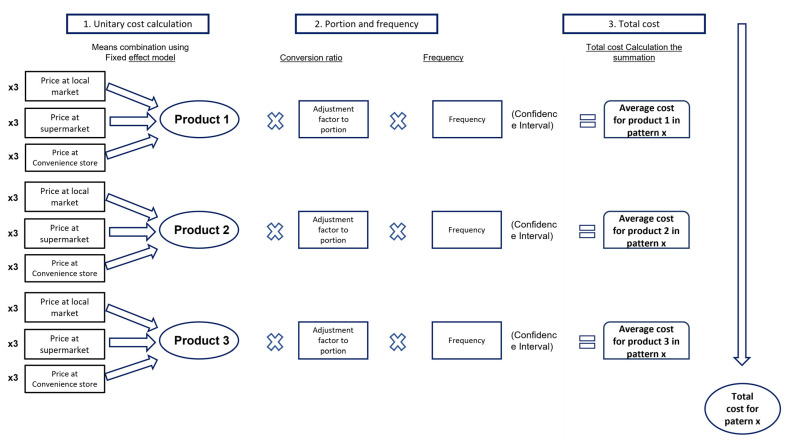
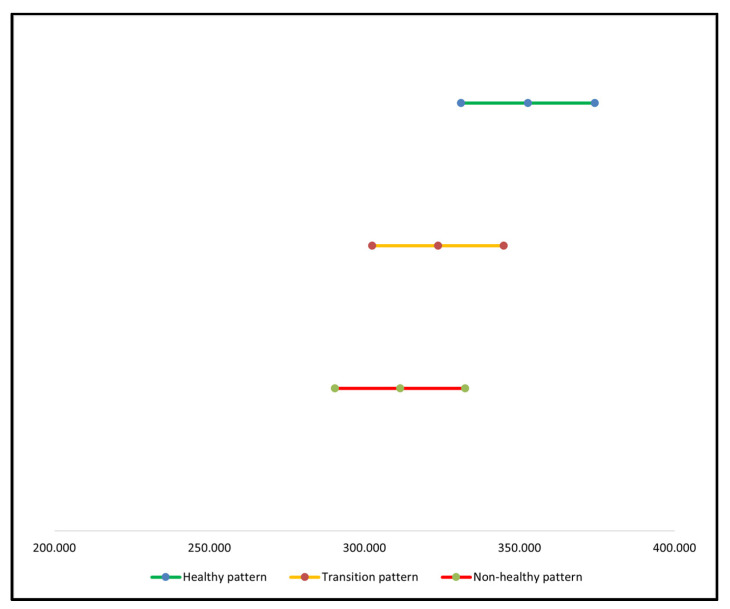
Unhealthy diets are recognized as a major risk factor for many diseases. The decrease in costs of industrialized products, as well as the possible misinformation about a healthy diet, has led to new behaviors in the dietary patterns of the pediatric population. The costs of dietary patterns have not been estimated in our population, so the objective of this study was to determine the cost associated with dietary patterns in Mexican children and adolescents, hypothesizing that a healthy diet is not necessarily more economically expensive. This study analyzed data from a population-based cross-sectional study of healthy children and adolescents in Mexico City. Data were collected from a food frequency questionnaire and the meal cost of habitual food shopping. Eating patterns were obtained by using principal component analysis. A micro-costing technique was performed to obtain the direct costs of each pattern. When comparing the healthy pattern with the transition and non-healthy patterns, it was observed that there were no statistically significant differences between the dietary patterns ( = 0.8293). The cost of the healthy pattern only takes up 16.6% of the total biweekly income of a salaried Mexican. In this study, no differences were observed between the costs of a healthy and a less healthy diet.
不健康的饮食被认为是许多疾病的一个主要风险因素。工业化产品成本的降低,以及关于健康饮食的可能错误信息,导致了儿科人群饮食模式的新行为。我们的人群中没有估计饮食模式的成本,因此本研究的目的是确定与墨西哥儿童和青少年饮食模式相关的成本,假设健康饮食不一定更昂贵。本研究分析了墨西哥城一项基于人群的健康儿童和青少年的横断面研究的数据。数据来自食物频率问卷和习惯性食物购物的膳食成本。通过主成分分析获得饮食模式。采用微观成本技术获得每种模式的直接成本。当比较健康模式与过渡模式和非健康模式时,观察到饮食模式之间没有统计学上的显著差异(=0.8293)。健康模式的成本仅占墨西哥受薪人员每两周总收入的 16.6%。在这项研究中,健康饮食和不太健康饮食的成本之间没有观察到差异。