Department of Nutrition, Harvard T.H. Chan School of Public Health, 665 Huntington Avenue, Boston, MA 02115, USA.
The Herbert Wertheim School of Public Health and Human Longevity Science, University of California San Diego, 9500 Gilman Drive, La Jolla, CA 92093, USA.
Nutrients. 2021 Nov 11;13(11):4021. doi: 10.3390/nu13114021.
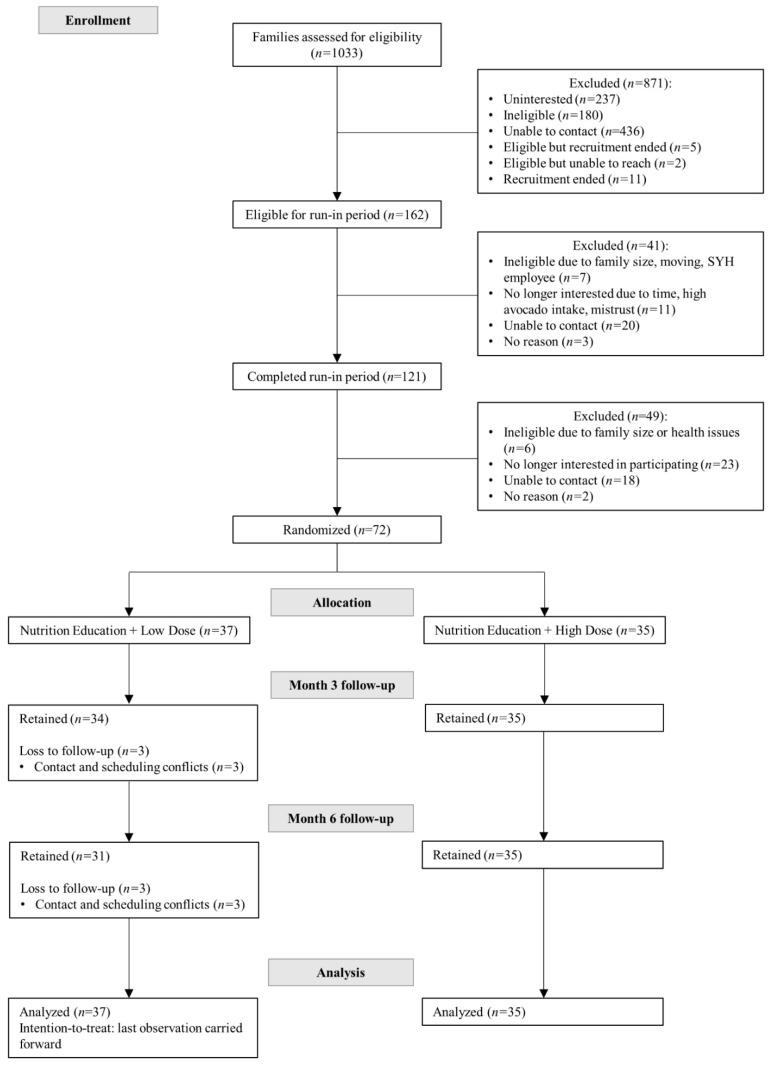
Avocados are a nutrient-dense plant-food, but limited trial-derived evidence exists about the effects of avocado intake on family nutritional status. We investigated the impact of two levels of avocado allotment, plus a standard nutrition education intervention on the nutritional status of Hispanic/Latino families. Seventy-two families consisting of at least three members of ≥5 years of age and residing in the same home, free of severe chronic disease, not on specific diets, and self-identified of Hispanic heritage, were randomized to one of two levels of avocado allotment (low = 3/week/family or high = 14/week/family) for 6 months plus 12 bi-weekly nutrition education sessions. The primary outcomes included change in a family's total energy and macro- and micronutrient intakes. Primary analysis was intention-to-treat with unpaired, two-sided -tests to assess mean changes between groups at 6 months. At 6 months, the high avocado allotment group had a significant reduction in energy intake, carbohydrate, animal and vegetable protein, saturated and polyunsaturated fat, calcium, magnesium, sodium, potassium, iron, and vitamin D intakes (all < 0.05). A high allotment of avocados significantly reduced self-reported energy intake by 29% kcal/family/day, compared to a 3% kcal/family/day reduction in families who received a low allotment. Culturally-appropriate plant-food interventions may alter the nutritional status of at-risk families.
鳄梨是一种营养密集型植物性食物,但关于鳄梨摄入量对家庭营养状况影响的试验证据有限。我们研究了两种鳄梨配给水平,加上标准营养教育干预对西班牙裔/拉丁裔家庭营养状况的影响。72 个家庭由至少 3 名≥5 岁的成员组成,居住在同一家庭,没有严重的慢性疾病,不遵循特定的饮食,自我认同为西班牙裔,随机分配到两种鳄梨配给水平(低=每周 3 份/家庭或高=每周 14 份/家庭),持续 6 个月,加上 12 次双周营养教育课程。主要结果包括家庭总能量和宏量营养素及微量营养素摄入量的变化。主要分析是意向治疗,采用非配对、双侧 t 检验评估 6 个月时两组之间的平均变化。在 6 个月时,高鳄梨配给组的能量摄入、碳水化合物、动物和植物蛋白、饱和脂肪和多不饱和脂肪、钙、镁、钠、钾、铁和维生素 D 摄入量显著减少(均<0.05)。与接受低配给的家庭相比,高配给的鳄梨显著减少了 29%的家庭每天摄入的能量,即 3%的卡路里。文化上适当的植物性食物干预可能会改变高风险家庭的营养状况。