Department of Neurology, Chang Gung Memorial Hospital Chiayi Branch, Puzi, Taiwan.
College of Medicine, Chang Gung University, Taoyuan, Taiwan.
BMJ Open. 2021 Nov 26;11(11):e054381. doi: 10.1136/bmjopen-2021-054381.
Branch atheromatous disease (BAD) contributes to small-vessel occlusion in cases of occlusion or stenosis of large calibre penetrating arteries, and it is associated with a higher possibility of early neurological deterioration (END) and recurrent stroke in acute ischaemic stroke. As the pathology of BAD is due to atherosclerosis, we postulate that early intensive medical treatment with dual antiplatelet therapy (DAPT) and high-intensity statins may prevent END and recurrent stroke in acute small subcortical infarction caused by BAD.
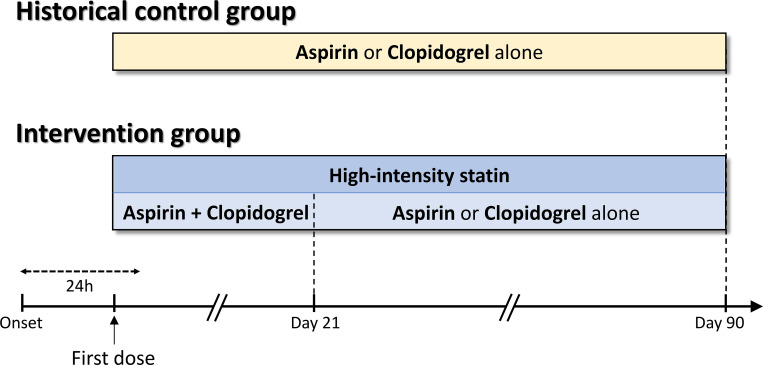
In this prospective, single-centre, open-label, non-randomised, single-arm study using a historical control, we will compare early DAPT and high-intensity statin treatment with a historical control group of patients with BAD who were treated with single antiplatelet therapy without high-intensity statin treatment. Patients will be eligible for enrolment if they are admitted for acute ischaemic stroke within 24 hours, have a National Institutes of Health Stroke Scale (NIHSS) score of 1-8 and are diagnosed with BAD by MRI. Patients will take aspirin, clopidogrel and high-intensity statins (atorvastatin or rosuvastatin) within 24 hours of stroke onset, followed by aspirin or clopidogrel alone from day 22. The primary endpoint is the percentage of patients who develop END within 7 days of stroke onset (defined as an increase in the NIHSS score ≥2 points) and recurrent stroke within 30 days. The total sample sizes will be 138 for the intervention group and 277 for the control group. A historical control group will be drawn from previous prospective observation studies.
The protocol of this study has been approved by the Institutional Review Board of Chang Gung Memorial Hospital (202001386A3). All participants will have to sign and date an informed consent form. The findings arising from this study will be disseminated in peer-reviewed journals and academic conferences.
NCT04824911.
分支粥样硬化病变(BAD)可导致大口径穿透动脉闭塞或狭窄时的小血管闭塞,并且与急性缺血性脑卒中的早期神经恶化(END)和复发性卒中的发生可能性更高相关。由于 BAD 的病理学是由于动脉粥样硬化所致,我们推测,早期强化的双联抗血小板治疗(DAPT)和高强度他汀类药物治疗可能预防由 BAD 引起的急性小皮质下梗死所致的 END 和复发性卒中。
这是一项前瞻性、单中心、开放标签、非随机、单臂研究,采用历史对照,我们将比较早期 DAPT 和高强度他汀类药物治疗与未经高强度他汀类药物治疗的 BAD 患者的历史对照组。如果患者在发病后 24 小时内因急性缺血性脑卒中入院、美国国立卫生研究院卒中量表(NIHSS)评分为 1-8 分且 MRI 诊断为 BAD,则符合入组条件。患者将在卒中发病后 24 小时内服用阿司匹林、氯吡格雷和高强度他汀类药物(阿托伐他汀或瑞舒伐他汀),然后从第 22 天起单独服用阿司匹林或氯吡格雷。主要终点是卒中发病后 7 天内发生 END(定义为 NIHSS 评分增加≥2 分)和 30 天内发生复发性卒中的患者比例。干预组的总样本量为 138 例,对照组为 277 例。历史对照组将从以前的前瞻性观察研究中抽取。
该研究的方案已获得长庚纪念医院机构审查委员会的批准(202001386A3)。所有参与者都必须签署并注明日期同意书。该研究的结果将在同行评议期刊和学术会议上发表。
NCT04824911。