EuroMov Digital Health in Motion, Univ Montpellier, IMT Mines Alès, Montpellier, France.
EuroMov Digital Health in Motion, Univ Montpellier, IMT Mines Alès, CHU Nîmes, Le Grau du Roi, France.
Sci Rep. 2021 Nov 26;11(1):23008. doi: 10.1038/s41598-021-02338-4.
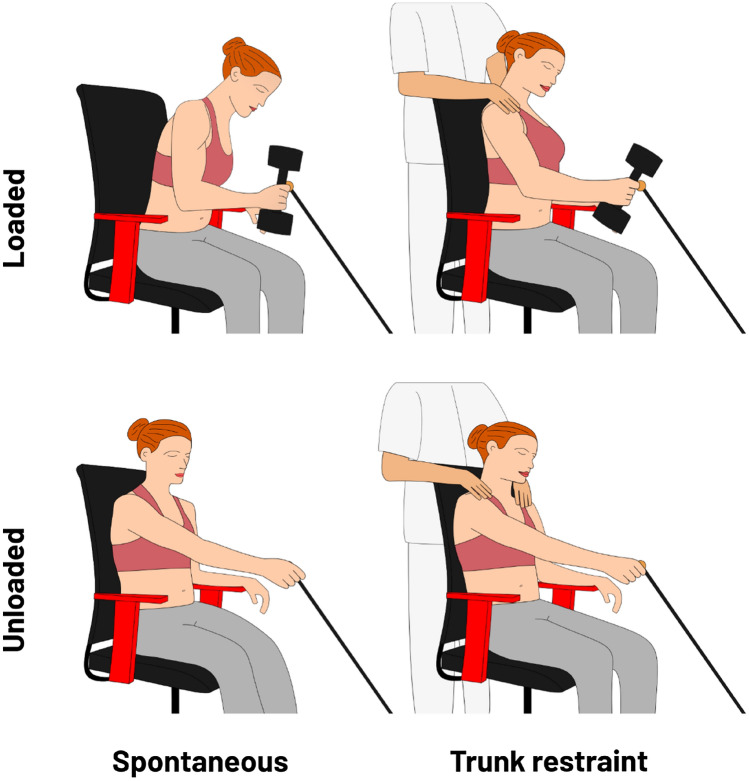
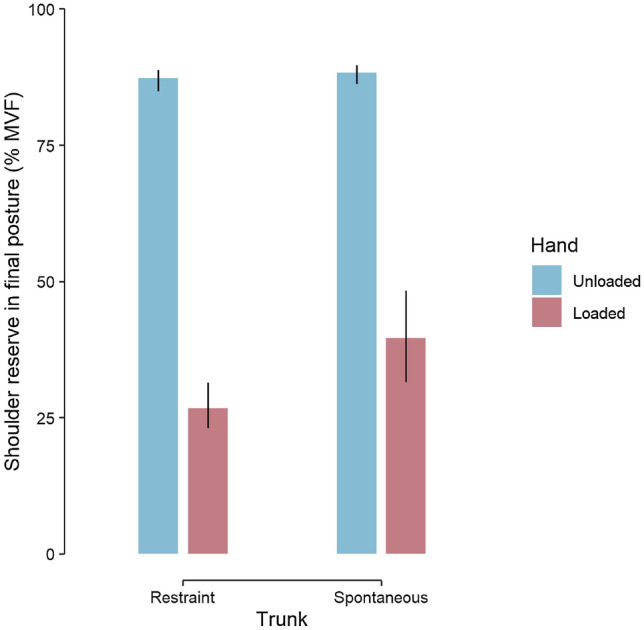
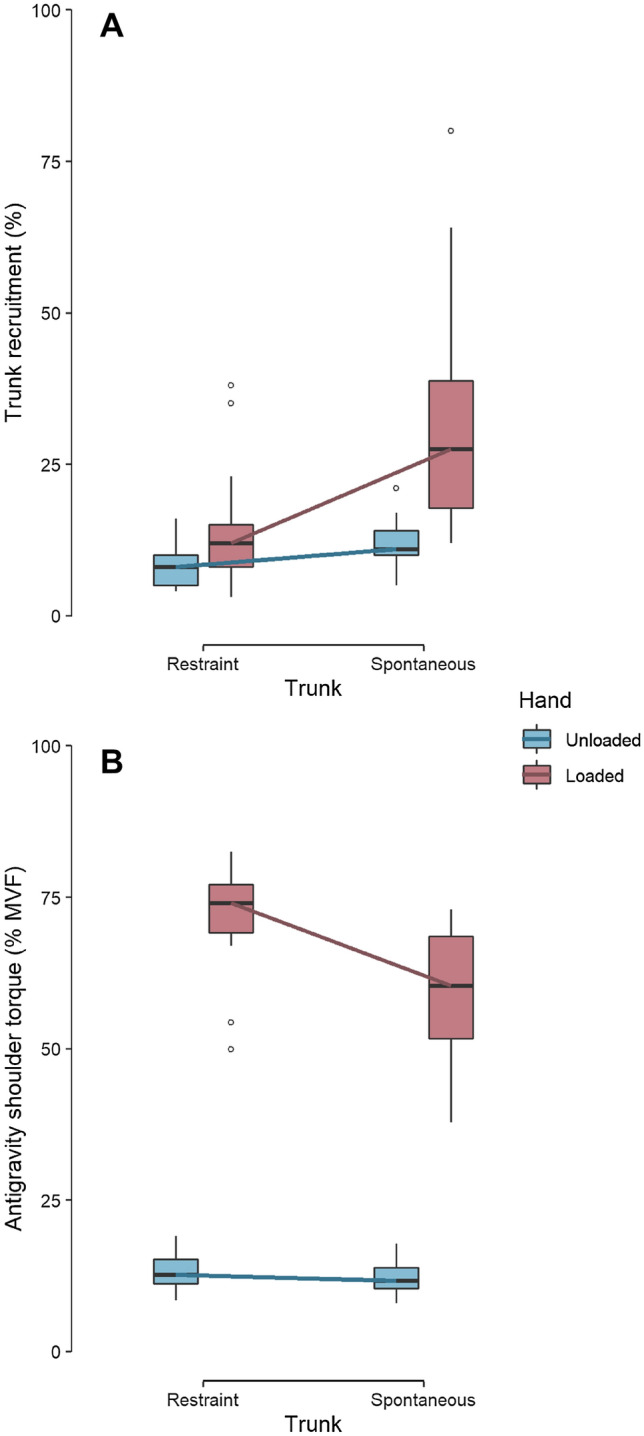
Humans coordinate biomechanical degrees of freedom to perform tasks at minimum cost. When reaching a target from a seated position, the trunk-arm-forearm coordination moves the hand to the well-defined spatial goal, while typically minimising hand jerk and trunk motion. However, due to fatigue or stroke, people visibly move the trunk more, and it is unclear what cost can account for this. Here we show that people recruit their trunk when the torque at the shoulder is too close to the maximum. We asked 26 healthy participants to reach a target while seated and we found that the trunk contribution to hand displacement increases from 11 to 27% when an additional load is handled. By flexing and rotating the trunk, participants spontaneously increase the reserve of anti-gravitational torque at the shoulder from 25 to 40% of maximal voluntary torque. Our findings provide hints on how to include the reserve of torque in the cost function of optimal control models of human coordination in healthy fatigued persons or in stroke victims.
人类通过协调生物力学自由度来以最小成本完成任务。当从坐姿到达目标位置时,躯干-手臂-前臂的协调运动将手移动到明确的空间目标,同时通常使手的急动和躯干的运动最小化。然而,由于疲劳或中风,人们明显会更多地移动躯干,目前尚不清楚这会带来什么成本。在这里,我们表明,当肩部的扭矩太接近最大值时,人们会使用躯干。我们要求 26 名健康参与者在坐姿时到达目标,我们发现当处理额外的负载时,躯干对手位移的贡献从 11%增加到 27%。通过弯曲和旋转躯干,参与者自发地将肩部的抗重力扭矩储备增加到最大自愿扭矩的 25%到 40%。我们的发现为如何在健康疲劳或中风患者的人体协调最优控制模型的成本函数中纳入扭矩储备提供了线索。