CIAMS, Univ. Paris-Sud, Université Paris-Saclay, F-91405, Orsay, France.
CIAMS, Université d'Orléans, 45067, Orléans, France.
Sci Rep. 2018 Jul 13;8(1):10655. doi: 10.1038/s41598-018-28979-6.
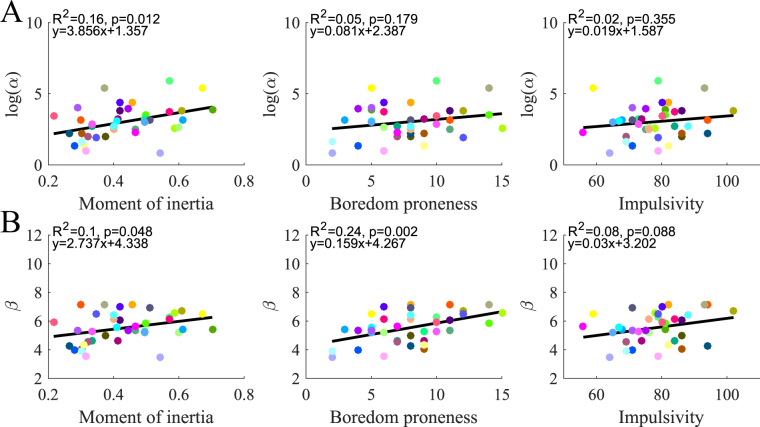
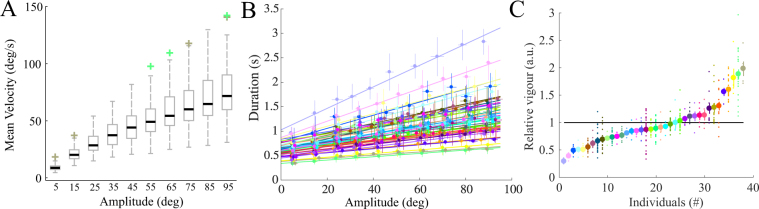
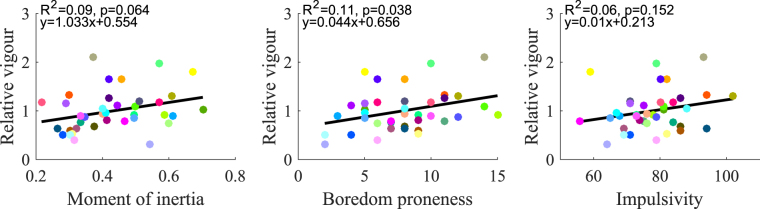
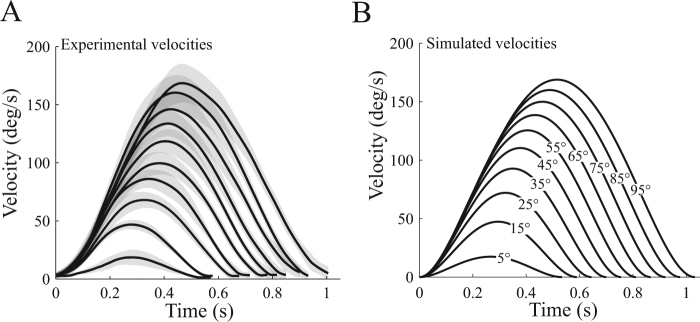
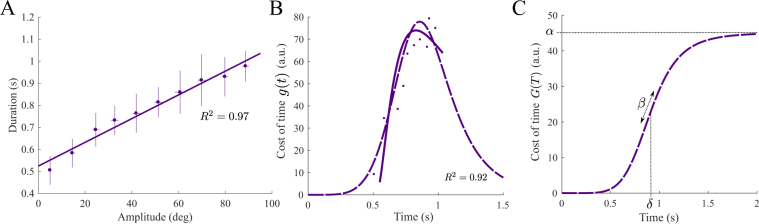
People usually move at a self-selected pace in everyday life. Yet, the principles underlying the formation of human movement vigour remain unclear, particularly in view of intriguing inter-individual variability. It has been hypothesized that how the brain values time may be the cornerstone of such differences, beyond biomechanics. Here, we focused on the vigour of self-paced reaching movement and assessed the stability of vigour via repeated measurements within participants. We used an optimal control methodology to identify a cost of time (CoT) function underlying each participant's vigour, considering a model of the biomechanical cost of movement. We then tested the extent to which anthropometric or psychological traits, namely boredom proneness and impulsivity, could account for a significant part of inter-individual variance in vigour and CoT parameters. Our findings show that the vigour of reaching is largely idiosyncratic and tend to corroborate a relation between the relative steepness of the identified CoT and boredom proneness, a psychological trait relevant to one's relationship with time in decision-making.
人们在日常生活中通常会按照自己选择的节奏移动。然而,对于人类运动活力形成的基本原理仍不清楚,特别是考虑到有趣的个体间可变性。有人假设,大脑对时间的重视程度可能是这种差异的基础,而不仅仅是生物力学。在这里,我们专注于自我节奏的伸手运动的活力,并通过参与者内部的重复测量来评估活力的稳定性。我们使用最优控制方法,为每个参与者的活力确定一个时间成本(CoT)函数,同时考虑运动的生物力学成本模型。然后,我们测试了体型或心理特征(即无聊倾向和冲动性)在多大程度上可以解释活力和 CoT 参数的个体间差异的重要部分。我们的发现表明,伸手的活力在很大程度上是因人而异的,并且倾向于证实所确定的 CoT 的相对陡峭程度与无聊倾向之间的关系,无聊倾向是与决策中与时间有关的一个心理特征。