Tampere University, FI-33014, Tampere, Finland.
UCL Great Ormond Street Institute of Child Health, 30 Guilford Street, London, WC1N 1EH, UK.
BMC Med Res Methodol. 2021 Nov 27;21(1):268. doi: 10.1186/s12874-021-01463-y.
There is an unmet need for review methods to support priority-setting, policy-making and strategic planning when a wide variety of interventions from differing disciplines may have the potential to impact a health outcome of interest. This article describes a Modular Literature Review, a novel systematic search and review method that employs systematic search strategies together with a hierarchy-based appraisal and synthesis of the resulting evidence.
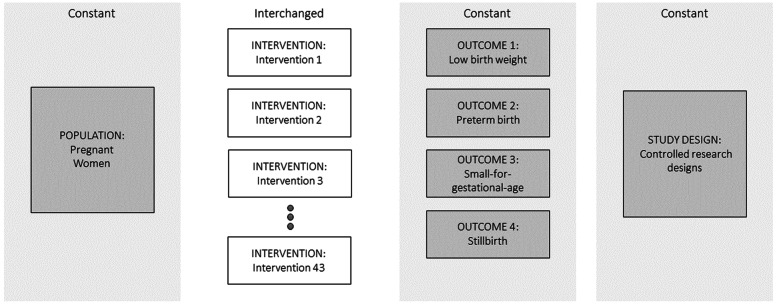
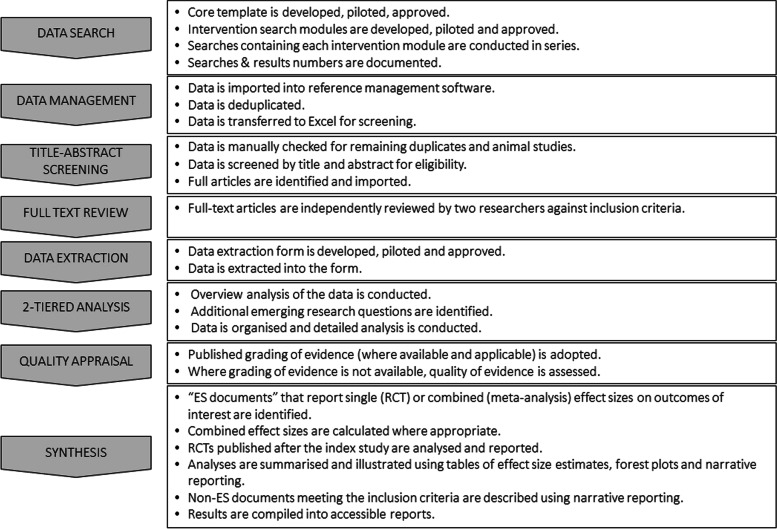
We designed the Modular Review to examine the effects of 43 interventions on a health problem of global significance. Using the PICOS (Population, Intervention, Comparison, Outcome, Study design) framework, we developed a single four-module search template in which population, comparison and outcome modules were the same for each search and the intervention module was different for each of the 43 interventions. A series of literature searches were performed in five databases, followed by screening, extraction and analysis of data. "ES documents", source documents for effect size (ES) estimates, were systematically identified based on a hierarchy of evidence. The evidence was categorised according to the likely effect on the outcome and presented in a standardised format with quantitative effect estimates, meta-analyses and narrative reporting. We compared the Modular Review to other review methods in health research for its strengths and limitations.
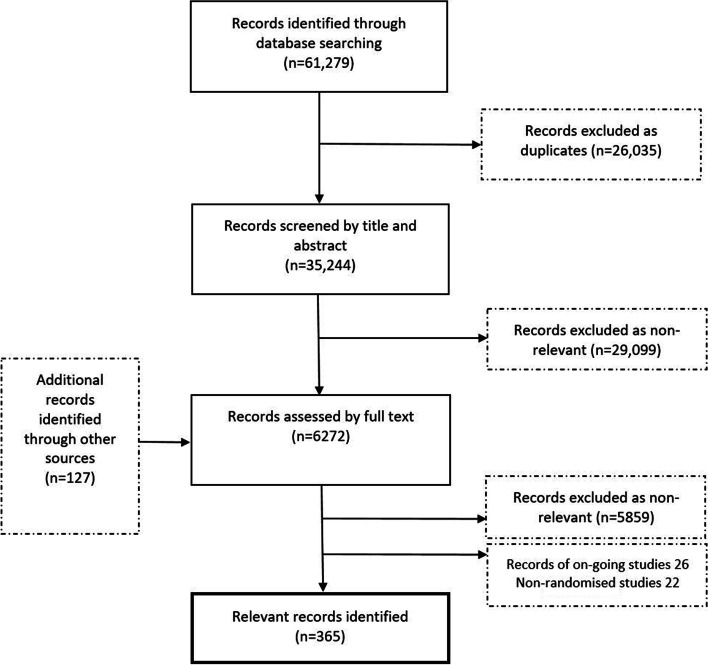
The Modular Review method was used to review the impact of 46 antenatal interventions on four specified birth outcomes within 12 months. A total of 61,279 records were found; 35,244 were screened by title-abstract. Six thousand two hundred seventy-two full articles were reviewed against the inclusion criteria resulting in 365 eligible articles.
The Modular Review preserves principles that have traditionally been important to systematic reviews but can address multiple research questions simultaneously. The result is an accessible, reliable answer to the question of "what works?". Thus, it is a well-suited literature review method to support prioritisation, decisions and planning to implement an agenda for health improvement.
当来自不同学科的各种干预措施有可能对感兴趣的健康结果产生影响时,需要有一种审查方法来支持优先排序、决策和战略规划,但目前这种方法尚未得到满足。本文描述了一种模块化文献综述,这是一种新颖的系统搜索和综述方法,它采用系统搜索策略,并对由此产生的证据进行基于层次的评估和综合。
我们设计了模块化综述来检查 43 种干预措施对具有全球意义的健康问题的影响。使用 PICOS(人群、干预、比较、结局、研究设计)框架,我们开发了一个单一的四模块搜索模板,其中每个搜索的人群、比较和结局模块都是相同的,而干预模块则针对 43 种干预措施中的每一种都是不同的。在五个数据库中进行了一系列文献检索,然后进行了筛选、提取和数据分析。“ES 文档”是根据证据层次系统确定的效应大小(ES)估计的源文档。根据对结局的可能影响对证据进行分类,并以标准格式呈现,包括定量效应估计、荟萃分析和叙述性报告。我们将模块化综述与健康研究中的其他综述方法进行了比较,以评估其优缺点。
该模块化综述方法用于评估 46 种产前干预措施对 12 个月内四个指定出生结局的影响。共发现 61279 条记录;通过标题-摘要筛选出 35244 条。有 6272 篇全文文章符合纳入标准,最终有 365 篇符合条件的文章进行了审查。
模块化综述保留了传统上对系统综述很重要的原则,但可以同时解决多个研究问题。其结果是对“什么有效?”这一问题提供了一个易于理解、可靠的答案。因此,它是一种适合支持优先排序、决策和规划以实施健康改善议程的文献综述方法。