Mohammadi Mohammad M, Bavi Omid
Department of Mechanical and Aerospace Engineering, Shiraz University of Technology, Shiraz, 71557-13876 Iran.
Biophys Rev. 2021 Nov 23;14(1):99-110. doi: 10.1007/s12551-021-00857-y. eCollection 2022 Feb.
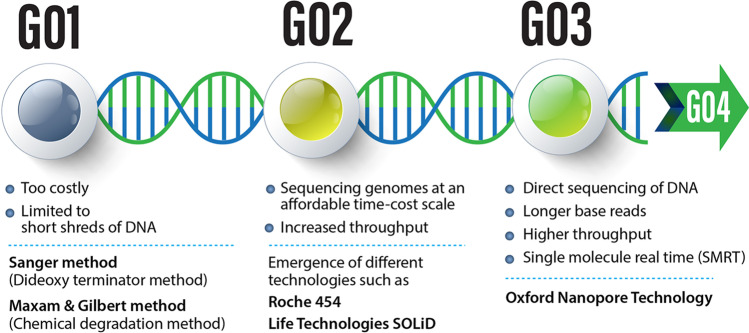
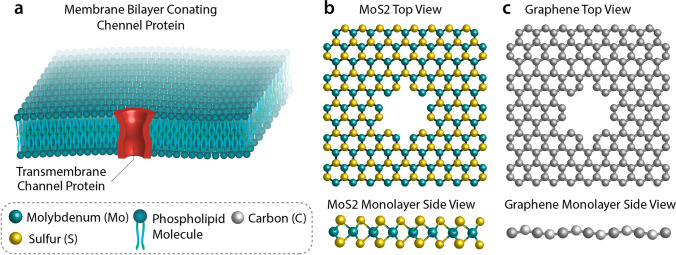
The field of sequencing is a topic of significant interest since its emergence and has become increasingly important over time. Impressive achievements have been obtained in this field, especially in relations to DNA and RNA sequencing. Since the first achievements by Sanger and colleagues in the 1950s, many sequencing techniques have been developed, while others have disappeared. DNA sequencing has undergone three generations of major evolution. Each generation has its own specifications that are mentioned briefly. Among these generations, nanopore sequencing has its own exciting characteristics that have been given more attention here. Among pioneer technologies being used by the third-generation techniques, nanopores, either biological or solid-state, have been experimentally or theoretically extensively studied. All sequencing technologies have their own advantages and disadvantages, so nanopores are not free from this general rule. It is also generally pointed out what research has been done to overcome the obstacles. In this review, biological and solid-state nanopores are elaborated on, and applications of them are also discussed briefly.
自测序领域出现以来,它一直是一个备受关注的话题,并且随着时间的推移变得越来越重要。该领域已经取得了令人瞩目的成就,尤其是在DNA和RNA测序方面。自20世纪50年代桑格及其同事取得首批成果以来,已经开发了许多测序技术,而其他一些技术则已消失。DNA测序经历了三代重大演变。每一代都有其简要提及的自身特点。在这些代次中,纳米孔测序有其令人兴奋的特性,在此受到了更多关注。在第三代技术所使用的先驱技术中,无论是生物纳米孔还是固态纳米孔,都已在实验或理论上得到了广泛研究。所有测序技术都有其自身的优缺点,因此纳米孔也不例外。文中还普遍指出了为克服这些障碍所做的研究。在本综述中,将详细阐述生物纳米孔和固态纳米孔,并简要讨论它们的应用。