Center of Functional Protein Assemblies, Technische Universität München, Garching, Germany.
PLoS Comput Biol. 2021 Nov 29;17(11):e1009625. doi: 10.1371/journal.pcbi.1009625. eCollection 2021 Nov.
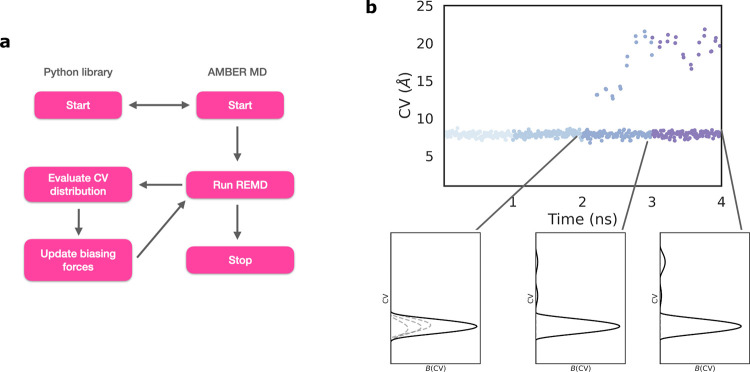
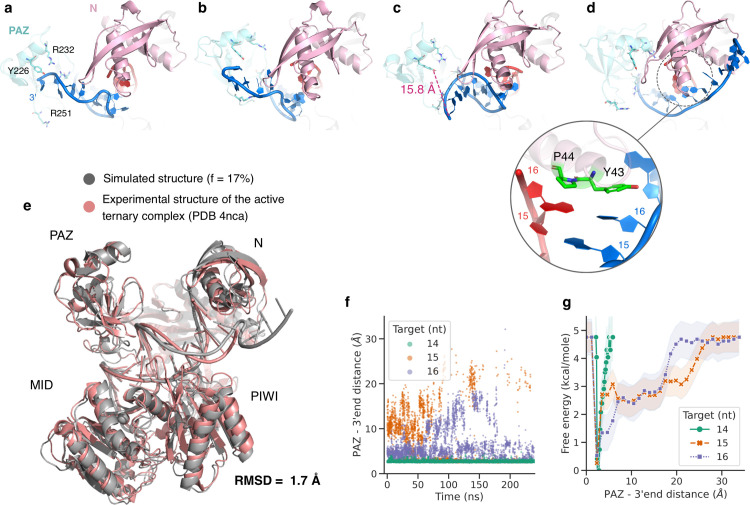
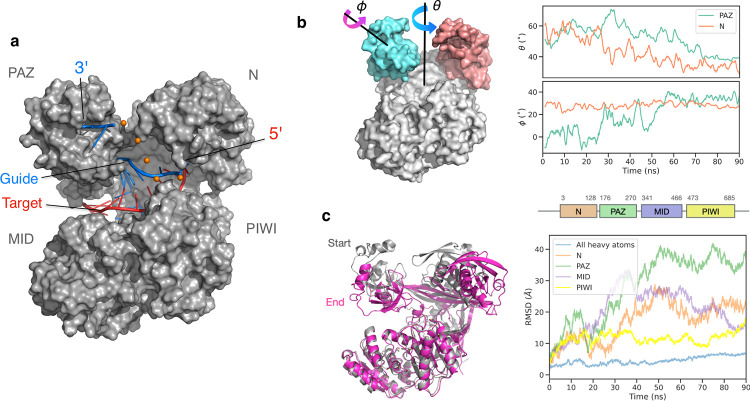
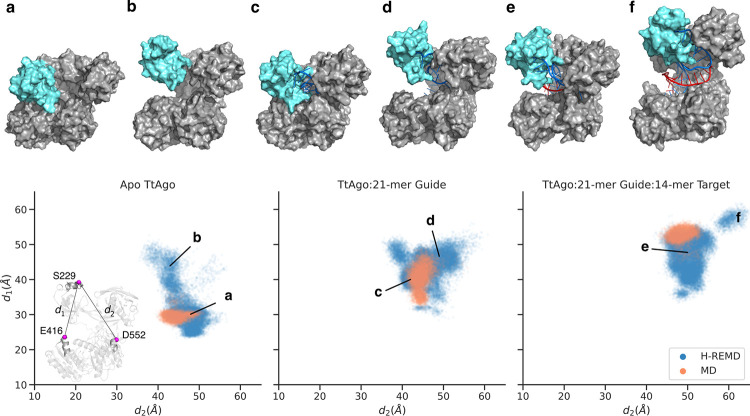
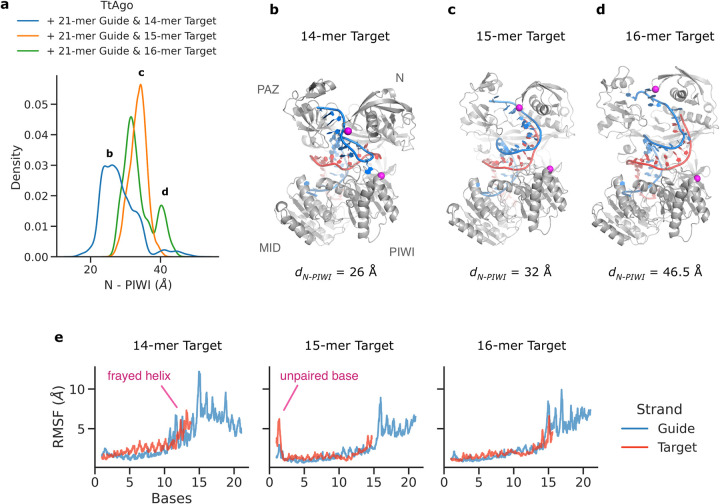
Argonaute proteins in combination with short microRNA (miRNAs) can target mRNA molecules for translation inhibition or degradation and play a key role in many regulatory processes. The miRNAs act as guide RNAs that associate with Argonaute and the complementary mRNA target region. The complex formation results in activation of Argonaute and specific cleavage of the target mRNA. Both the binding and activation processes involve essential domain rearrangements of functional importance. For the Thermus Thermophilus Argonaute (TtAgo) system guide-bound (binary) and guide/target-bound (ternary) complexes are known but how the binding of guide and target mediate domain movements is still not understood. We have studied the Argonaute domain motion in apo and guide/target bound states using Molecular Dynamics simulations and a Hamiltonian replica exchange (H-REMD) method that employs a specific biasing potential to accelerate domain motions. The H-REMD technique indicates sampling of a much broader distribution of domain arrangements both in the apo as well as binary and ternary complexes compared to regular MD simulations. In the apo state domain arrangements corresponding to more compact (closed) states are mainly sampled which undergo an opening upon guide and guide/target binding. Whereas only limited overlap in domain geometry between apo and bound states was found, a larger similarity in the domain distribution is observed for the simulations of binary and ternary complexes. Comparative simulations on ternary complexes with 15 or 16 base pairs (bp) formed between guide and target strands (instead of 14) resulted in dissociation of the 3'-guide strand from the PAZ domain and domain rearrangement. This agrees with the experimental observation that guide-target pairing beyond 14 bps is required for activation and gives a mechanistic explanation for the experimentally observed activation process.
Argonaute 蛋白与短 microRNA(miRNA)结合可以靶向 mRNA 分子进行翻译抑制或降解,在许多调节过程中发挥关键作用。miRNA 作为指导 RNA,与 Argonaute 和互补的 mRNA 靶区结合。复合物的形成导致 Argonaute 的激活和靶 mRNA 的特异性切割。结合和激活过程都涉及到功能重要的必需结构域重排。对于嗜热栖热菌 Argonaute(TtAgo)系统,已知结合指导物的(二元)和结合指导物/靶标的(三元)复合物,但指导物和靶标的结合如何介导结构域运动仍不清楚。我们使用分子动力学模拟和哈密顿复制交换(H-REMD)方法研究了apo 和指导物/靶标结合状态下 Argonaute 结构域的运动,该方法使用特定的偏置势来加速结构域运动。H-REMD 技术表明,与常规 MD 模拟相比,apo 状态以及二元和三元复合物中结构域排列的采样分布更广泛。在 apo 状态下,主要采样与更紧凑(关闭)状态相对应的结构域排列,这些排列在结合指导物和指导物/靶标时会打开。尽管在 apo 和结合状态之间发现结构域几何形状的重叠有限,但二元和三元复合物的模拟中观察到结构域分布的更大相似性。对形成于指导物和靶物链之间的 15 或 16 个碱基对(bp)(而不是 14 个)的三元复合物的比较模拟导致 3'-指导物链从 PAZ 结构域解离和结构域重排。这与实验观察一致,即超过 14 bp 的指导物-靶物配对对于激活是必需的,并为实验观察到的激活过程提供了机制解释。