Faculty of Education, School of Health Sciences, Health and Human Sciences, University of Greenwich, Avery Hill Campus, Avery Hill Road, London SE9 2UG, UK.
Smoking Cessation Department, University Hospital, South London and Maudsley NHS Foundation Trust, Lewisham High Street, London SE13 6LH, UK.
Nutrients. 2022 Mar 7;14(5):1120. doi: 10.3390/nu14051120.
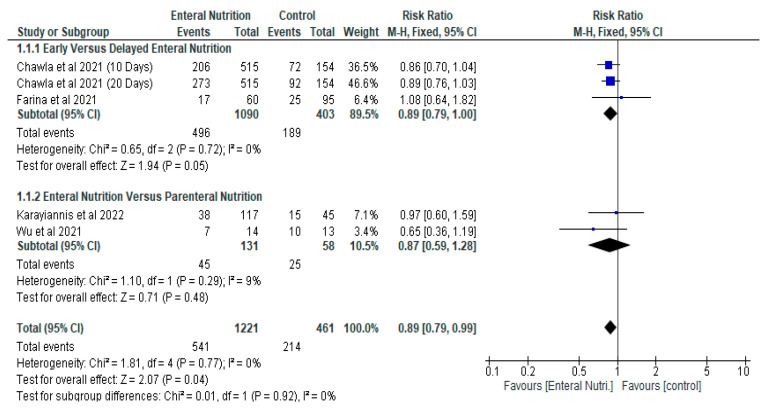
Background: Patients who are critically ill with COVID-19 could have impaired nutrient absorption due to disruption of the normal intestinal mucosa. They are often in a state of high inflammation, increased stress and catabolism as well as a significant increase in energy and protein requirements. Therefore, timely enteral nutrition support and the provision of optimal nutrients are essential in preventing malnutrition in these patients. Aim: This review aims to evaluate the effects of enteral nutrition in critically ill patients with COVID-19. Method: This systematic review and meta-analysis was conducted based on the preferred reporting items for systematic review and meta-Analysis framework and PICO. Searches were conducted in databases, including EMBASE, Health Research databases and Google Scholar. Searches were conducted from database inception until 3 February 2022. The reference lists of articles were also searched for relevant articles. Results: Seven articles were included in the systematic review, and four articles were included in the meta-analysis. Two distinct areas were identified from the results of the systematic review and meta-analysis: the impact of enteral nutrition and gastrointestinal intolerance associated with enteral nutrition. The impact of enteral nutrition was further sub-divided into early enteral nutrition versus delayed enteral nutrition and enteral nutrition versus parenteral nutrition. The results of the meta-analysis of the effects of enteral nutrition in critically ill patients with COVID-19 showed that, overall, enteral nutrition was effective in significantly reducing the risk of mortality in these patients compared with the control with a risk ratio of 0.89 (95% CI, 0.79, 0.99, p = 0.04). Following sub-group analysis, the early enteral nutrition group also showed a significant reduction in the risk of mortality with a risk ratio of 0.89 (95% CI, 0.79, 1.00, p = 0.05). The Relative Risk Reduction (RRR) of mortality in patients with COVID-19 by early enteral nutrition was 11%. There was a significant reduction in the Sequential Organ Failure Assessment (SOFA) score in the early enteral nutrition group compared with the delayed enteral nutrition group. There was no significant difference between enteral nutrition and parenteral nutrition in relation to mortality (RR = 0.87; 95% CI, 0.59, 1.28, p = 0.48). Concerning the length of hospital stay, length of ICU stay and days on mechanical ventilation, while there were reductions in the number of days in the enteral nutrition group compared to the control (delayed enteral nutrition or parenteral nutrition), the differences were not significant (p > 0.05). Conclusion: The results showed that early enteral nutrition significantly (p < 0.05) reduced the risk of mortality among critically ill patients with COVID-19. However, early enteral nutrition or enteral nutrition did not significantly (p > 0.05) reduce the length of hospital stay, length of ICU stay and days on mechanical ventilation compared to delayed enteral nutrition or parenteral nutrition. More studies are needed to examine the effect of early enteral nutrition in patients with COVID-19.
患有 COVID-19 的危重病患者可能由于正常肠道黏膜的破坏而导致营养吸收受损。他们通常处于高度炎症、应激和分解代谢状态,以及能量和蛋白质需求显著增加的状态。因此,及时进行肠内营养支持和提供最佳营养素对于预防这些患者的营养不良至关重要。目的:本综述旨在评估肠内营养对 COVID-19 危重病患者的影响。方法:本系统评价和荟萃分析是基于系统评价和荟萃分析的首选报告项目和 PICO 进行的。在 EMBASE、健康研究数据库和 Google Scholar 等数据库中进行了检索。检索从数据库成立到 2022 年 2 月 3 日。还查阅了文章的参考文献列表以寻找相关文章。结果:系统评价纳入了 7 篇文章,荟萃分析纳入了 4 篇文章。从系统评价和荟萃分析的结果中确定了两个不同的领域:肠内营养的影响和与肠内营养相关的胃肠道不耐受。肠内营养的影响进一步细分为早期肠内营养与延迟肠内营养以及肠内营养与肠外营养。荟萃分析 COVID-19 危重病患者肠内营养效果的结果表明,总体而言,与对照组相比,肠内营养显著降低了这些患者的死亡率,风险比为 0.89(95%CI,0.79,0.99,p = 0.04)。进行亚组分析后,早期肠内营养组的死亡率也显著降低,风险比为 0.89(95%CI,0.79,1.00,p = 0.05)。通过早期肠内营养,COVID-19 患者的死亡率相对风险降低(RRR)为 11%。早期肠内营养组的序贯器官衰竭评估(SOFA)评分较延迟肠内营养组显著降低。肠内营养与肠外营养相比,死亡率无显著差异(RR = 0.87;95%CI,0.59,1.28,p = 0.48)。关于住院时间、ICU 住院时间和机械通气天数,虽然肠内营养组与对照组(延迟肠内营养或肠外营养)相比,天数减少,但差异无统计学意义(p > 0.05)。结论:结果表明,早期肠内营养显著(p < 0.05)降低了 COVID-19 危重病患者的死亡率。然而,与延迟肠内营养或肠外营养相比,早期肠内营养或肠内营养并未显著(p > 0.05)降低住院时间、ICU 住院时间和机械通气天数。需要更多的研究来检查早期肠内营养对 COVID-19 患者的影响。