ISGlobal, Hospital Clínic - Universitat de Barcelona, Carrer Rosselló 132, 08036, Barcelona, Spain.
Department of Medical Sciences, University of Turin, Turin, Italy.
BMC Med. 2021 Nov 30;19(1):310. doi: 10.1186/s12916-021-02155-6.
We developed an integrated model called Microsimulation for Income and Child Health (MICH) that provides a tool for analysing the prospective effects of fiscal policies on childhood health in European countries. The aim of this first MICH study is to evaluate the impact of alternative fiscal policies on childhood overweight and obesity in Italy.
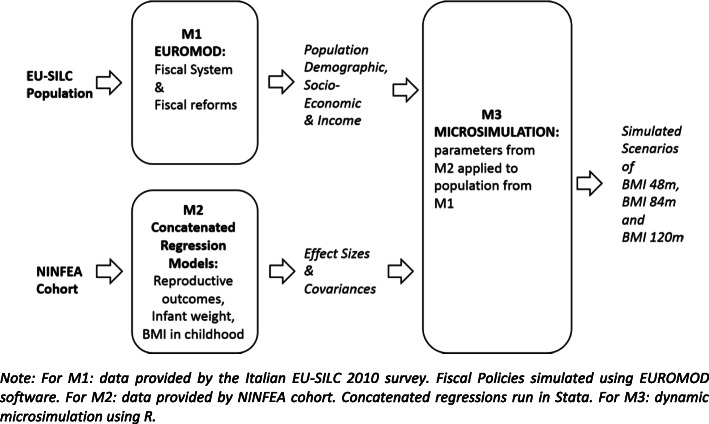
MICH model is composed of three integrated modules. Firstly, module 1 (M1) simulates the effects of fiscal policies on disposable household income using the tax-benefit microsimulation program EUROMOD fed with the Italian EU-SILC 2010 data. Secondly, module 2 (M2) exploits data provided by the Italian birth cohort called Nascita e Infanzia: gli Effetti dell'Ambiente (NINFEA), translated as Birth and Childhood: the Effects of the Environment study, and runs a series of concatenated regressions in order to estimate the prospective effects of income on child body mass index (BMI) at different ages. Finally, module 3 (M3) uses dynamic microsimulation techniques that combine the population structure and incomes obtained by M1, with regression model specifications and estimated effect sizes provided by M2, projecting BMI distributions according to the simulated policy scenarios.
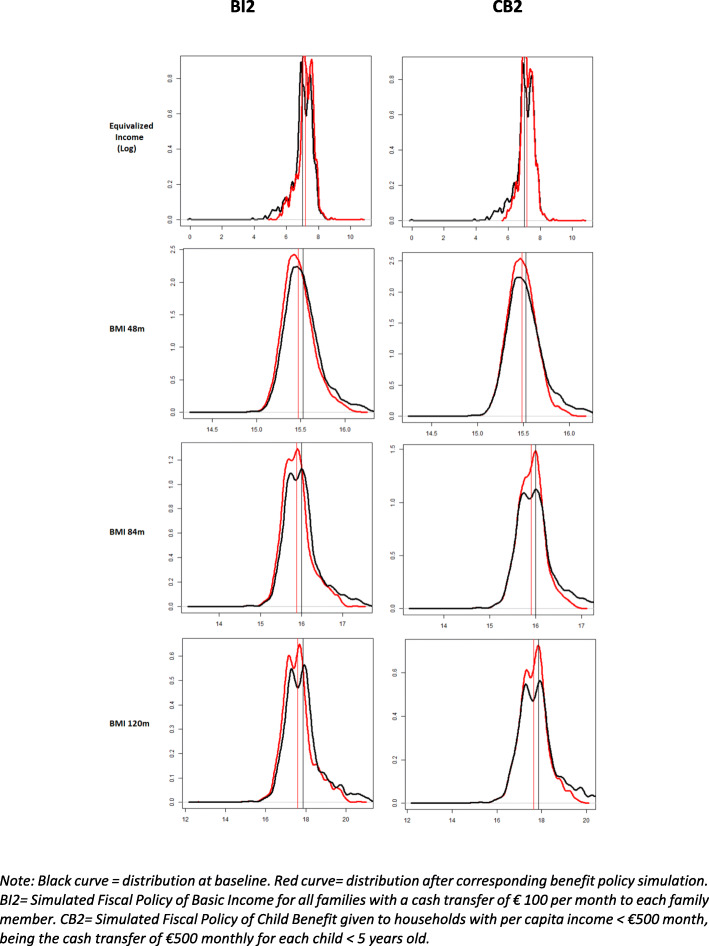
Both universal benefits, such as universal basic income (BI), and targeted interventions, such as child benefit (CB) for poorer households, have a significant effect on childhood overweight, with a prevalence ratio (PR) in 10-year-old children-in comparison with the baseline fiscal system-of 0.88 (95%CI 0.82-0.93) and 0.89 (95%CI 0.83-0.94), respectively. The impact of the fiscal reforms was even larger for child obesity, reaching a PR of 0.67 (95%CI 0·50-0.83) for the simulated BI and 0.64 (95%CI 0.44-0.84) for CB at the same age. While both types of policies show similar effects, the estimated costs for a 1% prevalence reduction in overweight and obesity with respect to the baseline scenario is much lower with a more focalised benefit policy than with universal ones.
Our results show that fiscal policies can have a strong impact on childhood health conditions. Focalised interventions that increase family income, especially in the most vulnerable populations, can help to prevent child overweight and obesity. Robust microsimulation models to forecast the effects of fiscal policies on health should be considered as one of the instruments to reach the Health in All Policies (HiAP) goals.
我们开发了一个名为 Microsimulation for Income and Child Health (MICH) 的综合模型,该模型为分析财政政策对欧洲国家儿童健康的预期影响提供了一种工具。本研究的目的是评估替代财政政策对意大利儿童超重和肥胖的影响。
MICH 模型由三个集成模块组成。首先,模块 1(M1)使用欧盟模式的税收-福利微观模拟程序,利用意大利欧盟- SILC 2010 年的数据来模拟财政政策对家庭可支配收入的影响。其次,模块 2(M2)利用意大利出生队列“Nascita e Infanzia:gli Effetti dell'Ambiente”(NINFEA)提供的数据,并运行一系列串联回归,以估计收入对不同年龄儿童体重指数(BMI)的预期影响。最后,模块 3(M3)使用动态微观模拟技术,将 M1 获得的人口结构和收入与 M2 提供的回归模型规范和估计的效应大小相结合,根据模拟的政策情景预测 BMI 分布。
普遍福利,如普遍基本收入(BI),和针对贫困家庭的有针对性干预,如儿童福利(CB),对儿童超重都有显著影响,与基线财政制度相比,10 岁儿童的流行率比值(PR)分别为 0.88(95%CI 0.82-0.93)和 0.89(95%CI 0.83-0.94)。模拟 BI 和 CB 在相同年龄时,儿童肥胖的财政改革影响更大,达到 0.67(95%CI 0.50-0.83)和 0.64(95%CI 0.44-0.84)的 PR。虽然这两种政策都有类似的效果,但相对于基线情景,减少超重和肥胖 1%的流行率,有针对性的福利政策的估计成本要比普遍福利政策低得多。
我们的结果表明,财政政策对儿童健康状况有很大影响。增加家庭收入的有针对性干预措施,特别是针对最弱势群体,可以帮助预防儿童超重和肥胖。应考虑使用强大的微观模拟模型来预测财政政策对健康的影响,作为实现“所有政策都重视健康”(HiAP)目标的手段之一。