Arthritis and Regenerative Medicine Laboratory, Aberdeen Centre for Arthritis and Musculoskeletal Health, Institute of Medical Sciences, University of Aberdeen, Aberdeen, UK.
Microscopy and Histology Core Facility, Institute of Medical Sciences, University of Aberdeen, Aberdeen, UK.
Ann Rheum Dis. 2022 Feb;81(2):214-224. doi: 10.1136/annrheumdis-2021-220875. Epub 2021 Nov 29.
We aimed to understand the role of the transcriptional co-factor Yes-associated protein (Yap) in the molecular pathway underpinning the pathogenic transformation of synovial fibroblasts (SF) in rheumatoid arthritis (RA) to become invasive and cause joint destruction.
Synovium from patients with RA and mice with antigen-induced arthritis (AIA) was analysed by immunostaining and qRT-PCR. SF were targeted using and mice, crossed with fluorescent reporters for cell tracing and mice for conditional ablation. Fibroblast phenotypes were analysed by flow cytometry, and arthritis severity was assessed by histology. Yap activation was detected using Yap-Tead reporter cells and Yap-Snail interaction by proximity ligation assay. SF invasiveness was analysed using matrigel-coated transwells.
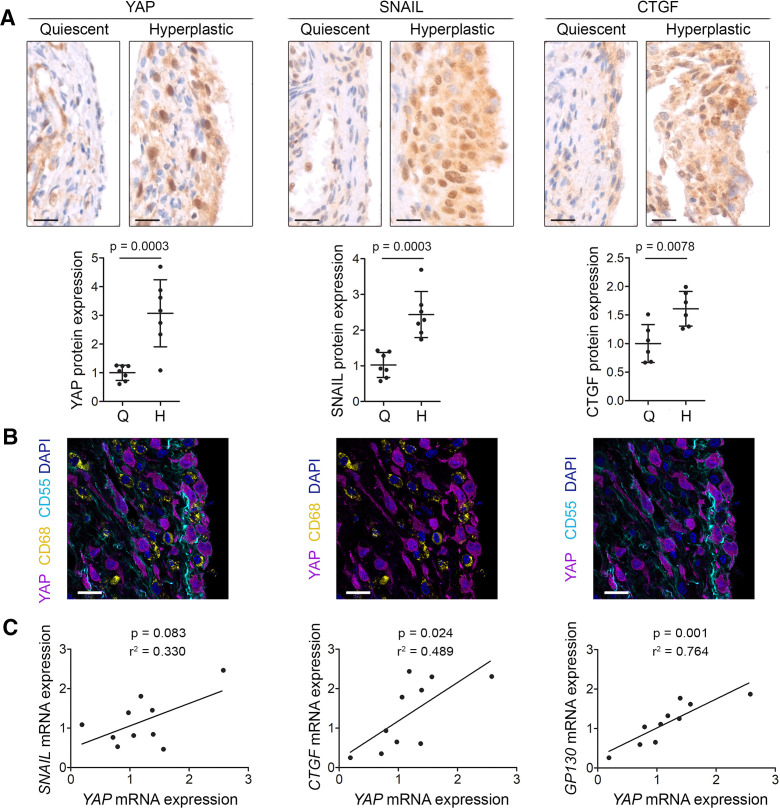
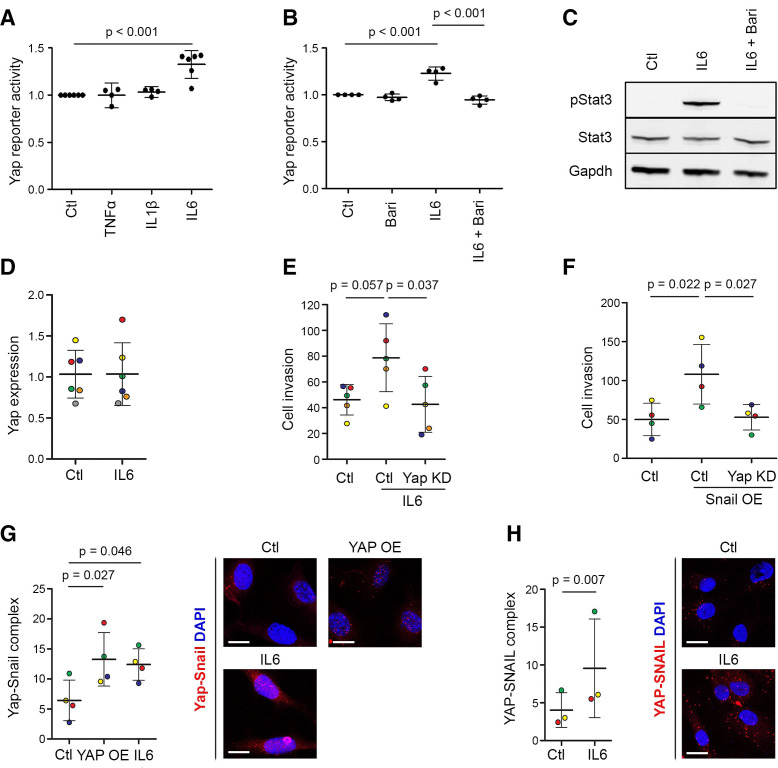
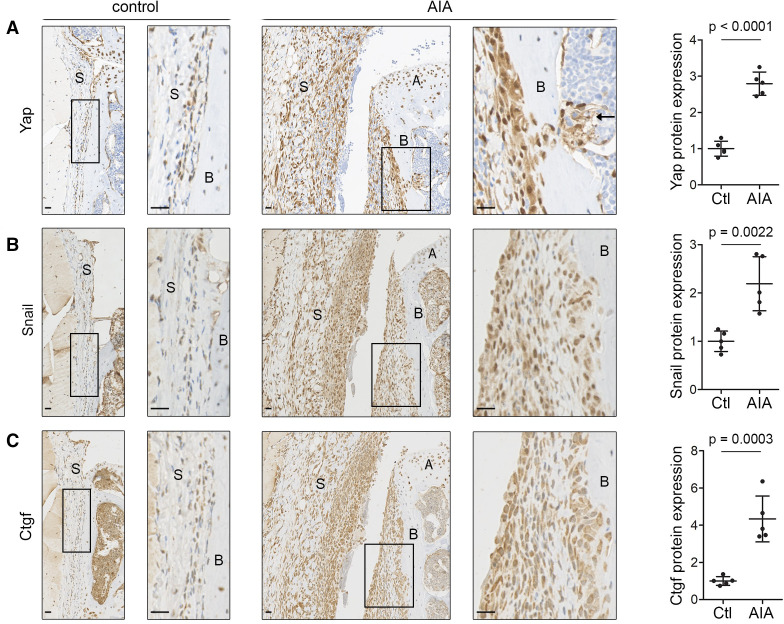
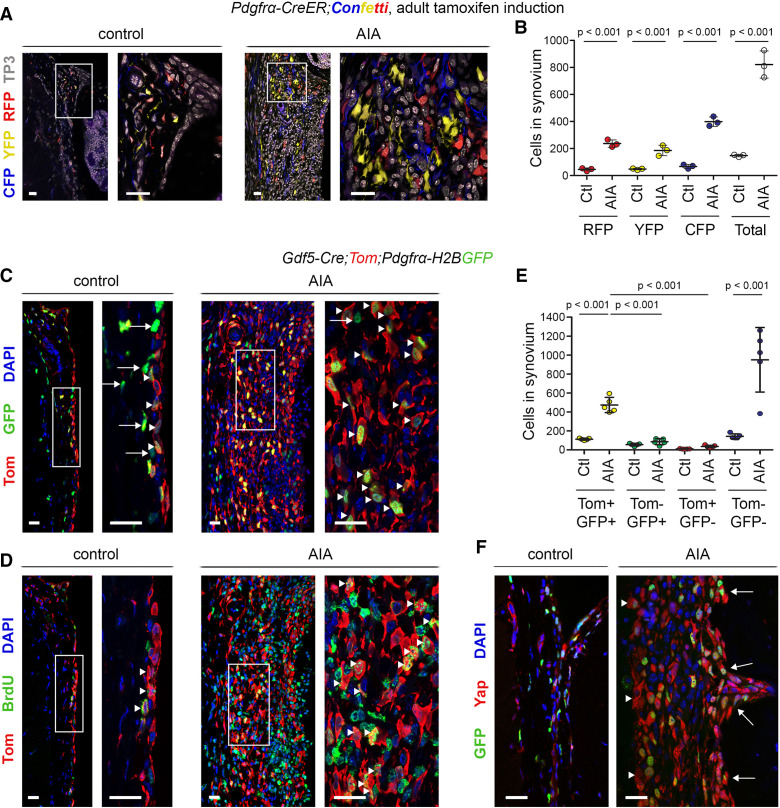
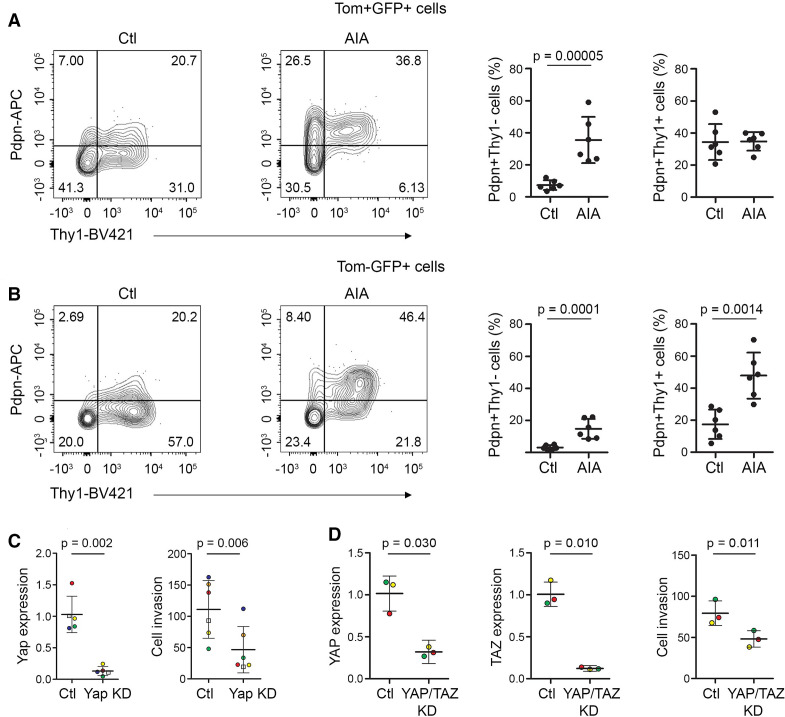
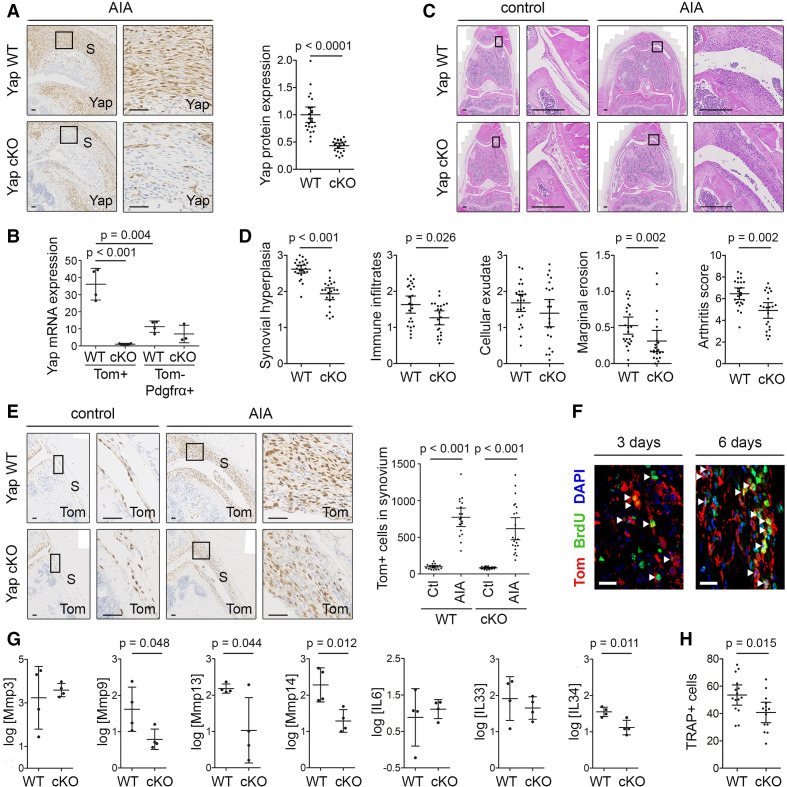
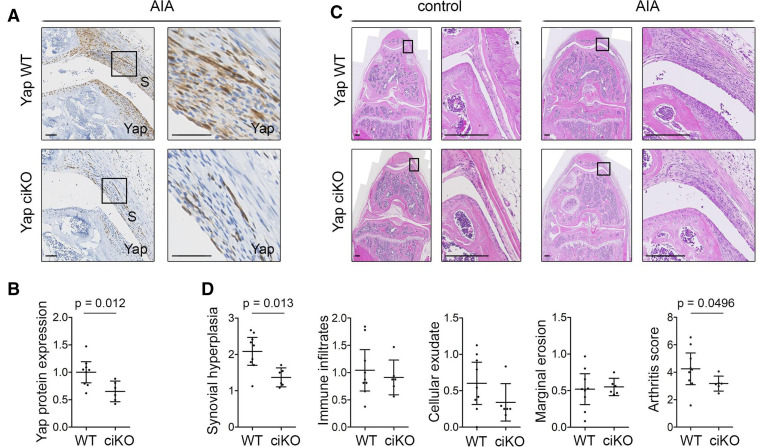
Yap, its binding partner Snail and downstream target connective tissue growth factor were upregulated in hyperplastic human RA and in mouse AIA synovium, with Yap detected in SF but not macrophages. Lineage tracing showed polyclonal expansion of -expressing SF during AIA, with predominant expansion of the -lineage SF subpopulation descending from the embryonic joint interzone. -lineage SF showed increased expression of and adopted an erosive phenotype (podoplanin+Thy-1 cell surface antigen-), invading cartilage and bone. Conditional ablation of in -lineage cells or -expressing fibroblasts ameliorated AIA. Interleukin (IL)-6, but not tumour necrosis factor alpha (TNF-α) or IL-1β, Jak-dependently activated Yap and induced Yap-Snail interaction. SF invasiveness induced by IL-6 stimulation or Snail overexpression was prevented by Yap knockdown, showing a critical role for Yap in SF transformation in RA.
Our findings uncover the IL-6-Yap-Snail signalling axis in pathogenic SF in inflammatory arthritis.
我们旨在了解转录共因子 Yes 相关蛋白(Yap)在类风湿关节炎(RA)滑膜成纤维细胞(SF)发生致病变性转化为侵袭性并导致关节破坏的分子途径中的作用。
通过免疫染色和 qRT-PCR 分析 RA 患者和抗原诱导关节炎(AIA)小鼠的滑膜。使用 和 小鼠靶向 SF,与细胞示踪荧光报告基因和 小鼠的条件性 缺失基因进行杂交。通过流式细胞术分析成纤维细胞表型,通过组织学评估关节炎严重程度。使用 Yap-Tead 报告细胞检测 yap 激活,通过邻近连接测定法检测 yap-Snail 相互作用。通过基质胶包被的 Transwell 分析 SF 的侵袭性。
在增生性人类 RA 和小鼠 AIA 滑膜中,yap、其结合伙伴 Snail 和下游靶基因结缔组织生长因子上调,yap 存在于 SF 中,但不存在于巨噬细胞中。谱系追踪显示,在 AIA 期间, -表达的 SF 发生多克隆扩增,胚胎关节间区衍生的 -谱系 SF 亚群扩增为主。-谱系 SF 表现出 和侵袭性表型(podoplanin+Thy-1 细胞表面抗原+)的表达增加,侵犯软骨和骨。在 -谱系细胞或 -表达成纤维细胞中条件性缺失 可改善 AIA。白细胞介素(IL)-6 而非肿瘤坏死因子-α(TNF-α)或 IL-1β,Jak 依赖性激活 yap 并诱导 yap-Snail 相互作用。由 IL-6 刺激或 Snail 过表达诱导的 SF 侵袭性被 yap 敲低所阻止,表明 yap 在 RA 中 SF 转化中起关键作用。
我们的研究结果揭示了炎症性关节炎中致病性 SF 中的 IL-6-Yap-Snail 信号轴。