Anderson Anne J, Kim Young Cheol
Department of Biological Engineering, Utah State University, Logan, UT 84322, USA.
Department of Applied Biology, College of Agriculture & Life Sciences, Chonnam National University, Gwangju 61186, Korea.
Plant Pathol J. 2021 Oct;37(5):415-427. doi: 10.5423/PPJ.RW.01.2021.0011. Epub 2021 Oct 1.
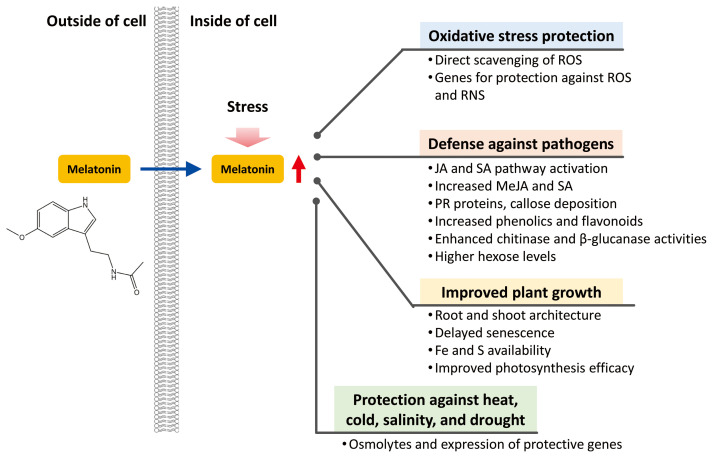
A plethora of compounds stimulate protective mechanisms in plants against microbial pathogens and abiotic stresses. Some defense activators are synthetic compounds and trigger responses only in certain protective pathways, such as activation of defenses under regulation by the plant regulator, salicylic acid (SA). This review discusses the potential of naturally occurring plant metabolites as primers for defense responses in the plant. The production of the metabolites, hexanoic acid and melatonin, in plants means they are consumed when plants are eaten as foods. Both metabolites prime stronger and more rapid activation of plant defense upon subsequent stress. Because these metabolites trigger protective measures in the plant they can be considered as "vaccines" to promote plant vigor. Hexanoic acid and melatonin instigate systemic changes in plant metabolism associated with both of the major defense pathways, those regulated by SA- and jasmonic acid (JA). These two pathways are well studied because of their induction by different microbial triggers: necrosis-causing microbial pathogens induce the SA pathway whereas colonization by beneficial microbes stimulates the JA pathway. The plant's responses to the two metabolites, however, are not identical with a major difference being a characterized growth response with melatonin but not hexanoic acid. As primers for plant defense, hexanoic acid and melatonin have the potential to be successfully integrated into vaccination-like strategies to protect plants against diseases and abiotic stresses that do not involve man-made chemicals.
大量化合物可刺激植物抵御微生物病原体和非生物胁迫的保护机制。一些防御激活剂是合成化合物,仅在某些保护途径中触发反应,例如在植物调节剂水杨酸(SA)调控下激活防御反应。本综述讨论了天然存在的植物代谢产物作为植物防御反应引发剂的潜力。植物中己酸和褪黑素这两种代谢产物的产生意味着当植物作为食物被食用时它们会被消耗。这两种代谢产物都会在后续胁迫时引发植物防御更强且更快速的激活。由于这些代谢产物能触发植物的保护措施,它们可被视为促进植物活力的“疫苗”。己酸和褪黑素会引发植物代谢的系统性变化,这与由SA和茉莉酸(JA)调控的两条主要防御途径都有关。这两条途径已得到充分研究,因为它们由不同的微生物触发因素诱导:导致坏死的微生物病原体诱导SA途径,而有益微生物的定殖则刺激JA途径。然而,植物对这两种代谢产物的反应并不相同,主要区别在于褪黑素会引发特定的生长反应,而己酸则不会。作为植物防御的引发剂,己酸和褪黑素有可能成功整合到类似疫苗接种的策略中,以保护植物免受不涉及人造化学物质的疾病和非生物胁迫。