Department of Cardiology, Beijing Friendship Hospital, Capital Medical University, Beijing, China
Department of General Surgery, Beijing Friendship Hospital, Capital Medical University, Beijing, China
BMJ Open. 2021 Nov 30;11(11):e049957. doi: 10.1136/bmjopen-2021-049957.
Serum calcium levels (sCa) were reported to be associated with risk of cardiovascular diseases. The aim of this study was to analyse the association between sCa and long-term mortality in patients with acute coronary syndrome (ACS).
A retrospective observational cohort study.
Single-centre study with participants recruited from the local area.
A total of consecutive 13 772 patients with ACS were included in this analysis. Patients were divided based on their sCa profile (≤2.1 mmol/L, 2.1-2.2 mmol/L, 2.2-2.3 mmol/L, 2.3-2.4 mmol/L, 2.4-2.5 mmol/L,>2.5 mmol/L) and followed up for a median of 2.96 years (IQR 1.01-4.07).
Long-term all-cause mortality.
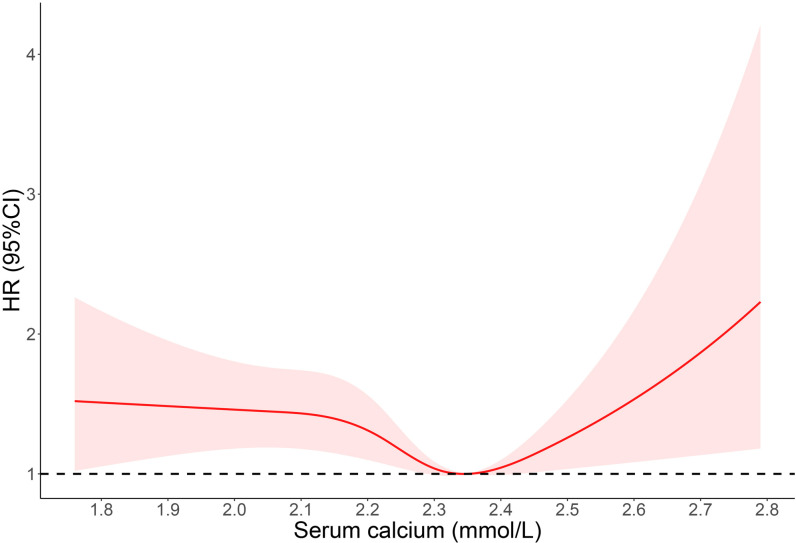
During a median follow-up period of 2.96 years, patients with sCa ≤2.1 mmol/L had the highest cumulative incidences of all-cause mortality (16.7%), whereas those with sCa 2.4-2.5 mmol/L had the lowest cumulative incidences of all-cause mortality (3.5%). After adjusting for potentially confounding variables, the Cox analysis revealed that compared with the reference group (sCa 2.4-2.5 mmol/L), all the other groups had higher mortality except for the sCa 2.3-2.4 mmol/L group (HR, 1.32, 95% CI 0.93 to 1.87). Restricted cubic splines showed that the relationship between sCa and all-cause mortality seemed to be U shaped. The optimal sCa cut-off point, 2.35 mmol/L, was determined based on the shape of restricted cubic splines.
Altered serum calcium homeostasis at admission independently predicts all-cause mortality in patients with ACS. In addition, a U-shaped relationship between sCa and all-cause mortality exists, and maintaining sCa at approximately 2.35 mmol/L may minimise the risk of mortality.
血清钙水平(sCa)与心血管疾病风险相关。本研究旨在分析急性冠状动脉综合征(ACS)患者 sCa 与长期死亡率之间的关系。
回顾性观察性队列研究。
单中心研究,参与者来自当地。
本分析共纳入 13772 例连续 ACS 患者。根据 sCa 水平(≤2.1mmol/L、2.1-2.2mmol/L、2.2-2.3mmol/L、2.3-2.4mmol/L、2.4-2.5mmol/L、>2.5mmol/L)将患者分为不同组,并随访中位数为 2.96 年(IQR 1.01-4.07)。
长期全因死亡率。
在中位数为 2.96 年的随访期间,sCa≤2.1mmol/L 的患者全因死亡率的累积发生率最高(16.7%),而 sCa 2.4-2.5mmol/L 的患者全因死亡率的累积发生率最低(3.5%)。调整潜在混杂变量后,Cox 分析显示,与参考组(sCa 2.4-2.5mmol/L)相比,除 sCa 2.3-2.4mmol/L 组外,其他所有组的死亡率均较高(HR,1.32,95%CI 0.93 至 1.87)。限制性三次样条显示,sCa 与全因死亡率之间的关系呈 U 形。根据限制性三次样条的形状,确定最佳 sCa 截断点为 2.35mmol/L。
入院时血清钙稳态的改变独立预测 ACS 患者的全因死亡率。此外,sCa 与全因死亡率之间存在 U 形关系,将 sCa 维持在约 2.35mmol/L 可能会将死亡率风险降至最低。