Aliashraf Jodat Maryam, Alilu Leyla, Ahangarzadeh Rezayee Sohila, Gharaaghaji Asl Rasool
Department of Psychiatric Nursing, Faculty of Nursing and Midwifery, Urmia University of Medical Sciences, Urmia, Iran.
Department of Medical Surgical Nursing, Faculty of Nursing and Midwifery, Urmia University of Medical Sciences, Urmia, Iran.
J Caring Sci. 2021 Mar 3;10(3):129-136. doi: 10.34172/jcs.2021.007. eCollection 2021 Aug.
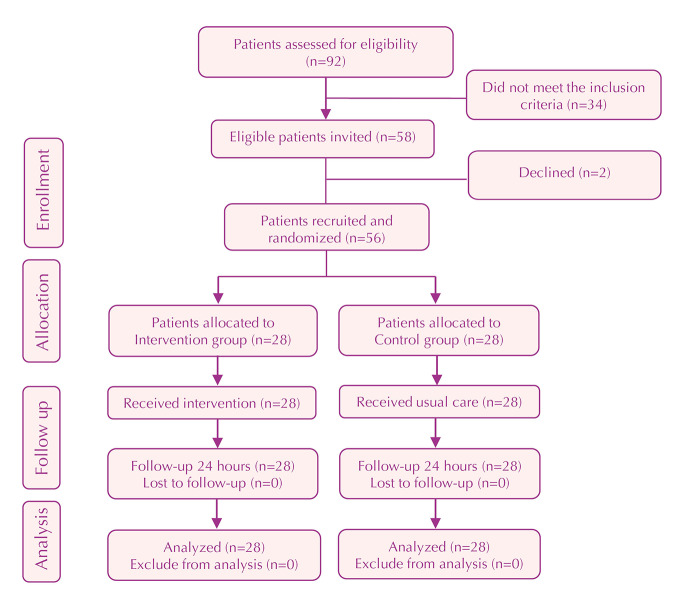
High prevalence of psychiatric disorders and the high effectiveness of electroconvulsive therapy (ECT) have made this treatment a useful intervention. Memory impairment, headache, and muscle pain are the most important complications after ECT. This research aimed to determine the effect of reflexology on the headache and muscle pain intensity of patients after receiving ECT. This randomized controlled trial was conducted in Razi teaching hospital of Urmia, Iran. A total of 56 patients with depression receiving ECT were randomly assigned into two equal groups of control (n=28) and intervention (n=28). In the intervention group, reflexology was performed for 20 minutes at reflex points and, in the control group, only the conventional measures were taken. Pain intensity was measured with visual analogue scale (VAS) before and 1, 6, and 24 hours after the intervention. Data were analyzed using the SPSS software version 13. Furthermore, chi-square, Mann-Whitney, Wilcoxon, and repeated-measures tests were performed. The mean difference in the severity of headache and muscle pain in the intervention group was significantly reduced compared to the control group. Moreover, the results demonstrated a significant difference between the mean headache and muscle pain in the two groups after the intervention. The results of this study showed the positive effect of reflexology on reducing the intensity of pain in patients receiving ECT. Thus, it is recommended that nurses, health care providers, and caregivers use reflexology to reduce pain in patients with depression receiving ECT.
精神疾病的高患病率以及电休克疗法(ECT)的高效性使得这种治疗成为一种有用的干预措施。记忆障碍、头痛和肌肉疼痛是ECT术后最重要的并发症。本研究旨在确定反射疗法对接受ECT治疗的患者头痛和肌肉疼痛强度的影响。这项随机对照试验在伊朗乌尔米耶的拉齐教学医院进行。共有56例接受ECT治疗的抑郁症患者被随机分为对照组(n = 28)和干预组(n = 28)两组。干预组在反射点进行20分钟的反射疗法,对照组仅采取常规措施。在干预前以及干预后1小时、6小时和24小时,使用视觉模拟量表(VAS)测量疼痛强度。使用SPSS 13版软件对数据进行分析。此外,还进行了卡方检验、曼-惠特尼检验、威尔科克森检验和重复测量检验。与对照组相比,干预组头痛和肌肉疼痛严重程度的平均差异显著降低。此外,结果表明干预后两组的平均头痛和肌肉疼痛存在显著差异。本研究结果显示了反射疗法对减轻接受ECT治疗患者疼痛强度的积极作用。因此,建议护士、医护人员和护理人员使用反射疗法来减轻接受ECT治疗的抑郁症患者的疼痛。