Bousmah Marwân-Al-Qays, Boyer Sylvie, Lalou Richard, Ventelou Bruno
Université de Paris, IRD, INSERM, Ceped, F-75006 Paris, France.
INSERM, IRD, SESSTIM, Sciences Economiques & Sociales de La Santé & Traitement de L'Information Médicale, Aix-Marseille University, Marseille, France.
SSM Popul Health. 2021 Nov 19;16:100974. doi: 10.1016/j.ssmph.2021.100974. eCollection 2021 Dec.
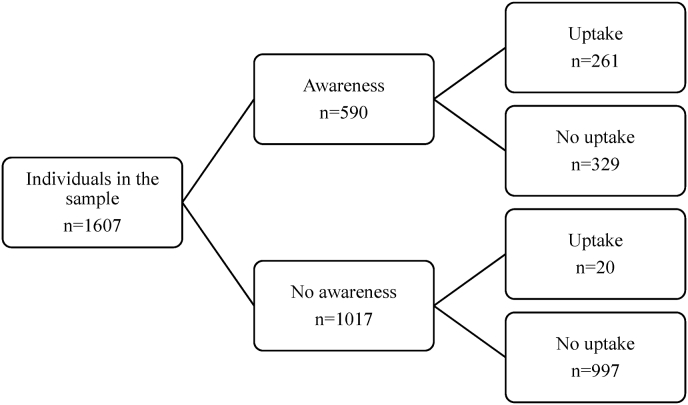
Limited access to information is one of the main health insurance market imperfections in developing countries. Differential access to information may determine individuals' awareness of health insurance schemes, thereby influencing their probability of enrollment. Relying on primary data collected in 2019-2020 in rural Senegal, we estimate the uptake of community-based health insurance using a Heckman-type model to correct for awareness-based sample selection bias. Besides showing that health insurance awareness is a precondition for effective enrollment in community-based health insurance schemes, we also bring new evidence on the roles which geographic factors and individual risk preference play in health insurance uptake by rural dwellers. We show that geographic distance prevents individuals from accessing information on health insurance schemes, and discourage those who are informed from enrolling, because of the additional distance they must travel to benefit from covered healthcare services. Results also show that individual risk preference influences health insurance uptake, but only when information barriers are taken into account. Overall, our results could help decision-makers better shape the universal health coverage roadmap, as policies to improve health insurance awareness differ substantially from policies to improve the features of health insurance schemes.
信息获取受限是发展中国家健康保险市场的主要缺陷之一。信息获取的差异可能决定个人对健康保险计划的认知程度,进而影响其参保概率。基于2019 - 2020年在塞内加尔农村地区收集的原始数据,我们使用赫克曼型模型估计社区医疗保险的参保情况,以纠正基于认知的样本选择偏差。除了表明健康保险认知是有效参保社区医疗保险计划的先决条件外,我们还为地理因素和个人风险偏好对农村居民医疗保险参保的作用提供了新证据。我们发现,地理距离阻碍个人获取医疗保险计划的信息,并使已了解信息的人不愿参保,因为他们必须额外跋涉一段距离才能享受医保覆盖的医疗服务。结果还表明,个人风险偏好会影响医疗保险参保情况,但前提是要考虑到信息障碍。总体而言,我们的结果有助于决策者更好地规划全民健康覆盖路线图,因为提高健康保险认知的政策与改善健康保险计划特征的政策有很大不同。