Manortey Stephen, VanDerslice James, Alder Steve, Henry Kevin A, Crookston Benjamin, Dickerson Ty, Benson Scott
Department of Family and Preventive Medicine, University of Utah , Salt Lake City, USA.
Department of Epidemiology, Rutgers School of Public Health , Piscataway, USA.
J Public Health Afr. 2014 Feb 4;5(1):353. doi: 10.4081/jphia.2014.353.
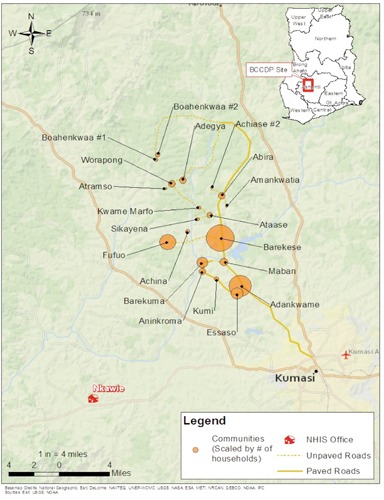
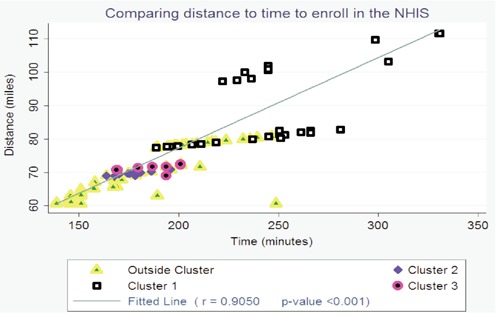
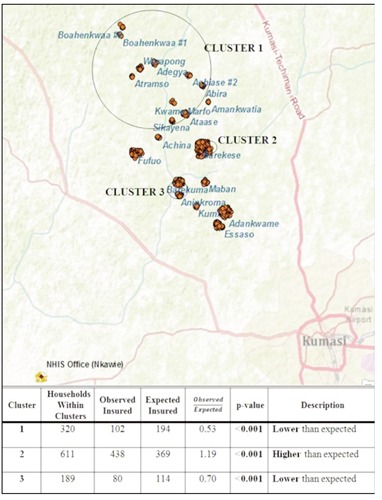
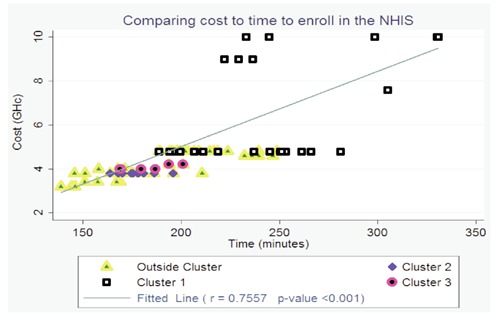
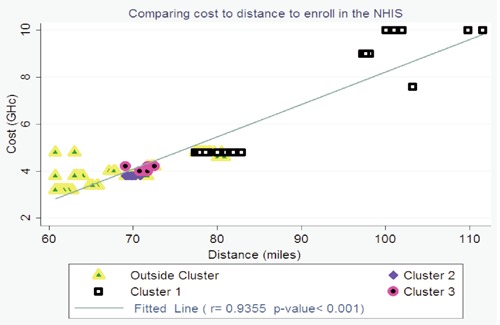
The use of health insurance schemes in financing healthcare delivery and to minimize the poverty gap is gaining considerable recognition among the least developed and resource challenged countries around the world. With the implementation of the socialized health insurance scheme, Ghana has taken the lead in Sub-Saharan Africa and now working out further strategies to gain universal coverage among her citizenry. The primary goal of this study is to explore the spatial relationship between the residential homes and demographic features of the people in the Barekese subdistrict in Ghana on the probability to enroll the entire household unit in the National Health Insurance Scheme (NHIS). Household level data were gathered from 20 communities on the enrollment status into the NHIS alongside demographic and socioeconomic indicators and the spatial location of every household that participated in the study. Kulldorff's purely spatial scan statistic was used to detect geographic clusters of areas with participatory households that have either higher or lower enrollment patterns in the insurance program. Logistic regression models on selected demographic and socioeconomic indicators were built to predict the effect on the odds of enrolling an entire household membership in the NHIS. Three clusters significantly stood out to have either high or low enrollment patterns in the health insurance program taking into accounts the number of households in those sub-zones of the study region. Households in the insurance group have very high travel expenses compared to their counterparts in the other idenfied clusters. Travel cost and time to the NHIS registration center to enroll in the program were both significant predictors to participation in the program when controlling for cluster effect. Residents in the High socioeconomic group have about 1.66 [95% CI: 1.27-2.17] times the odds to enroll complete households in the insurance program compared to their counterparts in the Low socioeconomic group. The study demonstrated the use of spatial analytical tools to identify clusters of household enrollment pattern in the NHIS among residents in rural Ghana. In the face of limited resources, policy makers can therefore use the findings as guideline to strategically channel interventions to areas of most need. Furthermore, these analyses can be repeated annually to assess progress on improving insurance coverage.
在世界上最不发达和资源匮乏的国家中,利用健康保险计划为医疗服务提供资金并缩小贫困差距正日益受到广泛认可。随着社会化健康保险计划的实施,加纳在撒哈拉以南非洲地区率先行动,目前正在制定进一步战略,以实现全体公民的全民覆盖。本研究的主要目标是探讨加纳巴雷凯塞分区居民住房与人口特征之间的空间关系,以及整个家庭单位加入国家健康保险计划(NHIS)的可能性。从20个社区收集了家庭层面的数据,内容包括加入NHIS的参保状况以及人口和社会经济指标,还有参与研究的每个家庭的空间位置。使用库尔道夫的纯空间扫描统计量来检测参保家庭在保险计划中参保模式较高或较低的地理区域集群。建立了关于选定人口和社会经济指标的逻辑回归模型,以预测对整个家庭成员加入NHIS几率的影响。考虑到研究区域内这些子区域的家庭数量后,有三个集群在健康保险计划中的参保模式明显呈现出高或低的情况。与其他已识别集群中的家庭相比,参保集群中的家庭旅行费用非常高。在控制集群效应时,前往NHIS登记中心参保的旅行成本和时间都是参与该计划的重要预测因素。高社会经济群体的居民让整个家庭加入保险计划的几率是低社会经济群体居民的约1.66倍[95%置信区间:1.27 - 2.17]。该研究展示了使用空间分析工具来识别加纳农村居民中NHIS家庭参保模式的集群情况。因此,在资源有限的情况下,政策制定者可以将这些研究结果作为指导方针,有策略地将干预措施引导至最需要的地区。此外,这些分析可以每年重复进行,以评估在提高保险覆盖率方面的进展。