Itarte Marta, Bofill-Mas Sílvia, Martínez-Puchol Sandra, Torrell Helena, Ceretó Adrià, Carrasco Marina, Forés Eva, Canela Núria, Girones Rosina, Rusiñol Marta
Laboratory of Viruses Contaminants of Water and Food, Genetics, Microbiology & Statistics Department at the University of Barcelona (UB), Barcelona, Catalonia, Spain.
The Water Research Institute (IdRA), Universitat de Barcelona, Barcelona, Catalonia, Spain.
Curr Opin Environ Sci Health. 2021 Dec;24:100308. doi: 10.1016/j.coesh.2021.100308. Epub 2021 Nov 6.
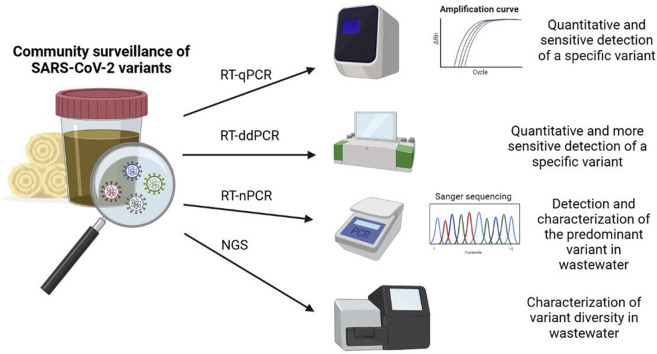
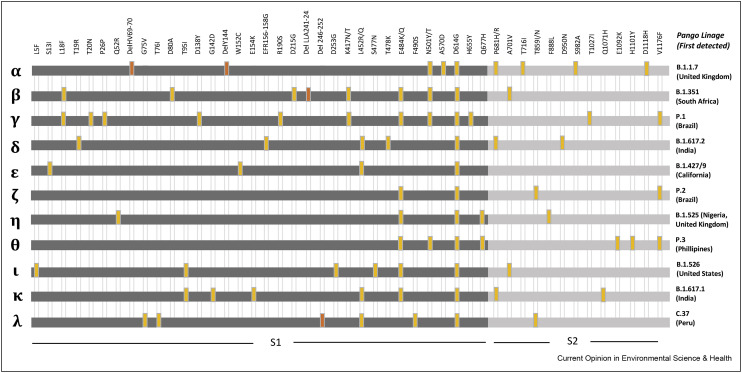
SARS-CoV-2 variants are emerging worldwide, and monitoring them is key in providing early warnings. Here, we summarize the different analytical approaches currently used to study the dissemination of SARS-CoV-2 variants in wastewater and discuss their advantages and disadvantages. We also provide preliminary results of two sensitive and cost-effective approaches: variant-specific reverse transcription-nested PCR assays and a nonvariant-specific amplicon deep sequencing strategy that targets three key regions of the viral spike protein. Next-generation sequencing approaches enable the simultaneous detection of signature mutations of different variants of concern in a single assay and may be the best option to explore the real picture at a particular time. Targeted PCR approaches focused on specific signature mutations will need continuous updating but are sensitive and cost-effective.
严重急性呼吸综合征冠状病毒2(SARS-CoV-2)变体正在全球出现,对其进行监测是提供早期预警的关键。在此,我们总结了目前用于研究SARS-CoV-2变体在废水中传播的不同分析方法,并讨论了它们的优缺点。我们还提供了两种灵敏且经济高效的方法的初步结果:变体特异性逆转录巢式PCR检测法和针对病毒刺突蛋白三个关键区域的非变体特异性扩增子深度测序策略。下一代测序方法能够在一次检测中同时检测不同关注变体的特征性突变,可能是探索特定时间真实情况的最佳选择。专注于特定特征性突变的靶向PCR方法需要不断更新,但灵敏且经济高效。