Children's Hospital of Eastern Ontario Research Institute, Ottawa, Ontario, K1H 8L1, Canada.
Department of Civil Engineering, University of Ottawa, Ottawa, Ontario, K1N 6N5, Canada.
Water Res. 2021 Oct 15;205:117681. doi: 10.1016/j.watres.2021.117681. Epub 2021 Sep 23.
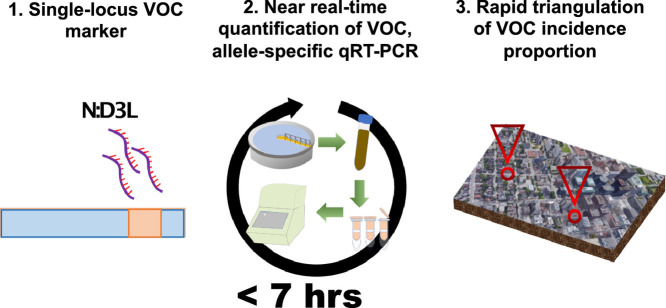
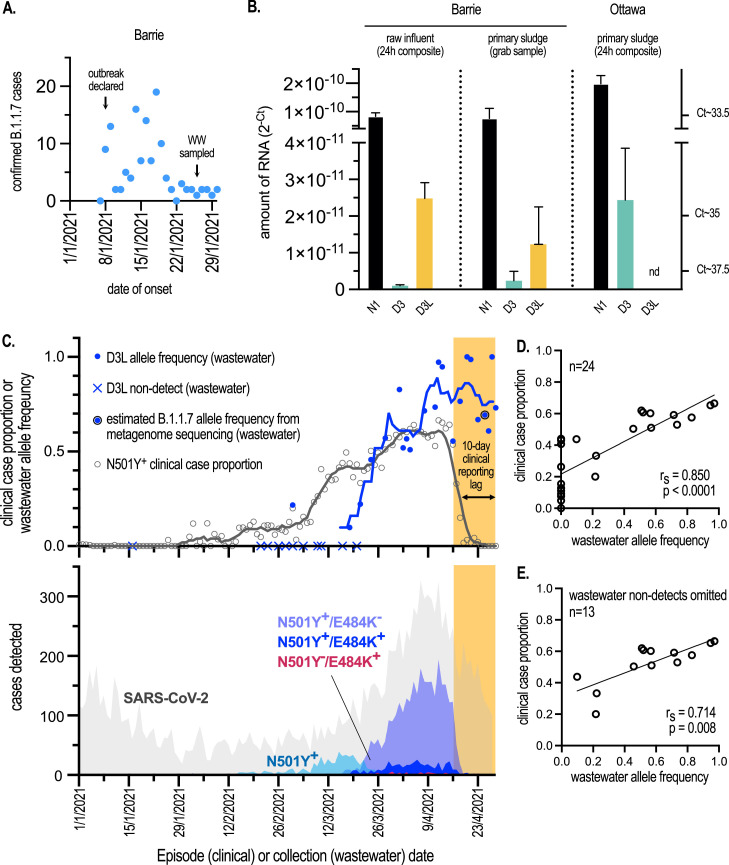
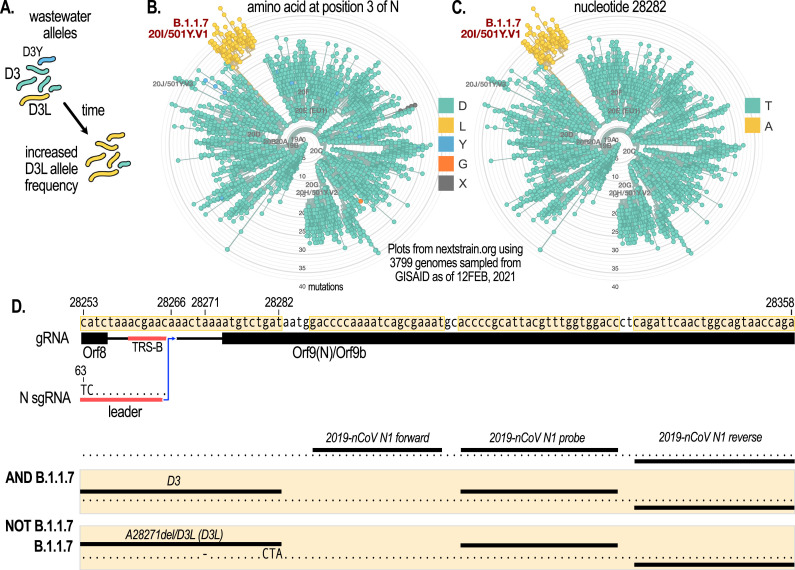
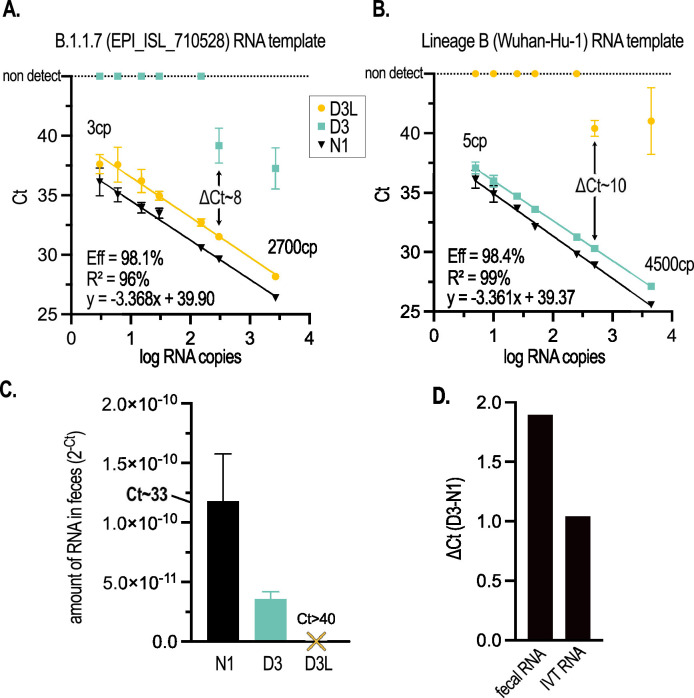
The coronavirus disease 2019 (COVID-19) pandemic caused by the severe acute respiratory syndrome coronavirus 2 (SARS-CoV-2) has claimed millions of lives to date. Antigenic drift has resulted in viral variants with putatively greater transmissibility, virulence, or both. Early and near real-time detection of these variants of concern (VOC) and the ability to accurately follow their incidence and prevalence in communities is wanting. Wastewater-based epidemiology (WBE), which uses nucleic acid amplification tests to detect viral fragments, is a reliable proxy of COVID-19 incidence and prevalence, and thus offers the potential to monitor VOC viral load in a given population. Here, we describe and validate a primer extension PCR strategy targeting a signature mutation in the N gene of SARS-CoV-2. This allows quantification of B.1.1.7 versus non-B.1.1.7 allele frequency in wastewater without the need to employ quantitative RT-PCR standard curves. We show that the wastewater B.1.1.7 profile correlates with its clinical counterpart and benefits from a near real-time and facile data collection and reporting pipeline. This assay can be quickly implemented within a current SARS-CoV-2 WBE framework with minimal cost; allowing early and contemporaneous estimates of B.1.1.7 community transmission prior to, or in lieu of, clinical screening and identification. Our study demonstrates that this strategy can provide public health units with an additional and much needed tool to rapidly triangulate VOC incidence/prevalence with high sensitivity and lineage specificity.
由严重急性呼吸系统综合症冠状病毒 2 型(SARS-CoV-2)引起的 2019 年冠状病毒病(COVID-19)大流行迄今已夺走数百万人的生命。抗原漂移导致具有潜在更高传染性、毒力或两者兼具的病毒变体出现。早期和近乎实时检测这些关注变种(VOC),并能够准确跟踪它们在社区中的发病率和流行率是非常重要的。基于废水的流行病学(WBE)使用核酸扩增测试来检测病毒片段,是 COVID-19 发病率和流行率的可靠替代品,因此有可能监测特定人群中 VOC 的病毒载量。在这里,我们描述并验证了一种针对 SARS-CoV-2 N 基因中特征性突变的引物延伸 PCR 策略。这使得无需使用定量 RT-PCR 标准曲线即可定量废水样本中 B.1.1.7 与非-B.1.1.7 等位基因的频率。我们表明,废水样本中的 B.1.1.7 谱与临床样本相对应,并且得益于近乎实时和简单的数据收集和报告流程。该检测方法可以在现有的 SARS-CoV-2 WBE 框架内快速实施,成本最低;允许在临床筛查和鉴定之前或替代临床筛查和鉴定,早期和同时估计 B.1.1.7 社区传播。我们的研究表明,该策略可为公共卫生部门提供一个额外的、非常需要的工具,以高灵敏度和谱系特异性快速确定 VOC 的发病率/流行率。