Department of Civil and Environmental Engineering, University of Illinois at Urbana-Champaigngrid.35403.31, Urbana, Illinois, USA.
Department of Computer Science, University of Illinois at Urbana-Champaigngrid.35403.31, Urbana, Illinois, USA.
Appl Environ Microbiol. 2022 Apr 12;88(7):e0228921. doi: 10.1128/aem.02289-21. Epub 2022 Mar 14.
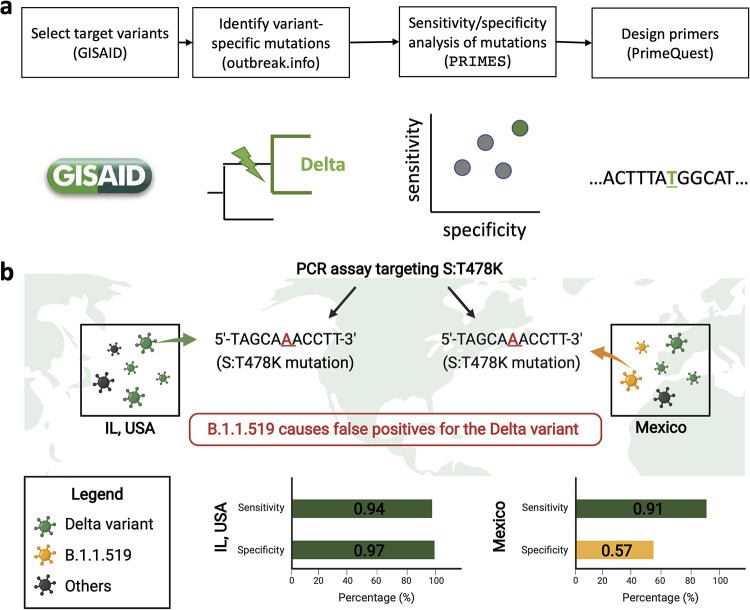
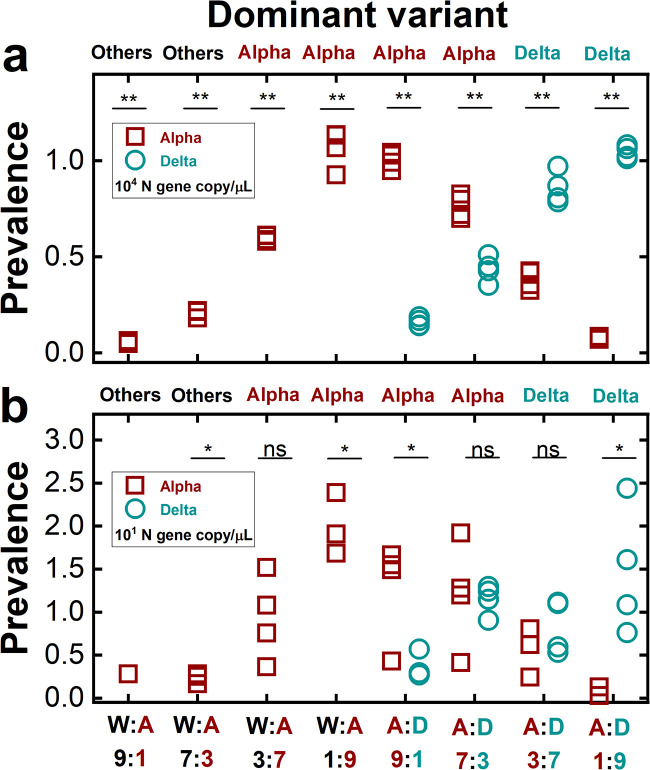
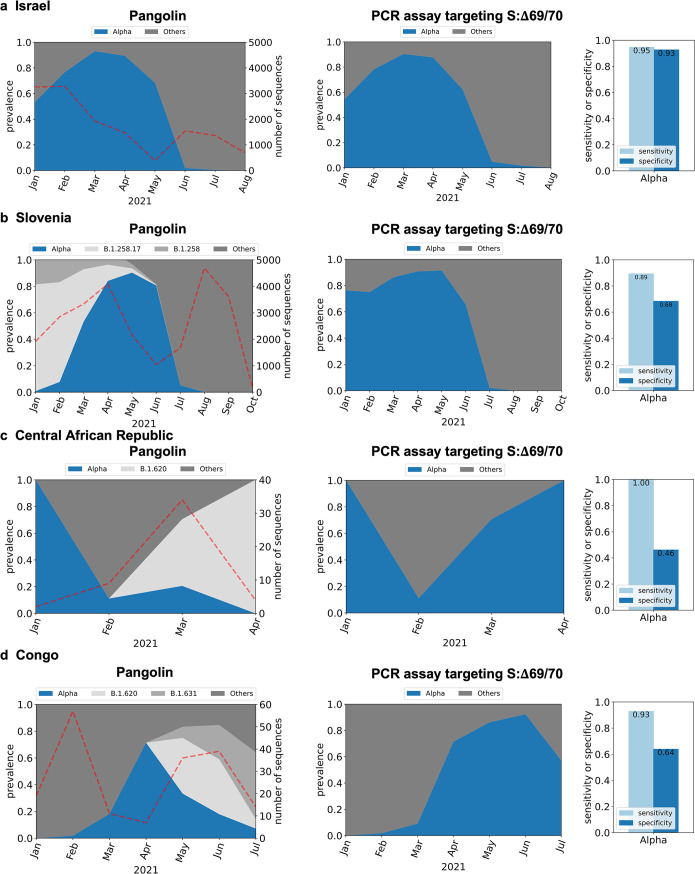
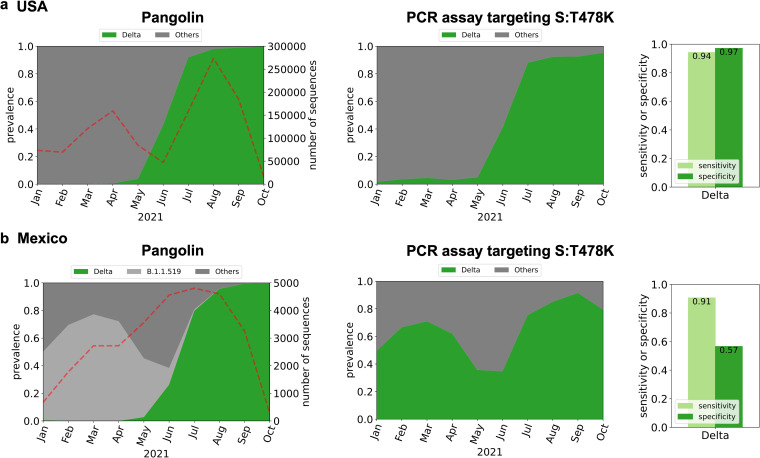
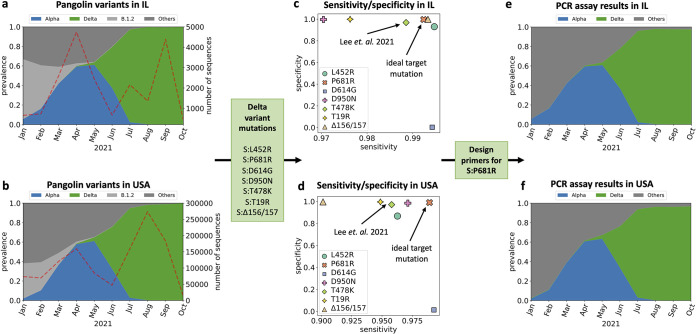
Monitoring the prevalence of SARS-CoV-2 variants is necessary to make informed public health decisions during the COVID-19 pandemic. PCR assays have received global attention, facilitating a rapid understanding of variant dynamics because they are more accessible and scalable than genome sequencing. However, as PCR assays target only a few mutations, their accuracy could be reduced when these mutations are not exclusive to the target variants. Here we introduce PRIMES, an algorithm that evaluates the sensitivity and specificity of SARS-CoV-2 variant-specific PCR assays across different geographical regions by incorporating sequences deposited in the GISAID database. Using PRIMES, we determined that the accuracy of several PCR assays decreased when applied beyond the geographic scope of the study in which the assays were developed. Subsequently, we used this tool to design Alpha and Delta variant-specific PCR assays for samples from Illinois, USA. analysis using PRIMES determined the sensitivity/specificity to be 0.99/0.99 for the Alpha variant-specific PCR assay and 0.98/1.00 for the Delta variant-specific PCR assay in Illinois, respectively. We applied these two variant-specific PCR assays to six local sewage samples and determined the dominant SARS-CoV-2 variant of either the wild type, the Alpha variant, or the Delta variant. Using next-generation sequencing (NGS) of the spike (S) gene amplicons of the Delta variant-dominant samples, we found six mutations exclusive to the Delta variant (S:T19R, S:Δ156/157, S:L452R, S:T478K, S:P681R, and S:D950N). The consistency between the variant-specific PCR assays and the NGS results supports the applicability of PRIMES. Monitoring the introduction and prevalence of variants of concern (VOCs) and variants of interest (VOIs) in a community can help the local authorities make informed public health decisions. PCR assays can be designed to keep track of SARS-CoV-2 variants by measuring unique mutation markers that are exclusive to the target variants. However, the mutation markers may not be exclusive to the target variants because of regional and temporal differences in variant dynamics. We introduce PRIMES, an algorithm that enables the design of reliable PCR assays for variant detection. Because PCR is more accessible, scalable, and robust for sewage samples than sequencing technology, our findings will contribute to improving global SARS-CoV-2 variant surveillance.
监测 SARS-CoV-2 变体的流行情况对于在 COVID-19 大流行期间做出明智的公共卫生决策是必要的。PCR 检测已受到全球关注,因为它们比基因组测序更容易获得和扩展,因此可以更快速地了解变体动态。然而,由于 PCR 检测仅针对少数突变,因此当这些突变并非目标变体所独有时,其准确性可能会降低。在这里,我们引入了 PRIMES,这是一种通过整合 GISAID 数据库中存储的序列来评估针对不同地理区域的 SARS-CoV-2 变体特异性 PCR 检测的敏感性和特异性的算法。使用 PRIMES,我们确定了当应用于开发这些检测的地理范围之外时,几种 PCR 检测的准确性会降低。随后,我们使用此工具为来自美国伊利诺伊州的样本设计了 Alpha 和 Delta 变体特异性 PCR 检测。使用 PRIMES 进行的分析确定,针对伊利诺伊州的 Alpha 变体特异性 PCR 检测的灵敏度/特异性分别为 0.99/0.99,针对 Delta 变体特异性 PCR 检测的灵敏度/特异性分别为 0.98/1.00。我们将这两种变体特异性 PCR 检测应用于六个当地污水样本,并确定了野生型、Alpha 变体或 Delta 变体的优势 SARS-CoV-2 变体。使用下一代测序(NGS)对 Delta 变体占主导地位的样本的 Spike(S)基因扩增子进行测序,我们发现了六个仅在 Delta 变体中存在的突变(S:T19R、S:Δ156/157、S:L452R、S:T478K、S:P681R 和 S:D950N)。变体特异性 PCR 检测与 NGS 结果之间的一致性支持了 PRIMES 的适用性。监测社区中关注变体(VOC)和感兴趣变体(VOI)的引入和流行情况可以帮助地方当局做出明智的公共卫生决策。可以通过测量仅针对目标变体的独特突变标记来设计 PCR 检测以跟踪 SARS-CoV-2 变体。然而,由于变体动态在区域和时间上存在差异,因此突变标记可能并非仅针对目标变体。我们引入了 PRIMES,这是一种可用于设计可靠的用于变体检测的 PCR 检测的算法。由于 PCR 比测序技术更容易获得、扩展和适用于污水样本,因此我们的发现将有助于改善全球 SARS-CoV-2 变体监测。