Department of Plant Breeding, Swedish University of Agricultural Sciences (SLU), Lomma SE-23422, Sweden.
Colegio de Postgraduados (COLPOS), CP 56230, Montecillos, Edo. de México, Mexico.
G3 (Bethesda). 2022 Jan 4;12(1). doi: 10.1093/g3journal/jkab362.
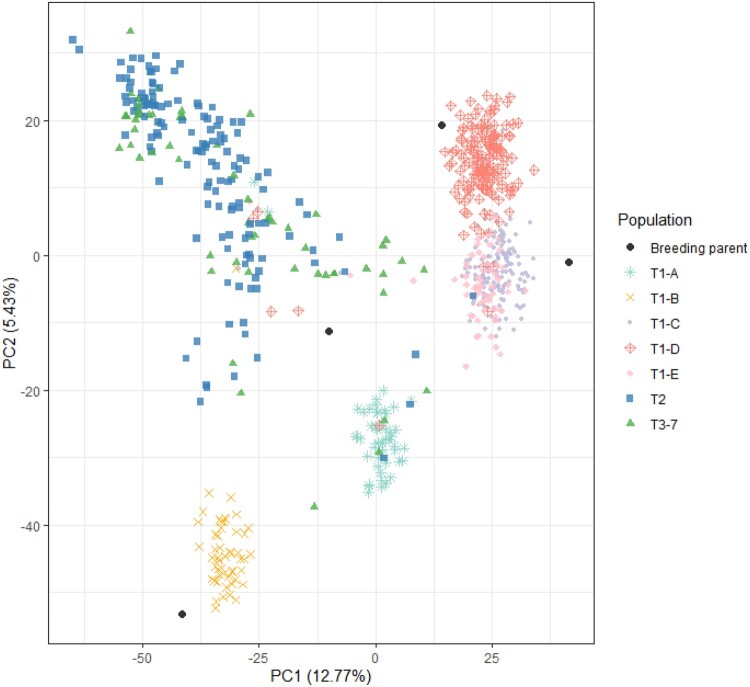
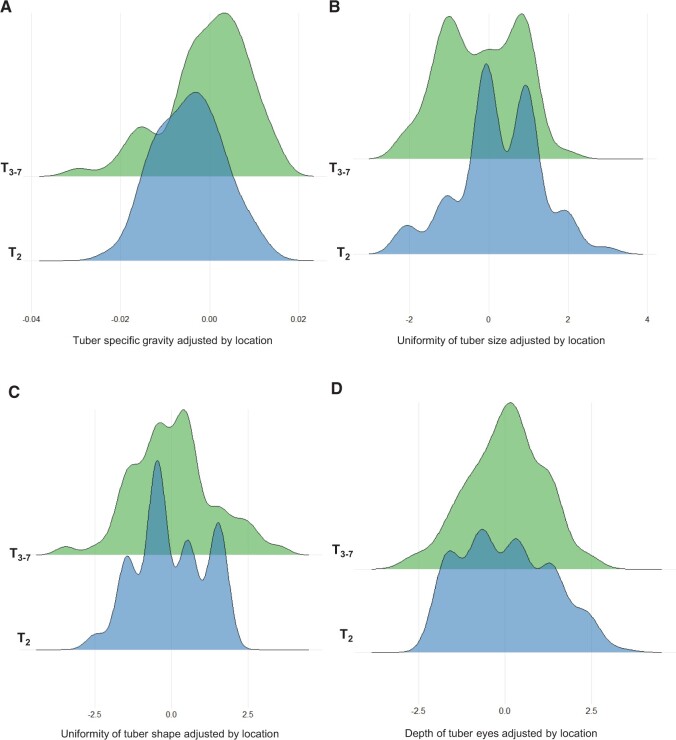
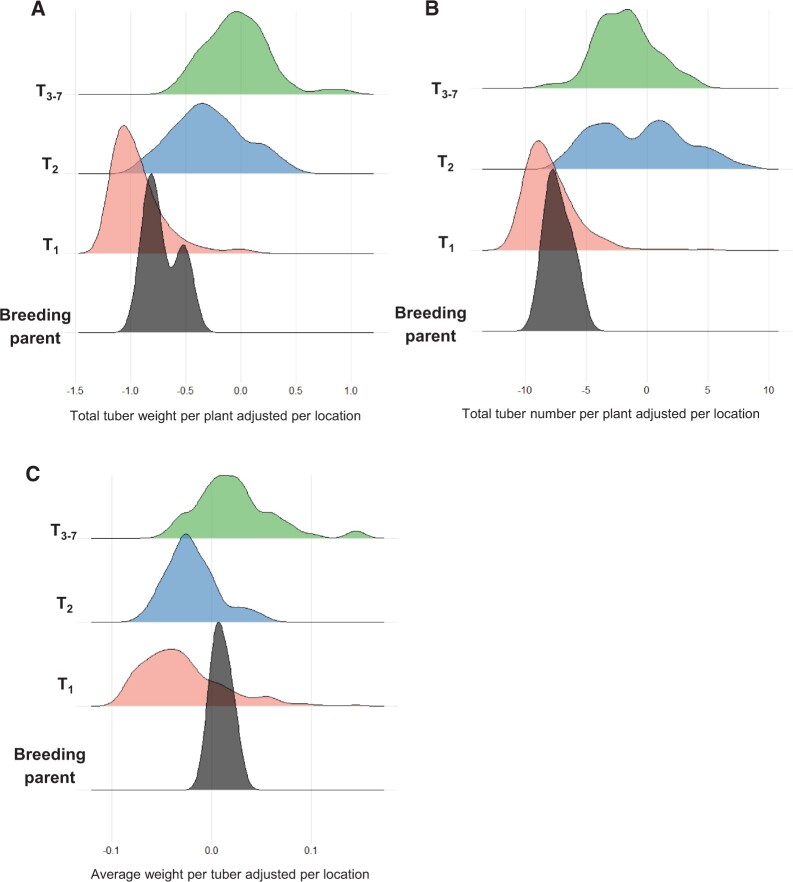
Potato breeding relies heavily on visual phenotypic scoring for clonal selection. Obtaining robust phenotypic data can be labor intensive and expensive, especially in the early cycles of a potato breeding program where the number of genotypes is very large. We have investigated the power of genomic estimated breeding values (GEBVs) for selection from a limited population size in potato breeding. We collected genotypic data from 669 tetraploid potato clones from all cycles of a potato breeding program, as well as phenotypic data for eight important breeding traits. The genotypes were partitioned into a training and a test population distinguished by cycle of selection in the breeding program. GEBVs for seven traits were predicted for individuals from the first stage of the breeding program (T1) which had not undergone any selection, or individuals selected at least once in the field (T2). An additional approach in which GEBVs were predicted within and across full-sib families from unselected material (T1) was tested for four breeding traits. GEBVs were obtained by using a Bayesian Ridge Regression model estimating single marker effects and phenotypic data from individuals at later stages of selection of the breeding program. Our results suggest that, for most traits included in this study, information from individuals from later stages of selection cannot be utilized to make selections based on GEBVs in earlier clonal generations. Predictions of GEBVs across full-sib families yielded similarly low prediction accuracies as across generations. The most promising approach for selection using GEBVs was found to be making predictions within full-sib families.
马铃薯的选育主要依赖于对无性系选择的表型评分。获得稳健的表型数据可能需要大量的人力和财力,尤其是在马铃薯选育计划的早期循环中,基因型的数量非常庞大。我们研究了基因组估计育种值(GEBVs)在马铃薯选育中从有限群体大小进行选择的能力。我们收集了来自马铃薯选育计划所有循环的 669 个四倍体马铃薯无性系的基因型数据,以及 8 个重要选育性状的表型数据。这些基因型分为训练和测试群体,通过选育计划的选择周期来区分。为在选育计划的第一阶段(T1)尚未进行任何选择的个体或至少在田间选择过一次的个体(T2)预测了七个性状的 GEBVs。还针对四个选育性状,测试了在未选择的材料(T1)中通过内部分子和全同胞家系进行 GEBVs 预测的另一种方法。通过使用贝叶斯岭回归模型估计单标记效应和个体的表型数据,从选育计划的选择后期获得 GEBVs。我们的结果表明,对于本研究中包含的大多数性状,无法利用来自选育计划后期选择的个体的信息,根据 GEBVs 对早期无性系世代进行选择。全同胞家系间 GEBVs 的预测精度也类似地较低。使用 GEBVs 进行选择最有前途的方法是在全同胞家系内进行预测。