UCL Respiratory, Royal Free Campus, Division of Medicine, University College London, London, UK.
Department of Respiratory Care, King Faisal University, Al-Ahsa, Saudi Arabia.
Physiol Rep. 2021 Dec;9(23):e15132. doi: 10.14814/phy2.15132.
Individuals with chronic obstructive pulmonary disease (COPD) commonly experience exacerbations, which may require hospital admission. Early detection of exacerbations, and therefore early treatment, could be crucial in preventing admission and improving outcomes. Our previous research has demonstrated that the pattern analysis of peripheral oxygen saturation (S O ) fluctuations provides novel insights into the engagement of the respiratory control system in response to physiological stress (hypoxia). Therefore, this pilot study tested the hypothesis that the pattern of S O variations in overnight recordings of individuals with COPD would distinguish between stable and exacerbation phases of the disease.
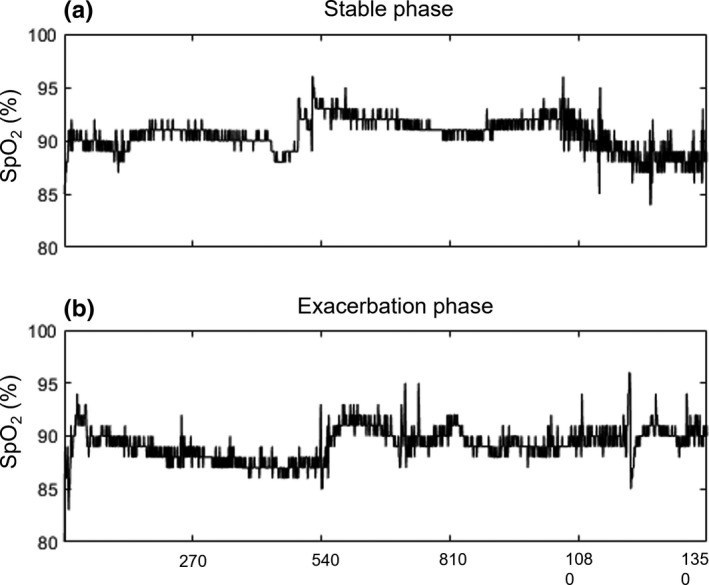
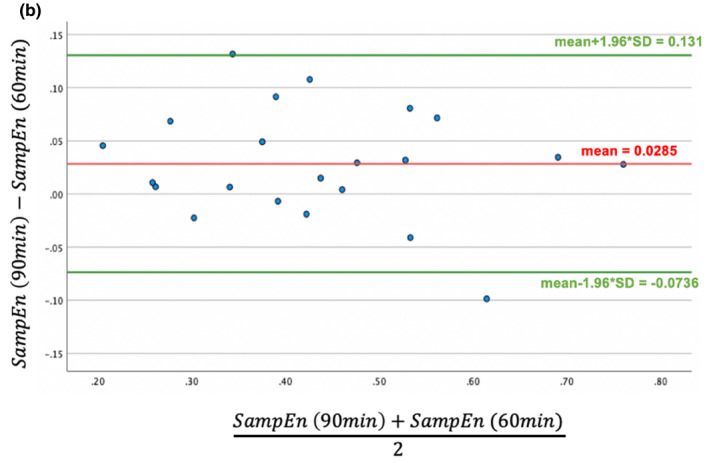
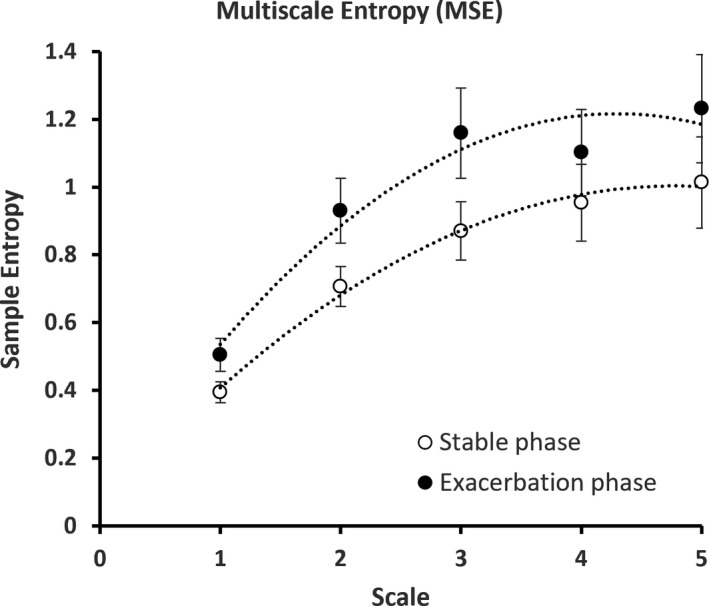
Overnight pulse oximetry data from 11 individuals with COPD, who exhibited exacerbation after a period of stable disease, were examined. Stable phase recordings were conducted overnight and one night prior to exacerbation recordings were also analyzed. Pattern analysis of S O variations was carried examined using sample entropy (for assessment of irregularity), the multiscale entropy (complexity), and detrended fluctuation analysis (self-similarity).
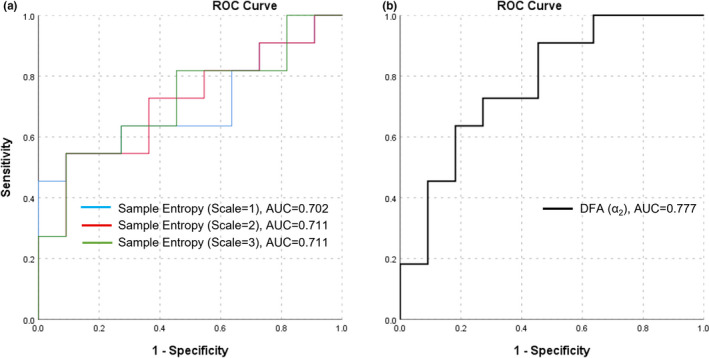
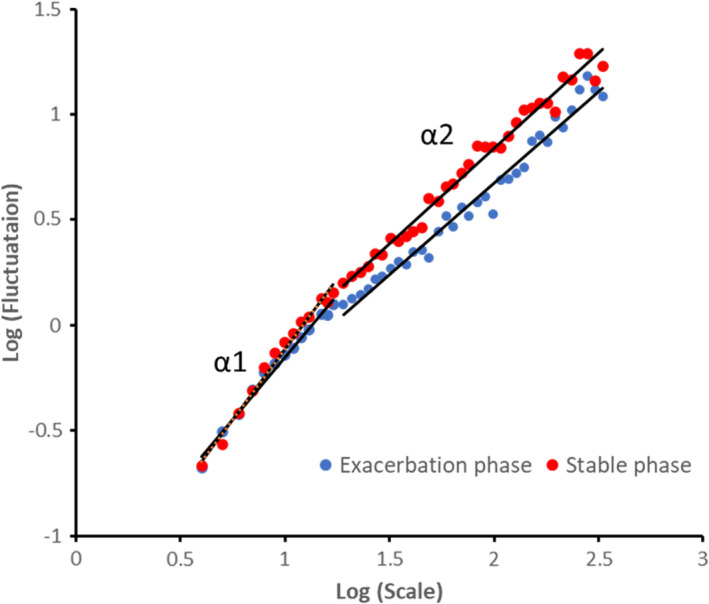
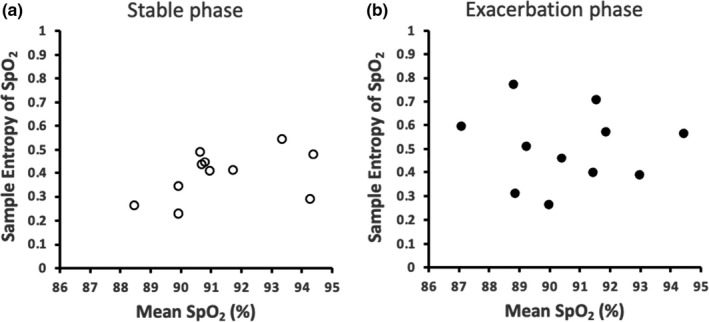
S O variations displayed a complex pattern in both stable and exacerbation phases of COPD. During an exacerbation, S O entropy increased (p = 0.029) and long-term fractal-like exponent (α2) decreased (p = 0.002) while the mean and standard deviation of S O time series remained unchanged. Through ROC analyses, S O entropy and α2 were both able to classify the COPD phases into either stable or exacerbation phase. With the best positive predictor value (PPV) for sample entropy (PPV = 70%) and a cut-off value of 0.454. While the best negative predictor value (NPV) was α2 (NPV = 78%) with a cut-off value of 1.00.
Alterations in S O entropy and the fractal-like exponent have the potential to detect exacerbations in COPD. Further research is warranted to examine if S O variability analysis could be used as a novel objective method of detecting exacerbations.
慢性阻塞性肺疾病(COPD)患者常经历病情恶化,这可能需要住院治疗。早期发现恶化,从而进行早期治疗,可能对预防住院和改善结局至关重要。我们之前的研究表明,外周血氧饱和度(S O )波动的模式分析为了解呼吸系统对生理应激(缺氧)的反应提供了新的见解。因此,这项初步研究检验了这样一个假设,即在 COPD 患者的夜间 S O 变化记录中,模式的变化可以区分疾病的稳定期和恶化期。
检查了 11 名 COPD 患者的夜间脉搏血氧仪数据,这些患者在稳定期后出现恶化。在进行夜间记录之前,还对稳定期记录和恶化期记录进行了分析。使用样本熵(用于评估不规则性)、多尺度熵(复杂性)和去趋势波动分析(自相似性)对 S O 变化模式进行了分析。
在 COPD 的稳定期和恶化期,S O 变化呈现出复杂的模式。在恶化期间,S O 熵增加(p = 0.029),长期分形指数(α2)降低(p = 0.002),而 S O 时间序列的均值和标准差保持不变。通过 ROC 分析,S O 熵和α2都能够将 COPD 阶段分为稳定期或恶化期。样本熵的最佳阳性预测值(PPV)为 70%(PPV = 70%),最佳截断值为 0.454。而最佳阴性预测值(NPV)为α2(NPV = 78%),最佳截断值为 1.00。
S O 熵和分形指数的改变有可能检测 COPD 的恶化。需要进一步的研究来检查 S O 变异性分析是否可以作为一种新的客观检测恶化的方法。