Bhogal Amar S, Mani Ali R
UCL Division of Medicine, University College LondonLondon, United Kingdom.
Front Physiol. 2017 Aug 2;8:555. doi: 10.3389/fphys.2017.00555. eCollection 2017.
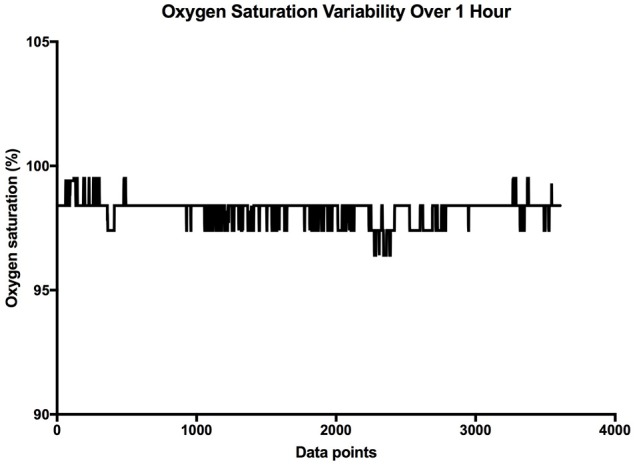
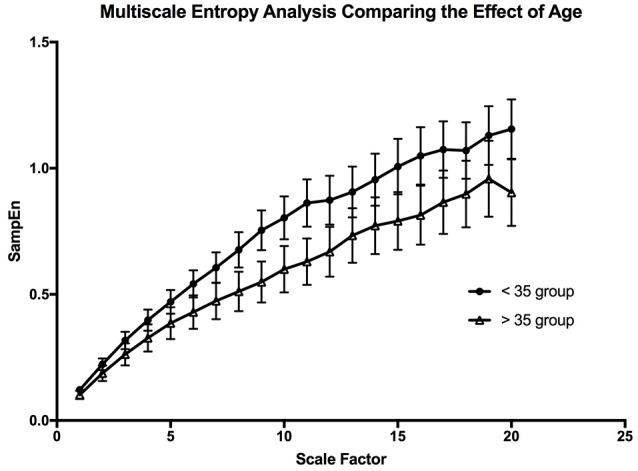
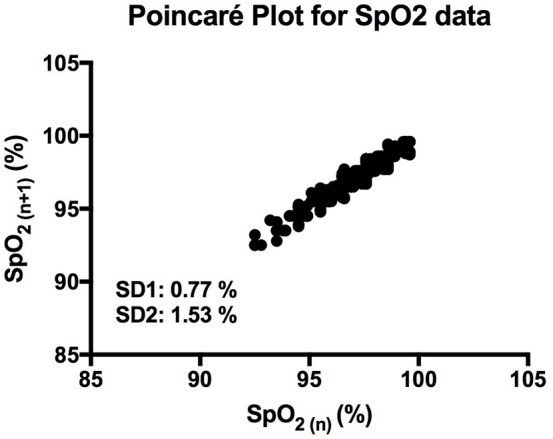
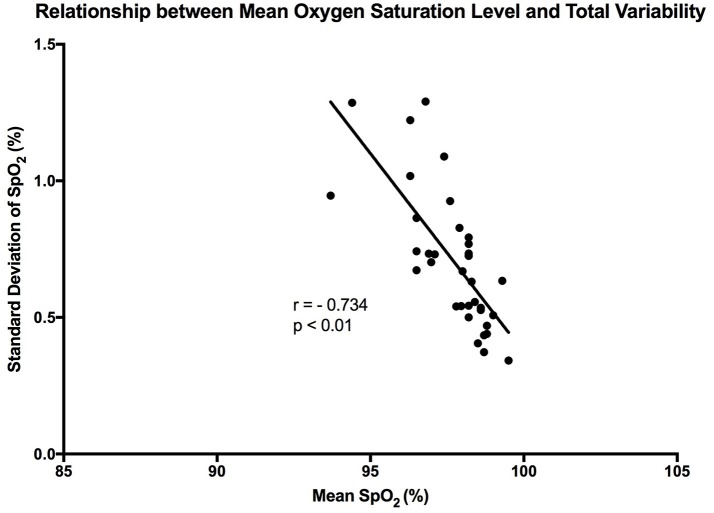
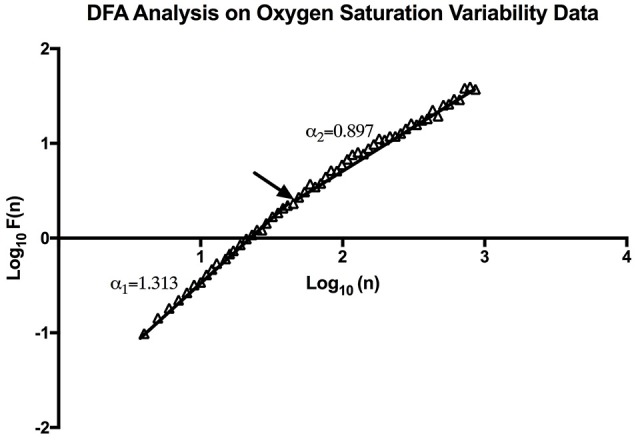
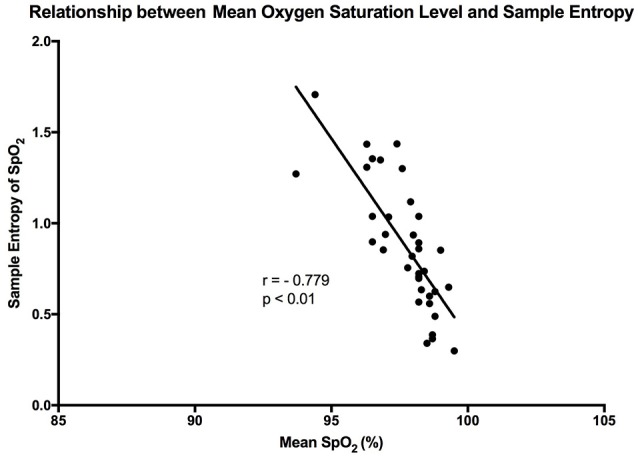
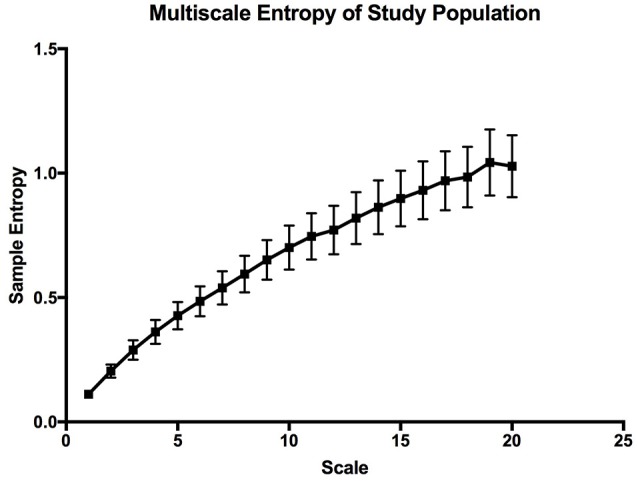
Pulse oximetry is routinely used for monitoring patients' oxygen saturation levels with little regard to the variability of this physiological variable. There are few published studies on oxygen saturation variability (OSV), with none describing the variability and its pattern in a healthy adult population. The aim of this study was to characterize the pattern of OSV using several parameters; the regularity (sample entropy analysis), the self-similarity [detrended fluctuation analysis (DFA)] and the complexity [multiscale entropy (MSE) analysis]. Secondly, to determine if there were any changes that occur with age. The study population consisted of 36 individuals. The "young" population consisted of 20 individuals [Mean (±1 SD) age = 21.0 (±1.36 years)] and the "old" population consisted of 16 individuals [Mean (±1 SD) age = 50.0 (±10.4 years)]. Through DFA analysis, OSV was shown to exhibit fractal-like patterns. The sample entropy revealed the variability to be more regular than heart rate variability and respiratory rate variability. There was also a significant inverse correlation between mean oxygen saturation and sample entropy in healthy individuals. Additionally, the MSE analysis described a complex fluctuation pattern, which was reduced with age ( < 0.05). These findings suggest partial "uncoupling" of the cardio-respiratory control system that occurs with aging. Overall, this study has characterized OSV using pre-existing tools. We have showed that entropy analysis of pulse oximetry signals carries information about body oxygenation. This may have the potential to be used in clinical practice to detect differences in diseased patient subsets.
脉搏血氧饱和度测定法通常用于监测患者的血氧饱和度水平,而很少考虑这一生理变量的变异性。关于血氧饱和度变异性(OSV)的已发表研究很少,没有一项研究描述健康成年人群中的变异性及其模式。本研究的目的是使用几个参数来描述OSV的模式;规律性(样本熵分析)、自相似性[去趋势波动分析(DFA)]和复杂性[多尺度熵(MSE)分析]。其次,确定是否有随年龄发生的变化。研究人群包括36名个体。“年轻”人群由20名个体组成[平均(±1标准差)年龄=21.0(±1.36岁)],“老年”人群由16名个体组成[平均(±1标准差)年龄=50.0(±10.4岁)]。通过DFA分析,显示OSV呈现出类似分形的模式。样本熵显示该变异性比心率变异性和呼吸频率变异性更具规律性。健康个体的平均血氧饱和度与样本熵之间也存在显著的负相关。此外,MSE分析描述了一种复杂的波动模式,这种模式随年龄增长而降低(<0.05)。这些发现表明,心肺控制系统会随着衰老而发生部分“解耦”。总体而言,本研究使用现有工具对OSV进行了特征描述。我们已经表明,脉搏血氧饱和度信号的熵分析携带有关身体氧合的信息。这可能有潜力在临床实践中用于检测患病患者亚组之间的差异。