Universidade NOVA de Lisboa. Nova School of Business and Economics. Carcavelos, Portugal.
Imperial College London. Faculty of Health Sciences. London, England.
Rev Saude Publica. 2021 Nov 26;55:97. doi: 10.11606/s1518-8787.2021055003903. eCollection 2021.
To investigate how sociodemographic conditions, political factors, organizational confidence, and non-pharmaceutical interventions compliance affect the COVID-19 vaccine hesitancy in Brazil.
Data collection took place between November 25th, 2020 and January 11th, 2021 using a nationwide online survey. Subsequently, the researches performed a descriptive analysis on the main variables and used logistic regression models to investigate the factors associated with COVID-19 vaccine hesitancy.
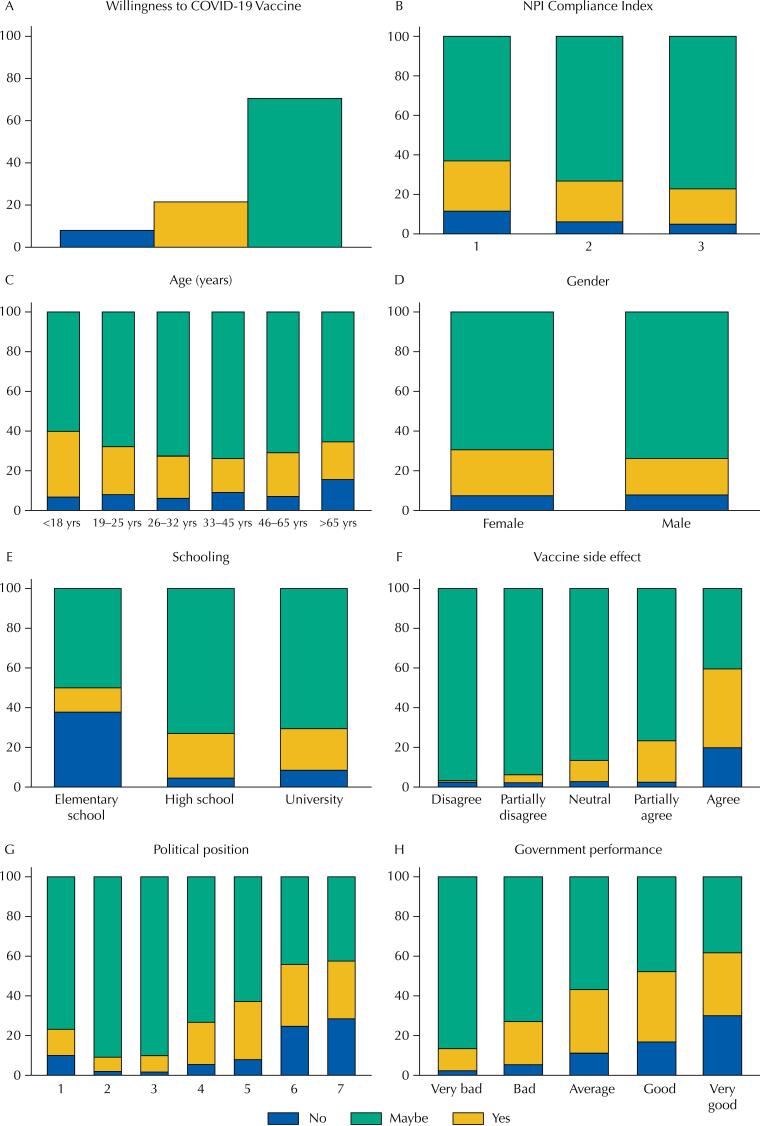
Less concern over vaccine side effects could improve the willingness to be vaccinated (probability changed by 7.7 pp; p < 0.10). The current vaccine distrust espoused by the Brazilian president is associated with vaccine hesitancy, among his voter base. Lower performance perception ("Very Bad" with 10.7 pp; p < 0.01) or higher political opposition (left-oriented) regarding the current presidency is associated with the willingness to be vaccinated. Higher compliance with non-pharmaceutical interventions (NPIs) is usually positively associated with the willingness to take the COVID-19 vaccine (+1 score to NPI compliance index is associated with higher willingness to be vaccinated by 1.4 pp, p < 0.05).
Willingness to be vaccinated is strongly associated with political leaning, perceived federal government performance, vaccine side effects, and compliance with non-pharmaceutical interventions (NPIs).
研究社会人口状况、政治因素、组织信心和非药物干预措施的遵守情况如何影响巴西的 COVID-19 疫苗犹豫。
数据收集于 2020 年 11 月 25 日至 2021 年 1 月 11 日之间通过全国性在线调查进行。随后,研究人员对主要变量进行了描述性分析,并使用逻辑回归模型调查了与 COVID-19 疫苗犹豫相关的因素。
对疫苗副作用的担忧程度降低会提高接种疫苗的意愿(概率变化 7.7 个百分点;p<0.10)。巴西总统目前对疫苗的不信任与其选民基础中的疫苗犹豫有关。对当前总统任期的绩效感知较低(“非常差”为 10.7 个百分点;p<0.01)或政治立场较高(倾向左派)与接种疫苗的意愿有关。对非药物干预措施(NPI)的遵守程度通常与接种 COVID-19 疫苗的意愿呈正相关(NPI 遵守指数增加 1 分与接种疫苗的意愿增加 1.4 个百分点相关,p<0.05)。
接种疫苗的意愿与政治倾向、联邦政府绩效感知、疫苗副作用和非药物干预措施(NPI)的遵守情况密切相关。