Anand Uma, Oldfield Christian, Pacchetti Barbara, Anand Praveen, Sodergren Mikael H
Faculty of Medicine, Imperial College London, Hammersmith Hospital, London, W12 ONN, UK.
EMMAC Life Sciences Ltd, London, UK.
J Pain Res. 2021 Nov 24;14:3603-3614. doi: 10.2147/JPR.S336773. eCollection 2021.
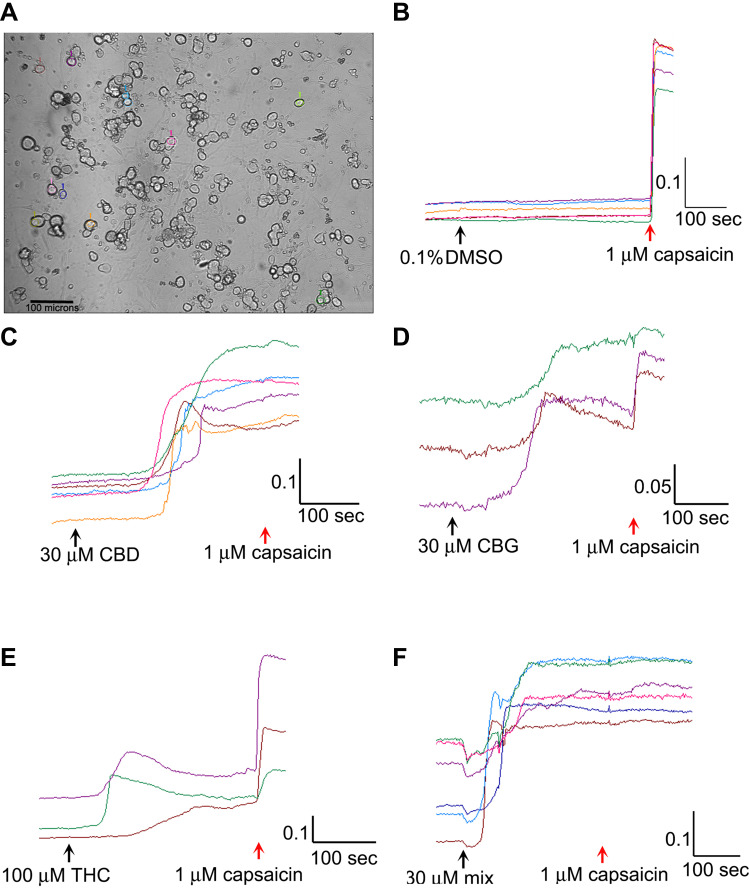
The analgesic effects of are mediated by ∆ tetrahydrocannabinol (THC), but the contributions of other bioactive complex components, including cannabigerol (CBG) and cannabidiol (CBD), are unclear. We describe the individual and combined effects of CBG, CBD and THC, on blocking capsaicin responses in dorsal root ganglion (DRG) neurons, in an in vitro model of nociceptor hypersensitivity.
Adult rat DRG were dissected and enzyme digested to obtain a neuronal suspension in BSF2 medium containing 2% fetal calf serum, and the neurotrophic factors NGF and GDNF. After 48 h, cultured neurons were loaded with Fura-2 AM, to determine the effects of cannabinoids on capsaicin responses using calcium imaging. In control experiments, neurons were treated with vehicle, followed by 1 µM capsaicin. In cannabinoid treated cultures, CBG, CBD or THC were applied individually, or combined (1:1:1 ratio), followed by 1 µM capsaicin. Data from n = 6 experiments were analysed with Student's -test and Pearson's correlation coefficient.
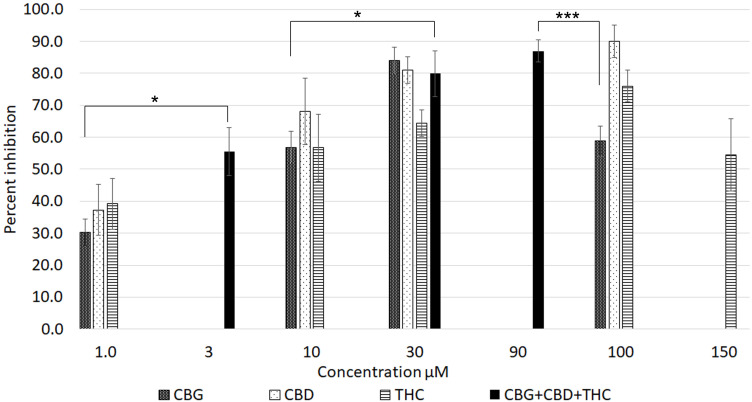
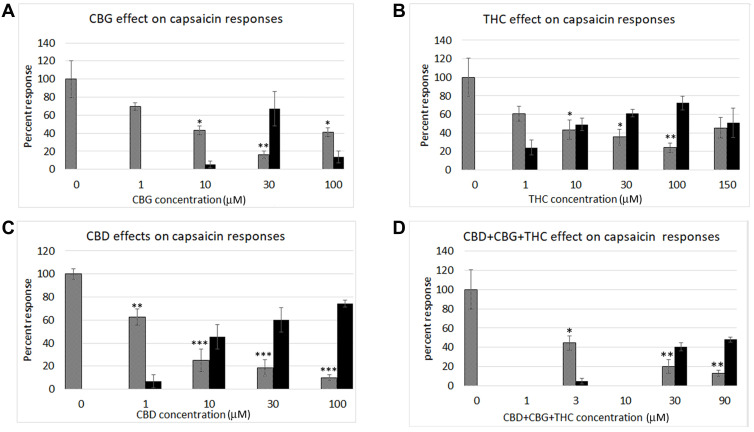
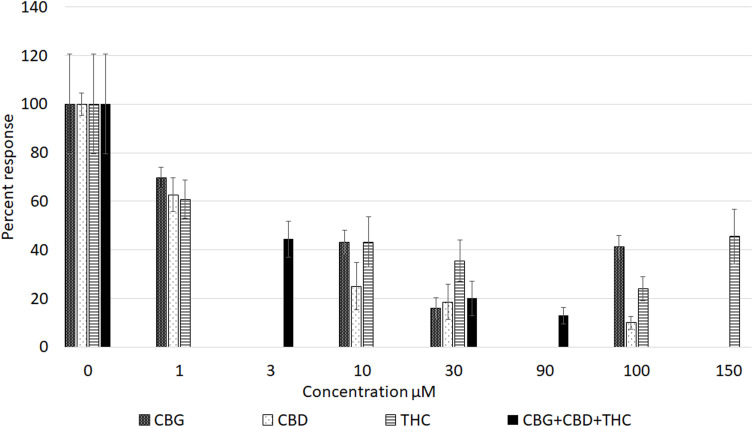
CBG, CBD and THC, applied individually, elicited dose-related calcium influx in a subset of DRG neurons, and a corresponding dose-related reduction of subsequent responses to capsaicin. Maximum inhibition of capsaicin responses was observed at 30 µM CBG, 100 µM CBD, and 100 µM THC individually, and with combined CBD+CBG+THC (1:1:1) at 90 µM. THC+CBD+CBG combined in a 1:1:1 proportion has the potential to enhance the potency of these compounds applied individually. There was a high correlation between cannabinoid-mediated calcium influx and reduction of capsaicin responses: CBG = -0.88, THC = -0.97, CBD = -0.99 and combined CBG + THC + CBD = -1.00.
CBG, CBD and THC demonstrated potent dose-related inhibition of capsaicin responses in DRG neurons when applied individually in vitro, and enhanced when applied in combination, being most effective at 90 μM. Thus, efficacy and tolerability of THC could be improved in combination with CBG and CBD at optimal concentrations, which deserve further studies in vivo.
大麻的镇痛作用由Δ-四氢大麻酚(THC)介导,但包括大麻二酚(CBG)和大麻二酚(CBD)在内的其他生物活性复合成分的作用尚不清楚。我们在伤害感受器超敏反应的体外模型中,描述了CBG、CBD和THC对阻断背根神经节(DRG)神经元中辣椒素反应的单独及联合作用。
解剖成年大鼠DRG并进行酶消化,以在含有2%胎牛血清以及神经营养因子NGF和GDNF的BSF2培养基中获得神经元悬浮液。48小时后,用Fura-2 AM加载培养的神经元,通过钙成像确定大麻素对辣椒素反应的影响。在对照实验中,用溶媒处理神经元,随后加入1μM辣椒素。在大麻素处理的培养物中,单独应用CBG、CBD或THC,或联合应用(1:1:1比例),随后加入1μM辣椒素。对n = 6个实验的数据进行Student's检验和Pearson相关系数分析。
单独应用CBG、CBD和THC时,在一部分DRG神经元中引起剂量相关的钙内流,并相应地使随后对辣椒素的反应呈剂量相关降低。分别在30μM CBG、100μM CBD和100μM THC时,以及在90μM的CBD+CBG+THC联合应用(1:1:1)时,观察到对辣椒素反应的最大抑制。以1:1:1比例联合的THC+CBD+CBG有可能增强这些化合物单独应用时的效力。大麻素介导的钙内流与辣椒素反应降低之间存在高度相关性:CBG = -0.88,THC = -0.97,CBD = -0.99,联合应用CBG + THC + CBD时 = -1.00。
体外单独应用时,CBG、CBD和THC在DRG神经元中表现出对辣椒素反应的有效剂量相关抑制,联合应用时增强,在90μM时最有效。因此,在最佳浓度下,THC与CBG和CBD联合应用时的疗效和耐受性可能会提高,这值得在体内进行进一步研究。