Pondicherry Institute of Medical Sciences, Puducherry, India.
Bharti Hospital, Karnal, India.
Endocrinol Diabetes Metab. 2022 Jan;5(1):e00316. doi: 10.1002/edm2.316. Epub 2021 Dec 1.
Longitudinal data on management and progression of type 2 diabetes mellitus (T2DM) in India are scarce. LANDMARC (CTRI/2017/05/008452), first-of-its-kind, pan-India, prospective, observational study aimed to evaluate real-world patterns and management of T2DM over 3 years.
Adults (≥25 to ≤60 years old at T2DM diagnosis; diabetes duration ≥2 years at enrolment; controlled/uncontrolled on ≥2 anti-diabetic agents) were enrolled. The first-year trends for glycaemic control, therapy and diabetic complications, including those from metropolitan and non-metropolitan cities are reported here.
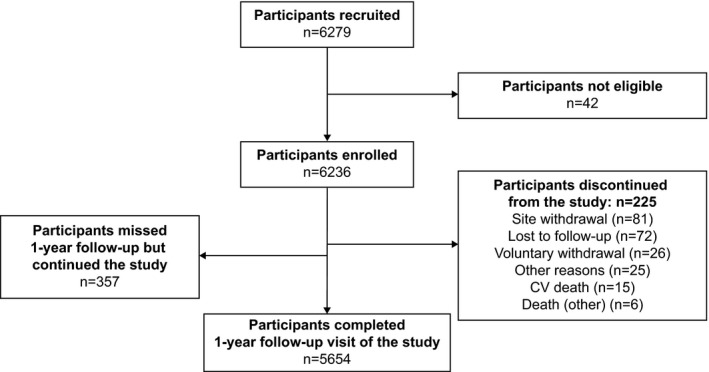
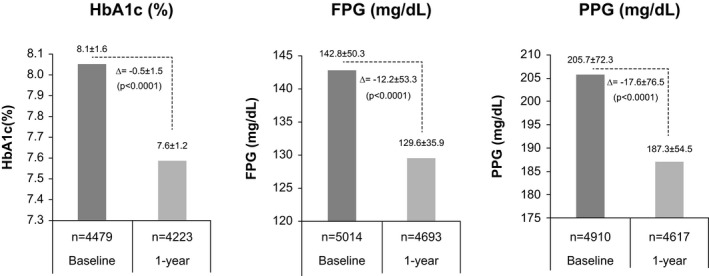
Of 6236 enrolled participants, 5654 completed 1 year in the study. Although the overall mean glycated haemoglobin (HbA1c) improved by 0.5% (baseline: 8.1%) at 1 year, only 20% of the participants achieved HbA1c <7%. Participants from metropolitan and non- metropolitan cities showed similar decrease in glycaemic levels (mean change in HbA1c: -0.5% vs. -0.5%; p = .8613). Among diabetic complications, neuropathy was the predominant complication (815/6236, 13.1% participants). Microvascular complications (neuropathy, nephropathy and retinopathy) were significantly (p < .0001) higher in non-metropolitan than metropolitan cities. Hypertension (2623/6236, 78.2%) and dyslipidaemia (1696/6236, 50.6%) continued to be the most commonly reported cardiovascular risks at 1 year. After 1 year, majority of the participants were taking only oral anti-diabetic drugs (OADs) (baseline: 4642/6236 [74.4%]; 1 year: 4045/6013 [67.3%]), while the proportion of those taking insulin along with OADs increased (baseline: 1498/6236 [24.0%] vs. 1 year: 1844/6013 [30.7%]). Biguanides and sulfonylureas were the most used OADs. The highest increase in use was seen for dipeptidyl peptidase-IV inhibitors (baseline: 3047/6236 [48.9%]; 1 year: 3529/6013 [58.7%]). Improvement in all glycaemic parameters was significantly (p < .0001) higher in the insulin vs. the insulin-naïve subgroups; in the insulin-naïve subgroup, no statistical difference was noted in those who received >3 vs. ≤3 OADs.
First-year trends of the LANDMARC study offer insights into real-world disease progression, suggesting the need for controlling risk factors and timely treatment intensification in people with T2DM.
印度关于 2 型糖尿病(T2DM)管理和进展的纵向数据很少。LANDMARC(CTRI/2017/05/008452)是首例在印度进行的、前瞻性、观察性研究,旨在评估 3 年内 T2DM 的真实世界模式和管理情况。
纳入年龄在 25 至 60 岁(T2DM 诊断时)、糖尿病病程≥2 年(入组时)、至少使用 2 种抗糖尿病药物控制/未控制的成年人。本研究报告了第 1 年血糖控制、治疗和糖尿病并发症的趋势,包括来自大都市和非大都市城市的趋势。
在 6236 名入组的参与者中,有 5654 名完成了第 1 年的研究。尽管总体平均糖化血红蛋白(HbA1c)在第 1 年改善了 0.5%(基线:8.1%),但只有 20%的参与者达到了 HbA1c<7%。来自大都市和非大都市城市的参与者的血糖水平下降相似(HbA1c 平均变化:-0.5%对-0.5%;p=0.8613)。在糖尿病并发症中,神经病是最主要的并发症(6236 名参与者中的 815 名,占 13.1%)。微血管并发症(神经病、肾病和视网膜病变)在非大都市城市明显高于大都市城市(p<0.0001)。高血压(6236 名参与者中的 2623 名,占 78.2%)和血脂异常(6236 名参与者中的 1696 名,占 50.6%)在第 1 年仍然是最常见的心血管风险。在第 1 年后,大多数参与者仅使用口服抗糖尿病药物(OAD)(基线:4642/6236[74.4%];第 1 年:4045/6013[67.3%]),而同时使用胰岛素和 OAD 的比例增加(基线:1498/6236[24.0%]比第 1 年:1844/6013[30.7%])。双胍类和磺酰脲类是最常用的 OAD。二肽基肽酶-4 抑制剂的使用增加最多(基线:6236 名参与者中的 3047 名[48.9%];第 1 年:6013 名参与者中的 3529 名[58.7%])。在胰岛素组和胰岛素初治组中,所有血糖参数的改善均显著高于(p<0.0001)。在胰岛素初治组中,接受>3 种与≤3 种 OAD 治疗的患者之间没有统计学差异。
LANDMARC 研究的第 1 年趋势提供了对真实世界疾病进展的见解,表明需要控制 T2DM 患者的危险因素并及时加强治疗。